A173 PATTERNS OF FISTULA DISEASE ACTIVITY IN PATIENTS WITH PERIANAL CROHN’S DISEASE
N Huebener, A Sweet, J McCurdy

TL;DR
This study identifies four patterns of disease activity in perianal Crohn’s disease and shows they predict long-term outcomes like surgery and remission.
Contribution
The paper introduces a new classification system for perianal Crohn’s disease activity based on early patterns and links it to long-term outcomes.
Findings
Four distinct disease activity patterns were identified in patients with perianal Crohn’s disease.
Transient disease activity was associated with the lowest risk of major adverse outcomes and highest remission rates.
Chronic persistent disease activity was linked to the worst long-term outcomes.
Abstract
The disease course of perianal fistulizing Crohn’s disease (PFCD) is highly variable, from transient symptoms to chronic, progressive disease activity. The patterns of PFCD activity over time and their impact on long-term fistula outcomes is poorly understood. To determine the patterns of PFCD activity within the first year of fistula diagnosis and their impact long-term outcomes. We performed a retrospective, observational study between 2005-2023 at a single Canadian academic institution. We included adults >17 years with PFCD and a minimum of 2 clinical touchpoints within the first year after fistula diagnosis. PFCD was categorized into one of four patterns of disease activity: transient, minimally active, relapsing-remitting, and chronic persistent based on clinical symptoms within the first year after fistula diagnosis (Figure 1). Our primary outcome was major adverse fistula…
Genes, proteins, chemicals, diseases, species, mutations and cell lines named across the full text — each resolved to its canonical identifier and authoritative record.
Click any figure to enlarge with its caption.
 Figure 1
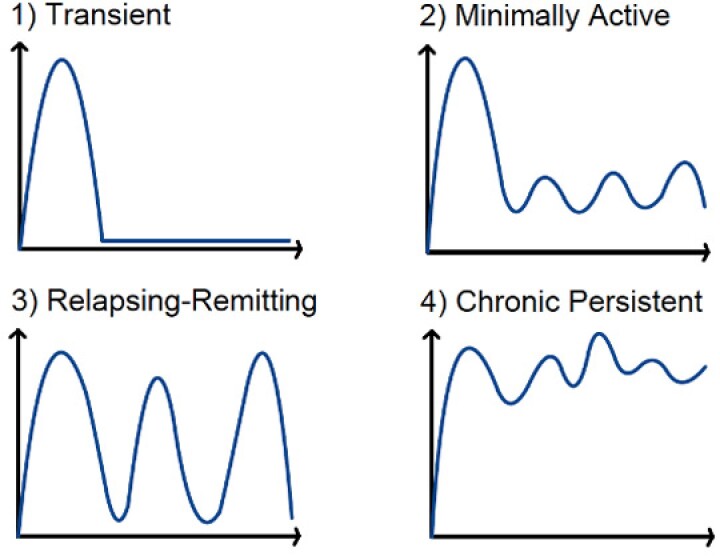 Figure 2
Peer Reviews
No public reviews on file for this paper yet. If you reviewed it on a platform where reviews are public (OpenReview, ICLR, NeurIPS, ICML), you can paste yours below so the community can read it here.
Videos
No videos yet. Explain this paper in a talk, walkthrough, or lecture? Add one.
Taxonomy
TopicsDiverticular Disease and Complications · Anorectal Disease Treatments and Outcomes · Inflammatory Bowel Disease