A40 INITIAL OUTCOMES FOLLOWING THE LAUNCH OF A PERORAL ENDOSCOPIC MYOTOMY (POEM) PROGRAM FOR ACHALASIA: A SINGLE-CENTRE EXPERIENCE IN CANADA
C H Tsai, M Woo, M Gupta, C Schieman, P J Belletrutti

TL;DR
This study reports early results from Canada's new POEM program for achalasia, showing significant symptom improvement and low complications.
Contribution
The paper provides initial Canadian data on POEM outcomes, highlighting its effectiveness and resource demands in a single-center setting.
Findings
Patients showed a significant decrease in Eckardt scores from 7.00 to 1.00 after one month.
Postoperative complications occurred in 2 out of 20 patients but were managed conservatively.
POEM procedures required a median hospital stay of 1 day and an average procedural time of 110.5 minutes.
Abstract
Peroral endoscopic myotomy (POEM) has gained prominence as a minimally invasive therapeutic option for achalasia. Despite its growing adoption worldwide, the establishment of POEM programs in Canada is relatively recent, and local data on clinical outcomes remain limited. This study aims to assess the short-term outcomes of patients undergoing POEM for achalasia including symptom improvement, complication rates, and detailing the endoscopic and hospital resources necessary to sustain a POEM program. A retrospective chart review was conducted to collect procedural and clinical outcome data for patients who underwent POEM and completed follow-up assessments from the inception of the program in October 2023 to September 2024 at the Foothills Medical Centre in Calgary, Alberta. The Eckardt symptom score was used to objectively evaluate symptoms pre-operatively and one-month post-POEM. A…
Genes, proteins, chemicals, diseases, species, mutations and cell lines named across the full text — each resolved to its canonical identifier and authoritative record.
Click any figure to enlarge with its caption.
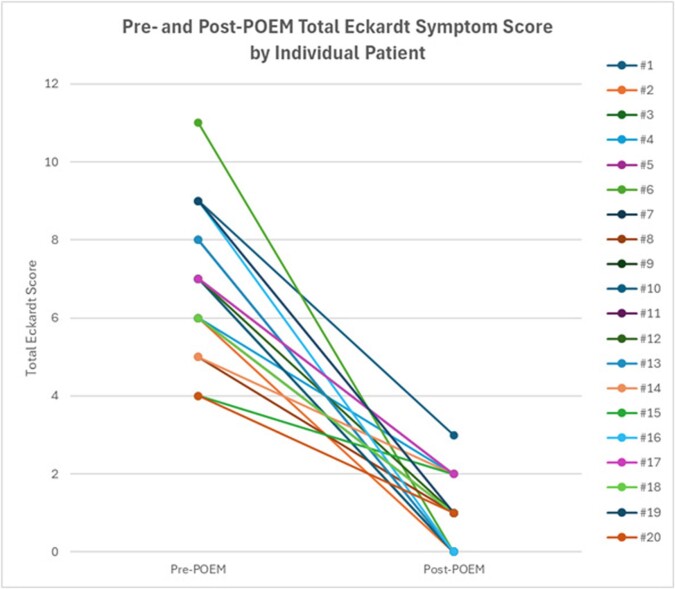 Figure 1
Peer Reviews
No public reviews on file for this paper yet. If you reviewed it on a platform where reviews are public (OpenReview, ICLR, NeurIPS, ICML), you can paste yours below so the community can read it here.
Videos
No videos yet. Explain this paper in a talk, walkthrough, or lecture? Add one.
Taxonomy
TopicsGastroesophageal reflux and treatments · Esophageal and GI Pathology