Analysis of the Functional Status Score for the Intensive Care Unit and its correlation with measures of muscle strength in critically ill patients during hospitalization in the intensive care unit
Gabriela de Sousa Martins, Katryne Holanda Silva, William Rafael Almeida Moraes, Eduardo Yoshio Nakano, Joanlise Marco de Leon Andrade, Laura Maria Tomazi Neves, Graziella França Bernardelli Cipriano

Abstract
Genes, proteins, chemicals, diseases, species, mutations and cell lines named across the full text — each resolved to its canonical identifier and authoritative record.
Click any figure to enlarge with its caption.
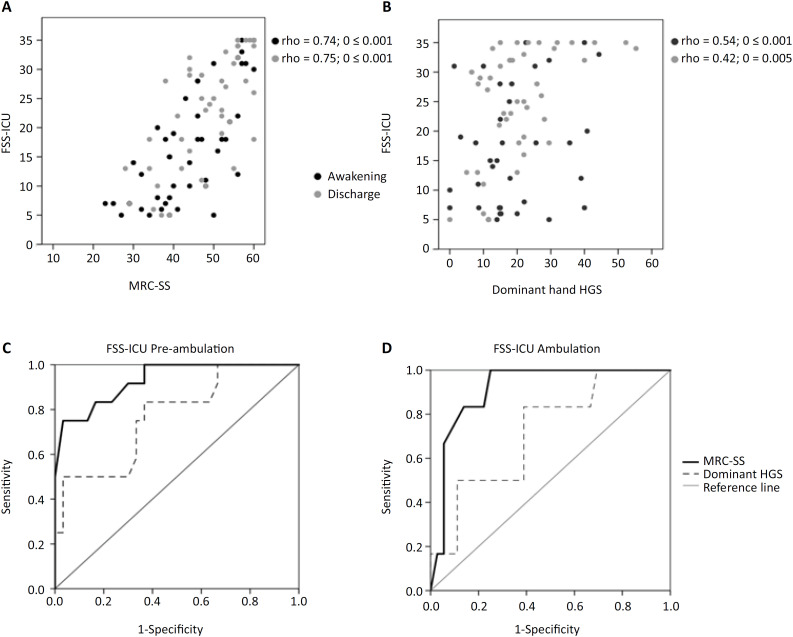 Figure 1
- —Programa Pesquisa para o SUS - Distrito Federal
- —Conselho Nacional de Desenvolvimento Científico e Tecnológico
Peer Reviews
No public reviews on file for this paper yet. If you reviewed it on a platform where reviews are public (OpenReview, ICLR, NeurIPS, ICML), you can paste yours below so the community can read it here.
Videos
No videos yet. Explain this paper in a talk, walkthrough, or lecture? Add one.
Taxonomy
TopicsIntensive Care Unit Cognitive Disorders · Frailty in Older Adults · Nutrition and Health in Aging
Advancements in intensive care have led to a reduction in mortality rates in intensive care units (ICUs), resulting in increased survival of critically ill patients but also increased challenges in health care and in the long-term recovery of survivors.^(1,2)^ Early measurement of functional status (FS) and muscle strength (MS) and follow-up measurements in the ICU are essential for identifying patients with physical decline, monitoring the effectiveness of rehabilitation interventions and observing the evolution of recovery.^(2)^ A scoping review^(3)^ reported the existence of approximately 60 instruments for assessing FS, although no gold standard has been established.
In this context, we evaluated the progression of FS and MS during the duration of ICU stays. We determined the association of the Functional Status Score for the Intensive Care Unit (FSS-ICU) with MS. We assessed the predictive value of MS measurements for patient independence in the FSS-ICU at awakening. We performed a prospective observational cohort study in which patients were followed from awakening until discharge from the ICU. Functional status was assessed with the FSS-ICU, and MS was assessed with the Medical Research Council-Sum Score (MRC-SS) and handgrip strength (HGS). The present study was approved by the Committee for Ethics in Human Research of the Fundação de Ensino e Pesquisa em Ciências da Saúde/ESCS (CAEE 30442514.7.0000.5553).
The assessments were performed upon awakening and upon discharge from the ICU, and the results were compared via the paired Wilcoxon test. Associations were determined via Spearman's correlation, and a receiver operating characteristic (ROC) curve was used to determine the cutoff points for MS. A complete description of the methods can be found in the Supplementary Material (Table S1 and Figure S1). The sample consisted of 48 participants who were predominantly males (62%), with a mean age of 49 ± 16 years and a median (interquartile deviation [IQD]) duration of ICU stay of 10 (14) days (Table 1). This results are similar to those identified in a review study of 113 Brazilian intensive care units.^(4)^
During the ICU stay, we observed differences in the total FSS-ICU score between awakening and discharge and between the pre-ambulation and ambulation scores (p < 0.001), similar to the differences observed in MS as evaluated by the MRC-SS (p = 0.002) and HGS (p = 0.001). Most patients were right-handed (71%) (Table 1). Similar results were observed in other cohort studies conducted in Australia,^(5)^ the United States^(6)^ and Brazil.^(7)^
The FSS-ICU score was significantly correlated with the MRC-SS (rho = 0.74 and rho = 0.75) and HGS (rho = 0.57 and rho = 0.42) at awakening and at discharge (Figure 1A and 1B). The MRC-SS cutoffs for independence in the FSS-ICU were 49 points (area under the ROC curve [AUC] = 0.912; 95%CI = 0.826 − 0.998; p < 0.001) for pre-ambulation and 57 points (AUC = 0.923; 95%CI = 0.838 − 1.000; p = 0.001) for ambulation. For HGS, the cutoff values were 16kg/f (AUC = 0.769; 95%CI = 0.610 − 0.929; p = 0.007) and 18kg/f (AUC = 0.720; 95%CI = 0.511 − 0.929; p = 0.008) (Figure 1C and 1D).
Associations among the FSS-ICU, MRC-SS and HGS and with other functional scales have been demonstrated in the literature.^(8-10)^ To date, no studies have evaluated the cutoff values for MS prediction in the FSS-ICU. However, one cohort study suggested a minimum cutoff of 41.5 out of 60 points on the MRC-SS as a predictor of the performance of the functional components of the Physical Function Intensive Care Test (PFIT) at ICU discharge.^(9)^ Our findings demonstrate that the FSS-ICU, MRC-SS and HGS are effective tools for measuring the progression of patient functionality in the ICU. In addition, the strength measures demonstrated a significant association with the functional independence of patients.
Supplementary Material
The reference list from the paper itself. Each links out to its DOI / PubMed record.
- 1Rousseau AF Prescott HC Brett SJ Weiss B Azoulay E Creteur J Long-term outcomes after critical illness: recent insights Crit Care 20212511081083373120110.1186/s 13054-021-03535-3PMC 7968190 · doi ↗ · pubmed ↗
- 2Chapple LS Parry SM Schaller SJ Attenuating muscle mass loss in critical illness: the role of nutrition and exercise Curr Osteoporos Rep 20222052903083604417810.1007/s 11914-022-00746-7PMC 9522765 · doi ↗ · pubmed ↗
- 3González-Seguel F Corner EJ Merino-Osorio C International classification of functioning, disability, and health domains of 60 physical functioning measurement instruments used during the adult intensive care unit stay: a scoping review Phys Ther 20199956276403059083910.1093/ptj/pzy 158PMC 6517362 · doi ↗ · pubmed ↗
- 4Aguiar LM Martins GS Valduga R Gerez AP Carmo EC Cunha KD Profile of adult intensive care units in Brazil: systematic review of observational studies Rev Bras Ter Intensiva 202233462463410.5935/0103-507X.20210088 PMC 888959535081247 · doi ↗ · pubmed ↗
- 5Parry SM Denehy L Beach LJ Berney S Williamson HC Granger CL Functional outcomes in ICU – what should we be using? - an observational study Crit Care 20151911271272588846910.1186/s 13054-015-0829-5PMC 4404223 · doi ↗ · pubmed ↗
- 6Thrush A Rozek M Dekerlegand JL The clinical utility of the Functional Status Score for the Intensive Care Unit (FSS-ICU) at a long-term acute care hospital: a prospective cohort study Phys Ther 20129212153615452295642710.2522/ptj.20110412 · doi ↗ · pubmed ↗
- 7Souza GC Cazotto GA Simões GM Peyneau LG Análise da funcionalidade dos pacientes da UTI de um hospital filantrópico da cidade de Vitória-ES Braz J Develop 2022843206532073
- 8Alves GA Martinez BP Lunardi AC Assessment of the measurement properties of the Brazilian versions of the Functional Status Score for the ICU and the Functional Independence Measure in critically ill patients in the intensive care unit Rev Bras Ter Intensiva 20193145215283196722710.5935/0103-507X.20190065 PMC 7009004 · doi ↗ · pubmed ↗