Functional brain connectivity prior to the COVID‐19 outbreak predicts mental health trajectories during two years of pandemic
María Cabello‐Toscano, Lídia Vaqué‐Alcázar, Ivet Bayes‐Marin, Gabriele Cattaneo, Javier Solana‐Sánchez, Lídia Mulet‐Pons, Nuria Bargalló, Josep M. Tormos, Alvaro Pascual‐Leone, David Bartrés‐Faz

Abstract
Genes, proteins, chemicals, diseases, species, mutations and cell lines named across the full text — each resolved to its canonical identifier and authoritative record.
Click any figure to enlarge with its caption.
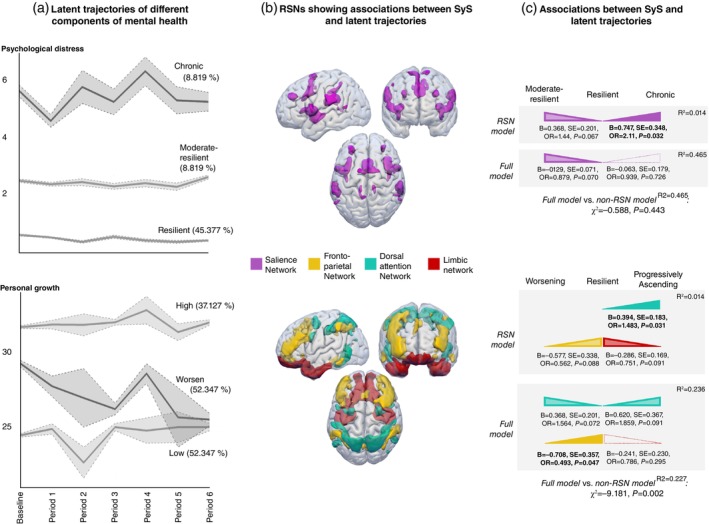 Figure 1
- —'la Caixa' Foundation 10.13039/100010434
- —Fundació la Marató de TV3 10.13039/100008666
- —Agència de Gestió d'Ajuts Universitaris i de Recerca 10.13039/501100003030
- —Institució Catalana de Recerca i Estudis Avançats 10.13039/501100003741
- —Ministerio de Ciencia e Innovación 10.13039/501100004837
Peer Reviews
No public reviews on file for this paper yet. If you reviewed it on a platform where reviews are public (OpenReview, ICLR, NeurIPS, ICML), you can paste yours below so the community can read it here.
Videos
No videos yet. Explain this paper in a talk, walkthrough, or lecture? Add one.
Taxonomy
TopicsMental Health Research Topics · Functional Brain Connectivity Studies · COVID-19 and Mental Health
While acknowledging the hardships caused by COVID‐19, the pandemic also provided a unique opportunity to study mental well‐being and individual vulnerability or resilience.1, 2 Sociodemographic, psychological factors, and lifestyles, have been identified as predictors of mental health during COVID‐19.3 Our previous study demonstrated the relevance of the interplay between psychological measures and brain networks' functional connectivity (FC).4 However, important questions remain to be addressed. For example, can FC—alone or in combination with other measures – predict longer‐term mental health? Additionally, most studies focus on emotional aspects (psychological distress), although mental health (MH) comprises emotional, psychological (personal growth, [PG]), and social (loneliness) well‐being components, which were differently impacted during the pandemic.3 This study aims to investigate if there exists specificity between FC measures and long‐term changes across MH components, knowing the links between brain networks and ‘resilience processes’.5, 6
We studied 702 healthy, middle‐aged individuals (350 women, age: 50.66 ± 6.98 years) who met the criteria in a 2023 study by Bayes‐Marin and colleagues.3 All participants gave written informed consent according to the Declaration of Helsinki. The study protocol was approved by the Comitè Ètic d'Investigació de la Fundació Unió Catalana d'Hospitals (CEIC‐17/06). Resting‐state functional magnetic resonance imaging images acquired before the COVID‐19 outbreak were preprocessed, and system segregation (SyS; integration‐segregation balance) was calculated for seven resting state networks (RSN) [see4] and Data S1). Multinomial logistic regressions were fitted to predict trajectory membership for the three MH components (Resilient or Chronic trajectories, for psychological distress and loneliness, and Resilient, Progressively Ascending, or Worsening for PG, as captured by growth mixture models contrasting pre‐ versus during‐pandemic observations within two‐year follow‐up (see 3, Data S1 and Fig. 1a). RSN models included FC for seven RSNs. Full models combined significant RSN measures and significant predictors found in our previous study (age, sex, monthly income, stress coping, personality, general health, and lifestyle habits) (see3). Non‐RSN models were as full models but without RSN data, and through likelihood ratio tests (non‐RSN vs full models) we assessed whether the goodness of fit improved by adding FC measures to sociodemographic, psychological, and lifestyle measures. In total, we fitted three models (RSN, non‐RSN, and full) for each of the three MH components.
The emotional trajectory membership (Fig. 1a) was significantly predicted by the Salience Network (SN) FC (Fig. 1b), revealing that a more functionally integrated SN (i.e., lower SyS) was more representative of Resilient trajectories in comparison to Chronic and marginally to Moderate‐Resilient ones. In the full model, the significance of SN‐FC as a predictor was reduced, and the comparison of full versus non‐RSN models was non‐significant (Fig. 1c).
The psychological trajectory membership (Fig. 1a) was significantly predicted by the Dorsal Attention Network (DAN), and marginally by Limbic Network (LN) and Fronto‐Parietal Network (FPN). However, in the full model, only FPN‐FC remained strictly significant, with a higher probability of belonging to the resilient trajectory with a greater integrated FPN. Notably, the full model was significantly better than the non‐RSN model (Fig. 1c).
Finally, social trajectory membership was not significantly predicted by any of the RSN‐SyS values (R ^2^ = 0.008).
Our findings indicate that measures of FC reflecting the integration‐segregation of principal RSNs offer distinct predictions for long‐term MH outcomes across the COVID‐19 pandemic. This study suggests that pandemic anxious‐depressive trends were affected by SN‐SyS. However, emotional trajectories were predicted by a simpler and equally informative model that did not include RSN information, suggesting that lifestyles and psychological factors are enough to describe them. Nevertheless, when studying PG, baseline FPN‐SyS was shown to add meaningful information to the model derived from aggregated sociodemographic, psychological factors, and lifestyles. Individual differences in PG maintenance likely reflect the capacity to thrive through reappraising and attaching value to stressful situations.7 As such, the associations found between PG and FPN connectivity, commonly linked to cognitive flexibility and control processes,8 may reveal the importance of cognition within psychological aspects. Finally, not finding any RSN‐SyS associated with social well‐being may be due to measuring the individual's subjective perception but not the direct engagement in social contacts, and/or the previously reported paradoxical effects of the outbreak on loneliness during the outbreak.9 Altogether, the present findings contribute to our previous observations,4 revealing the impact of the DMN‐ and FPN‐SyS on emotional trajectories through stress‐perception. This supports the triple‐network perspective.5, 6, 10
Overall, our findings suggest that assessing brain network integration versus segregation aids in predicting individual resilience and vulnerability across MH dimensions, allowing for early identification of at‐risk individuals, and the design and evaluation of personalized preventive strategies.
Disclosure statement
Author APL discloses consulting fees received from Neuroelectrics, TetraNeuron, Medrhythms, and Magstim, where he serves as a paid member of the scientific and medical advisory committees. APL is also listed as an inventor on several issued and pending patents related to the real‐time integration of transcranial magnetic stimulation with electroencephalography and magnetic resonance imaging. These patents encompass applications of noninvasive brain stimulation in various neurological disorders, as well as digital biomarkers of cognition and digital assessments for the early diagnosis of dementia. Additionally, APL acknowledges participation on a Data Safety Monitoring Board or Advisory Board for Linus Health and discloses being a co‐founder with ownership of stock in both Linus Health and TI solutions. Authors GC and JSS disclose being granted or contracted by Fundació la Marató de TV3, Alzheimer Drug Discovery Foundation and Spanish ministry of science and innovation.
Supporting information
DATA S1. Supporting information.
The reference list from the paper itself. Each links out to its DOI / PubMed record.
- 1Pascual‐Leone A , Bartres‐Faz D . Human brain resilience: A call to action. Ann. Neurol. 2021; 90: 336–349.34219268 10.1002/ana.26157 PMC 8981025 · doi ↗ · pubmed ↗
- 2Chen S , Bonanno GA . Psychological adjustment during the global outbreak of COVID‐19: A resilience perspective. Psychol. Trauma 2020; 12: S 51–S 54.32538658 10.1037/tra 0000685 · doi ↗ · pubmed ↗
- 3Bayes‐Marin I , Cabello‐Toscano M , Cattaneo G et al. COVID‐19 after two years: Trajectories of different components of mental health in the Spanish population. Epidemiol. Psychiatr. Sci. 2023; 32: e 19.37066626 10.1017/S 2045796023000136 PMC 10130737 · doi ↗ · pubmed ↗
- 4Cabello‐Toscano M , Lídia V‐A , Cattaneo G et al. Functional brain connectivity prior to the COVID‐19 outbreak moderates the effects of coping and perceived stress on mental health changes: A first year of COVID‐19 pandemic follow‐up study. Biol Psychiatry Cogn Neurosci Neuroimaging. 2022; 8: 200–209.35998824 10.1016/j.bpsc.2022.08.005PMC 9392559 · doi ↗ · pubmed ↗
- 5Bolsinger J , Seifritz E , Kleim B , Manoliu A . Neuroimaging correlates of resilience to traumatic events—A comprehensive review. Front. Psychiatry 2018; 9: 1–15.10.3389/fpsyt.2018.00693 PMC 631515830631288 · doi ↗ · pubmed ↗
- 6van Oort J , Tendolkar I , Hermans EJ et al. How the brain connects in response to acute stress: A review at the human brain systems level. Neurosci Biobehav Rev [Internet]. 2017; 83: 281–297.29074385 10.1016/j.neubiorev.2017.10.015 · doi ↗ · pubmed ↗
- 7Bartrés‐Faz D , Cattaneo G , Solana J , Tormos JM , Pascual‐Leone A . Meaning in life: Resilience beyond reserve. Alzheimers Res Ther. 2018; 10: 1–10.29793549 10.1186/s 13195-018-0381-z PMC 5968537 · doi ↗ · pubmed ↗
- 8Cole MW , Reynolds JR , Power JD , Repovs G , Anticevic A , Braver TS . Multi‐task connectivity reveals flexible hubs for adaptive task control. Nat. Neurosci. 2013; 16: 1348–1355.23892552 10.1038/nn.3470 PMC 3758404 · doi ↗ · pubmed ↗