Pilot Study Demonstrates Tetramethylhexadecenyl Succinoyl Cysteine (TSC) Reduces Tretinoin‐Induced Erythema and Dryness in Human Subjects
Eduardo Pérez, José R. Fernández, Yasanuri Sato, Corey Fitzgerald, Karl Rouzard, Jason Healy, Masanori Tamura, Jeffry B. Stock, Tsuyoshi Ishii

Abstract
Genes, proteins, chemicals, diseases, species, mutations and cell lines named across the full text — each resolved to its canonical identifier and authoritative record.
Click any figure to enlarge with its caption.
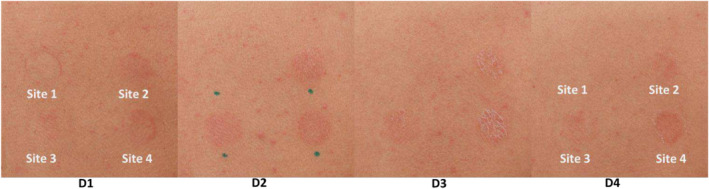 FIGURE 1
| Time point | 0.2% Tret | 0.2% Tret + 0.5% TSC | 0.2% Tret + 0.5% QFC | |
|---|---|---|---|---|
| Mean ± SD | Mean ± SD | Mean ± SD | ||
| % change^ | % change^ | % change^ | ||
| ( | ( | ( | ||
| Assessment | Day 2 |
1.40 ± 1.34 N/A (N/A) |
1.20 ± 1.30 N/A (N/A) |
1.00 ± 1.22 N/A (N/A) |
| Day 3 |
1.80 ± 0.84 29% (0.688) |
1.10 ± 1.14 −8% (0.922) |
1.40 ± 1.14 40% (0.670) | |
| Day 4 |
2.00 ± 0.71 43% (0.305) |
1.00 ± 1.00 −17% (0.799) |
2.20 ± 0.84 120% (0.109) | |
| Mean of cumulative scores (% difference of 0.2% Tret + 0.5% TSC to 0.2% Tret) | 1.50 (N/A) | 0.93 (−47%) | 1.35 (N/A) | |
| Day 2 |
2.30 ± 0.45 N/A (N/A) |
2.50 ± 0.50 N/A (N/A) |
2.50 ± 0.45 N/A (N/A) | |
| Day 3 |
2.10 ± 0.55 −9% (0.587) |
1.70 ± 0.27 −32% (0.056) |
2.30 ± 0.67 −8% (0.621) | |
| Day 4 |
1.40 ± 0.65 −39% (0.009 |
0.80 ± 0.45 −68% (0.010 |
1.60 ± 0.89 −36% (0.053) | |
| Mean of cumulative scores (% difference of 0.2% Tret + 0.5% TSC to 0.2% Tret) | 1.80 (N/A) | 1.53 (−17%) | 1.98 (N/A) | |
Peer Reviews
No public reviews on file for this paper yet. If you reviewed it on a platform where reviews are public (OpenReview, ICLR, NeurIPS, ICML), you can paste yours below so the community can read it here.
Videos
No videos yet. Explain this paper in a talk, walkthrough, or lecture? Add one.
Taxonomy
TopicsSkin Protection and Aging · Retinoids in leukemia and cellular processes · Acne and Rosacea Treatments and Effects
To the Editor,
Isoprenylcysteine (IPC) molecules represent a novel, safe class of compounds with a broad range of anti‐inflammatory, antimicrobial, wound healing, and moisturizing properties. These molecules are primarily synthesized with two distinct long tail fatty acid chains attached to a cysteine residue, either possessing a 15‐carbon farnesyl or a 20‐carbon phytyl moiety. We previously reported that novel IPC compounds, diosodium tetramethylhexadecenyl succinoyl cysteine (TSC aka SIG1273) and acetylglutaminoyl farnesylcysteine (QFC aka SIG1191), possess several skin‐protecting properties, including the inhibition of UVA, UVB, Ni^+2^, toll‐like receptor, and T‐cell receptor‐induced inflammation [1, 2, 3]. Moreover, other farnesyl cysteine derivatives have been shown to reduce erythema when topically applied to human subjects [4], while phytyl cysteine–derived compounds have been shown to be well tolerated and reduce signs of aging and are effective in subjects with acne‐prone skin [5, 6]. Topical retinoids, such as all‐trans retinoic acid (tretinoin) and retinol, are commonly utilized in both the prescription and cosmetic space to treat acne and skin aging. Per Verified Market Reports, the global market size for tretinoin is currently valued at USD 10 billion by 2030. However, despite their effectiveness, the topical use of retinoids can cause burning, itching, stinging, and redness for consumers. Given their previous skin health–promoting activities, we sought to perform a pilot clinical study to assess whether TSC and/or QFC could effectively reduce tretinoin‐induced irritation and thus ameliorate the negative side effects that come with its use.
This study was a 5‐day efficacy evaluation with five subjects performed at a third party CRO (Validated Claim Support, Teaneck, NJ). There were four female and one male participant with a mean age of 35 years ranging from 31 to 42 years. No adverse events were observed. Four test sites on the subjects' backs were utilized: Test site 1—negative control (untreated), Test site 2—positive control (tretinoin 0.2%), Test site 3—(0.5% TSC + 0.2% tretinoin), and Test site 4—(0.5% QFC + 0.2% tretinoin). In addition to the actives, the only other ingredients used in each formulation were isopropyl palmitate (74.3%–74.8%) and pentylene glycol (25%). Test samples (0.1 mL) were applied topically under an occlusive patch at Days 0 and 1. No application was made on Days 3 or 4. Objective tolerance grading and clinical photography were captured from Day 1 to 4. Clinical results demonstrate that 0.5% TSC +0.2% tretinoin elicited a milder response and faster reduction in both dryness and erythema as compared to the positive control, tretinoin 0.2%, and 0.5% QFC + 0.2% tretinoin (Table 1; Figure 1). Increase in dryness persisted through the final evaluation day (Day 4) for the positive control, while 0.5% TSC + 0.2% tretinoin showed a decrease over the evaluation period (Table 1; Figure 1). A difference of 47% (mean cumulative scores) between 0.5% TSC + 0.2% tretinoin and tretinoin 0.2% was noted for dryness. Additionally, erythema in the 0.5% TSC + 0.2% tretinoin test site was reduced significantly by 68% (p = 0.010*) at Day 4 compared to tretinoin 0.2% (39%) and 0.5% QFC + 0.2% tretinoin (36%). The results from this pilot study suggest that the phytyl‐cysteine lipid tail (TSC) may be more effective in reducing tretinoin‐induced dryness and erythema than the farnesyl moiety, as QFC appeared to have little to no effect on this type of irritation, while TSC effectively improved dryness and reduced redness. Altogether, given these initial encouraging results, further study of TSC in a dose‐dependent manner in a larger, controlled study is warranted.
TSC, but not QFC, visually improves tretinoin‐induced irritation and dryness. Images of the scapular back were captured at Day 1 (D1) through Day 4 (D4) utilizing a Canon R5. Subjects were positioned on a stool resting their arms in front of them. The below images are for Subject #4. Site 1—baseline (untreated), Site 2—0.2% tretinoin (positive control), Site 3—0.5% TSC + 0.2% tretinoin, Site 4—0.5% QFC + 0.2% tretinoin.
Author Contributions
E.P., J.S., Y.S., and J.F. designed the research study; T.I., K.R., C.F., Y.S., M.S., and E.P. analyzed the data; J.H. and M.T. contributed essential reagents or tools; and E.P. wrote the paper. All authors read and approved the final letter prior to submission.
Ethics Statement
This study was conducted in accordance with the intent and purpose of Good Clinical Practice regulations described in Title 21 of the U.S. Code of Federal Regulations (CFR) and the Declaration of Helsinki and its later amendments.
Conflicts of Interest
All authors of this letter are paid employees or consultants of Signum Biosciences or Rohto Pharmaceutical, which funded the study.
The reference list from the paper itself. Each links out to its DOI / PubMed record.
- 1J. R. Fernandez , E. Perez , M. Voronkov , et al., “Anti‐Inflammatory and Anti‐Bacterial Properties of Tetramethylhexadecenyl Succinyl Cysteine (TSC): A Skin‐Protecting Cosmetic Functional Ingredient,” International Journal of Cosmetic Science 37 (2015): 129–133.25256809 10.1111/ics.12166 · doi ↗ · pubmed ↗
- 2J. R. Fernandez , K. Rouzard , M. Voronkov , et al., “In Vitro and Clinical Evaluation of SIG 1273: A Cosmetic Functional Ingredient With a Broad Spectrum of Anti‐Aging and Antioxidant Activities,” Journal of Cosmetic Dermatology 15, no. 2 (2016): 150–157.26754448 10.1111/jocd.12206 · doi ↗ · pubmed ↗
- 3J. R. Fernandez , C. Webb , K. Rouzard , et al., “N‐Acetylglutaminoyl‐S‐Farnesyl‐L‐Cysteine (SIG‐1191): An Anti‐Inflammatory Molecule That Increases the Expression of the Aquaglyceroporin, Aquaporin‐3, in Human Keratinocytes,” Archives of Dermatological Research 309, no. 2 (2017): 103–110.27988893 10.1007/s 00403-016-1708-x PMC 5309294 · doi ↗ · pubmed ↗
- 4E. Perez , J. R. Fernandez , C. Fitzgerald , et al., “Pilot Study Demonstrates N‐Succinyl‐S‐Farnesyl‐L‐Cysteine Reduces Erythema and Inflammatory Lesions in Rosacea Subjects,” Journal of Cosmetic Dermatology 22, no. 9 (2023): 2622–2623.37073424 10.1111/jocd.15758 · doi ↗ · pubmed ↗
- 5J. R. Fernandez , C. Webb , K. Rouzard , et al., “SIG‐1273 Protects Skin Against Urban Air Pollution and When Formulated in Age IQ™ Night Cream Anti‐Aging Benefits Clinically Demonstrated,” Journal of Cosmetic Dermatology 18, no. 5 (2019): 1366–1371.30456862 10.1111/jocd.12825 · doi ↗ · pubmed ↗
- 6J. R. Fernandez , C. Webb , K. Rouzard , et al., “SIG 1459: A Novel Phytyl‐Cysteine Derived TLR 2 Modulator With In Vitro and Clinical Anti‐Acne Activity,” Experimental Dermatology 27, no. 9 (2018): 993–999.29797368 10.1111/exd.13692 · doi ↗ · pubmed ↗