Mentees perception of Formal Mentorship at public sector Medical School, Pakistan
Tayyiba Wasim, Fatima Haroon, Afshan Shahid, Anaab Wasim

TL;DR
This study evaluates the first formal mentorship program at a public medical school in Pakistan and finds that most students had positive experiences, though some concerns about confidentiality were raised.
Contribution
The study presents the first evaluation of a formal mentorship program at a public sector medical school in Pakistan.
Findings
90.3% of students reported positive experiences with mentors in areas like accessibility, confidence building, and communication skills.
Most students identified strengths in personal development, communication, and professional guidance, while concerns about confidentiality were common.
Around 15.1% of students suggested individual sessions to reduce hesitancy in group settings.
Abstract
To evaluate medical students’ experiences with mentors along with strengths and limitations of the first formal mentorship program at Medical School. This cross sectional study was conducted at Services Institute of Medical Sciences, a public sector medical college in Lahore. The mentoring program was planned and implemented for first time from January 2022 to November 2022 for MBBS students. Mentors were faculty members who received training prior to the program. Mentorship session of two hours every month was included in timetable. After the successful completion of one year of the program, the feedback questionnaire was filled by mentees about their perceptions about mentors and mentorship program and analyzed. A total of 362 students gave feedback. The findings highlight that 327/362 (90.3%) of students had positive experiences with their mentors, particularly in areas of mentor…
Genes, proteins, chemicals, diseases, species, mutations and cell lines named across the full text — each resolved to its canonical identifier and authoritative record.
Click any figure to enlarge with its caption.
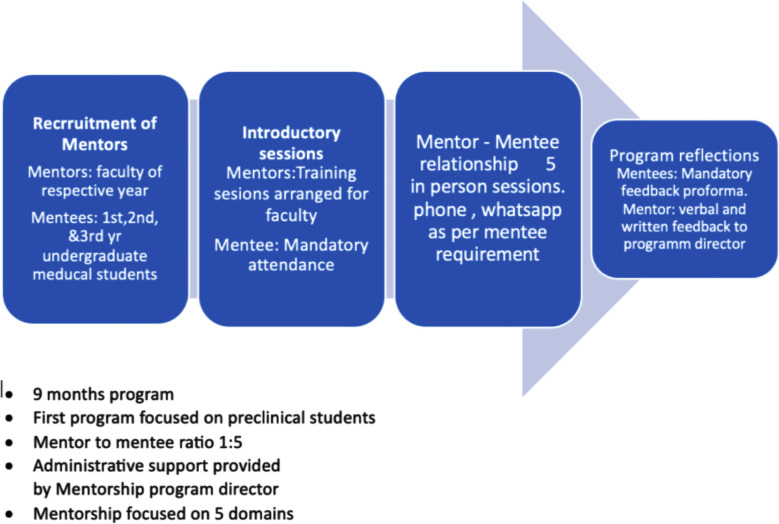 Fig.1
Fig.1| Statement | Strongly Disagree | Disagree | Indecisive | Agree | Strongly Agree |
|---|---|---|---|---|---|
| Mentor developed clear expectations of the mentoring relationship | 8 (2.2) | 7 (1.9) | 20 (5.5) | 233 (64.4) | 94 (26.0) |
| Mentor was a good listener | 4 (1.1) | 5 (1.4) | 11 (3.0) | 179 (49.4) | 163 (45.0) |
| Mentor was accessible and available | 5 (1.4) | 14 (3.9) | 21 (5.8) | 200 (55.2) | 122 (33.7) |
| Mentor encouraged confidence building | 4 (1.1) | 9 (2.5) | 19 (5.2) | 201 (55.5) | 129 (35.6) |
| Mentor stimulated creativity | 6 (1.7) | 18 (5.0) | 92 (25.4) | 195 (53.9) | 51 (14.1) |
| Mentor helped in career planning | 4 (1.1) | 57 (15.7) | 103 (28.5) | 156 (43.0) | 42 (11.6) |
| I learned how to study smart | 5 (1.4) | 28 (7.7) | 33 (9.1) | 195 (53.9) | 101 (27.9) |
| Mentor helped in improving my communication skills | 8 (2.2) | 19 (5.2) | 50 (13.8) | 189 (52.2) | 96 (26.5) |
| Mentor participated enthusiastically in mentoring activities | 8 (2.2) | 7 (1.9) | 31 (8.6) | 199 (55.0) | 117 (32.3) |
| I learnt how to be good professional | 8 (2.2) | 7 (1.9) | 31 (8.6) | 199 (55.0) | 117 (32.3) |
| Mentor facilitated improvement in ethical behavior | 3 (0.8) | 5 (1.4) | 23 (6.4) | 204 (56.4) | 127 (35.1) |
| I learnt balancing personal and professional responsibilities | 5 (1.4) | 9 (2.5) | 24 (6.6) | 206 (56.9) | 118 (32.6) |
| I will be able to manage stress better | 5 (1.4) | 2 (0.6) | 31 (8.6) | 193 (53.3) | 131 (36.2) |
| Mentor guided about professional problems and helped to remove deficiencies | 3 (0.8) | 10 (2.8) | 116 (32.0) | 210 (58.0) | 23 (6.4) |
| I anticipate an extended future relationship with my mentor | 6 (1.7) | 21 (5.8) | 60 (16.6) | 175 (48.3) | 100 (27.6) |
| I would recommend mentor for future mentees | 4 (1.1) | 8 (2.2) | 27 (7.5) | 186 (51.4) | 137 (37.8) |
|
| |||||
| Adequate introductory information was provided on the program in the orientation session | 7 (1.9) | 25 (6.9) | 41 (11.3) | 217 (59.9) | 72 (19.9) |
| The mentor/mentee match was satisfactory | 3 (0.8) | 20 (5.5) | 28 (7.7) | 213 (58.8) | 98 (27.1) |
| Mentoring program experience was satisfactory | 6 (1.7) | 15 (4.1) | 28 (7.7) | 233 (64.4) | 80 (22.1) |
| Mentoring was professionally and personally benefitting | 6 (1.7) | 12 (3.3) | 34 (9.4) | 212 (58.6) | 98 (27.1) |
| Mentoring program was well organized | 11 (3.0) | 37 (10.2) | 42 (11.6) | 179 (49.4) | 93 (25.7) |
| Mentoring sessions were helpful for mentoring experience | 7 (1.9) | 15 (4.1) | 41 (11.3) | 208 (57.5) | 91 (25.1) |
| Expected outcomes and objectives were achieved | 8 (2.2) | 30 (8.3) | 59 (16.3) | 193 (53.3) | 72 (19.9) |
| Category | Total Frequency | Percentage | subcategories | subcategory Frequencies |
|---|---|---|---|---|
| Personal Development and support | 141 | 40% | Confidence Building, Problem Solving, Guidance and support, Motivation, Stress Reduction, Personal and Professional Development | 58, 33, 22, 18,10 |
| Communication and Interaction | 131 | 35% | Interaction, Communication Skills, Listening Skills, Networking | 57, 52, 12, 10 |
| Miscellaneous | 58 | 16 % | Communicating general campus issues, strategies to enhance Creativeness among students, communicating Hostel Issues, Healthy Environment | 49, 4, 3, 2 |
| Time and Relationship Management | 22 | 6% | Time Management, Mentor- mentee Relationship and I/P relationships | 11, 11 |
| Professional Guidance | 10 | 3% | Professional Life Awareness, Future Planning, Ethical Guidance | 6, 3, 1 |
| Total | 362 | 100.0 |
| Strengths | Limitations | Suggestions |
|---|---|---|
| Personal development & support 141(40%) | No weaknesses 107(29%) | Need based individual session planning 20% |
Peer Reviews
No public reviews on file for this paper yet. If you reviewed it on a platform where reviews are public (OpenReview, ICLR, NeurIPS, ICML), you can paste yours below so the community can read it here.
Videos
No videos yet. Explain this paper in a talk, walkthrough, or lecture? Add one.
Taxonomy
TopicsMentoring and Academic Development · Diversity and Career in Medicine · Adolescent and Pediatric Healthcare
INTRODUCTION
Mentoring involves a relationship where a more experienced individual (mentor) provides guidance and trusted advice to a less experienced individual (mentee). Medical school mentoring programs have been established globally, each with different goals and objectives. Formal mentorship programs have provided medical students with increased research opportunities, career guidance, and support for both professional and personal development.1
As medical education continues to grow, mentors remain essential to student training and professional career development. They offer valuable wisdom, share expert insights, and help mentees develop skills for long-term success.2 Mentoring programs have been linked to various faculty benefits, such as enhanced recruitment, increased engagement, successful faculty promotions, improved retention rates, earlier career achievements, and positive perceptions of the institution’s commitment to its faculty.3
Medical schools around the world have implemented both formal and informal mentoring programs for their students. Mentoring or counseling medical students is a fundamental requirement for medical school accreditation according to national and international standards. However, in some countries, only 30% to 60% of medical schools offer formal mentoring programs.4 There are notable challenges in creating and implementing effective mentorship initiatives especially in low middle income countries such as time constraints for faculty and students, lack of financial and professional incentives for faculty members and lack of structured curriculum.5,6
Medical education in Pakistan has seen significant challenges over the past few decades. The combination of academic pressure, long hours, and high expectations often lead to mental health issues such as depression, anxiety, and burnout in students.7 High student-to-teacher ratios can limit individual attention and the quality of education. Student engagement by teachers and providing them guidance is extremely important in this digital era where student teacher distance is increasing day by day. There is a lack of structured mentorship program in Pakistan medical schools that can guide students in their clinical practice and career choices.
There are 172 medical schools in Pakistan but formal mentoring programs are sparse.8-10 First formal mentorship program for medical students was started at Services institute of Medical Sciences, a public sector medical school at Lahore Pakistan. The aim of this study was to evaluate medical students’ experiences with the benefits along with strengths and limitations of the mentoring program designed to prepare them for their roles as junior doctors. This could inform the development of a potential mentoring model for other institutions.
METHODS
This cross sectional study was conducted at Services Institute of Medical Sciences which is a public sector medical college in Lahore and caters to students in five years MBBS program.The mentoring program was planned and implemented for first time from January 2022 to November 2022 to students of basic/preclinical medical sciences enrolled in 1^st^ to 3^rd^ year. Formal Mentorship program was started across all basic sciences departments. Core group of faculties including professors of all classes were notified. Mentors were faculty members from all basic science department including lecturers, assistant professors, associate professors and Professors. Mentees were assigned in 1:5 to each mentor. Training sessions of mentors were taken by experienced faculty including academic Dean and program director. Mentorship session of two hours every month was included in timetable. Mentees were guided for personal and professional development, along with ideas how to study smart, ethics, professionalism, work life balance, communication skills and future career planning. Process overview of mentorship program is shown in Fig.1.
Process overview of Mentorship Program.
Ethnical Approval:
The study was approved by the institution’s Ethics Committee approval Ref no. IRB/2024/1369/SIMS dated 14.06.2024.
A structured feedback Form was developed with face and content validation carried out by the curriculum Committee in collaboration with the Medical Education department. Reliability analysis was conducted to assess the internal consistency of the questionnaire, which was measured using Cronbach’s alpha. Items were considered to have an acceptable level of internal consistency if the Cronbach’s alpha value ranged from 0.5 to 0.7, and a good level if it exceeded 0.7. The feedback form included a section of demographic profile, three open-ended and 23 close-ended questions with 16 questions about the sessions and seven questions about the program. A total sample of 362 students calculated by using open epi software. Simple random sampling was done by a making a sampling frame with the help of student’s college identification numbers.
After the successful completion of one year of the program, the feedback questionnaire was distributed to mentees to gather their perceptions of the mentorship program. Their responses were collected and analyzed. To avoid bias, the feedback questionnaires were distributed by non-teaching staff and collected in boxes placed in the department office to ensure confidentiality and anonymity. The feedback data was measured using a 5-point Likert scale (1 to 5), where Five indicated “Strongly Agree”. Open ended questions were asked at the end of the questionnaire focusing mainly on the strengths and areas of improvement in the mentoring program. Frequencies and percentages were calculated for quantitative variables and open-ended questionnaires responses were read and recurrent responses were pooled for suggestions, weaknesses, and strengths. Frequencies of responses were calculated by using SPSS software.
RESULTS
In our study, mean age of students was 18-20 years with 214(59.1%) females and 148(40.8%) male students. The findings highlight that 327/362 (90.3%) of students had positive experiences with their mentors, particularly in areas such as clear expectations, accessibility, confidence building, ethical behavior facilitation, communication skills and work life balance. 179(49.4%) agreed and 163(45.0%) strongly agreed that their mentors were good listeners. Accessibility and availability of mentors also received high marks, with 200(55.2%) agreeing and 122(33.7%) strongly agreeing. Guidance regarding ethical behavior, how to study smart and professionalism was agreed(A)and strongly agreed (SA) by (A 204(56.4%) SA127(35.1%), 195(53.9%) SA101(27.9%) and 199(55.0) SA117(32.3%) of students respectively. Feedback on psychological support was positive, with 193(53.3%) of the participants agreed and 118(32.6%) strongly agreeing that they will be able to handle stress better. In terms of balancing personal and professional responsibilities, 56.9% agreed that the interaction with mentors was helpful. Regarding the overall organization of the mentorship program, 49.4% agreed and 25.7% strongly agreed that it was well-organized and it helped them achieve expected outcomes. (Table-I)
The open-ended questions review provided an insight into the strengths, weaknesses and suggestions to improve the program in future.
Strengths:
There were five key strengths identified by student responses were personal development and Support 141(40%), better communication and interaction 131(35%), enhanced time and relationships management skills 22(6%) and professional guidance 10(3%). Miscellaneous category also constituted 58(16%), which included communicating general issues related to campus and hostels covering various other elements that can enhance their learning experience (Table-II).
Limitations and Suggestions for improvement:
Firstly, 107(29.9%) students perceived no weakness in the program. Non assurance of confidentiality and hesitancy to communicate in groups was perceived as most important weakness by 181(50%) and 55(15%) of students. Individual frequent sessions in distraction free environment, feedback with program director and emphasis on career guidance were suggested by students (Table-III).
DISCUSSION
Mentoring is an important educational strategy in medical education with various aims and objectives. The findings of our study emphasize that mentors play a critical role in the personal and professional development of medical students. The positive feedback regarding mentors’ ability to set clear expectations, listen effectively, and be accessible highlights the essential qualities of mentors that contribute to a successful mentoring relationship as shown in other studies as well.11,12 Personal development in terms of confidence building and ethical behavior were significant strength of our mentorship program identified by 141(40%) of the students.
Several studies have suggested that mentorship plays a crucial role in fostering professionalism, personal growth, and ensuring the well-being of students.13 Our students’ feedback and experiences highlight that mentorship provides benefits beyond what can be achieved in classroom. The roles of a mentor is distinct; while an educational or clinical supervisor focuses on planning, goal setting, and assessing performance against required training outcomes, a mentor supports personal development and offers psychological support through an ongoing relationship. Medical curriculum is overloaded, high stake exam and lack of emotional support makes the students lives stressful. In our study, it was seen that better communication with mentors and ability to express their issues helped them in overcoming their fears and stresses of hostel life. Studies have shown that students generally found it easier to seek personal and pastoral guidance from their mentors have less burnout.14,15
The most significant strength identified was the program’s role in fostering personal development and providing support. This suggests that the mentorship program successfully helps students grow on a personal level, offering guidance, encouragement, improved self-confidence and better decision-making skills. This aligns with existing literature that mentorship experiences play a crucial role in shaping their decisions regarding rotation selections, residency programs, fields of practice, and overall career direction.16,17 Through effective evaluation methods, we can assess its positive impact on students’ academic performance, career preparation, job satisfaction, research productivity and the program’s success. Our study highlighted the importance of mentors being good listeners, accessible, enthusiastic and willing to help. A study by Deng C emphasized that effective mentors possess qualities such as good interpersonal skills, initiative and the ability to provide constructive feedback.18
Our mentorship program had a positive feedback by majority (90.3%) of students. Setting up of a program for first time is quite challenging as there is no existing framework. Medical school faculty have heavy clinical, teaching, and research responsibilities, leaving little time for mentorship. Finding mentors who are both available and genuinely interested in engaging with students can be difficult. Not all faculty members have the skills required to be effective mentors. Matching mentors and mentees, building trust, training of mentors, adjusting sessions in time table were few challenges that we tried to address. These challenges are reflected in other studies as well.2,10,19 Training workshops for mentors, interest of institution head and faculty commitment were few reasons for the success of the program. Non assurance of confidentiality was identified as a limitation by half of the students and 15% felt hesitant to communicate in groups. Building trust between mentors and mentees is crucial for a successful mentorship program. However, students come from diverse backgrounds and may hesitate to share personal challenges or career concerns in groups. Establishing clear confidentiality guidelines, ensuring that both mentors and mentees understand them, and creating a safe space for open communication are vital to fostering trust.20
We plan to have more structured training for mentors on developing trust with mentees to ensure a more uniform and effective mentoring experience. The suggestions for improving the mentorship program at our institute regarding individual, frequent sessions, venue, exclusive mentor engagement and implementing regular feedback mechanisms will help us in designing future sessions. Enhancing the structure and content of mentoring workshops to better align with students’ needs has been highlighted in other studies as well.6,21,22 By fostering better teacher-student interactions, aiding in personal growth, improving time management, interpersonal skills and offering professional guidance, the program contributes significantly to the overall career success and well-being of the students. These strengths highlight the value of maintaining and further developing such mentorship initiatives within medical education.
CONCLUSION
The formal mentorship program plays a vital role in supporting medical students’ personal and professional development. Enhancing confidentiality protocols, addressing communication barriers in group settings, ensuring session continuity and regular feedback are critical steps that could significantly strengthen the program.
Authors’ Contribution:
TW: Conceived, designed, final manuscript editing.
FH: Literature search**,:** Did initial manuscript writing.
AS: data collection, statistical analysis
AW data collection, literature search.
All authors have read the final version and are accountable for the integrity of the study.
The reference list from the paper itself. Each links out to its DOI / PubMed record.
- 1Crites GE Ward WL Archuleta P Fornari A Hill SEM Westervelt LMA Scoping Review of Health Care Faculty Mentorship Programs in Academia:Implications for Program Design, Implementation, and Outcome Evaluation J Contin Educ Health Prof 20234314251 doi:10.3109/0142159 X.2014.8996833621516210.1097/CEH.0000000000000459 · doi ↗ · pubmed ↗
- 2Nimmons D Giny S Rosenthal J Medical student mentoring programs:Current insights Adv Med Educ Pract 201910113123 doi:10.2147/AMEP.S 1549743088117310.2147/AMEP.S 154974 PMC 6404673 · doi ↗ · pubmed ↗
- 3Chua WJ Cheong CWS Lee FQH Koh EYH Toh YP Mason S Structuring Mentoring in Medicine and Surgery. A Systematic Scoping Review of Mentoring Programs between 2000 and 2019 J Contin Educ Health Prof 2020403158168 doi:10.1097/CEH.00000000000003083289812010.1097/CEH.0000000000000308 · doi ↗ · pubmed ↗
- 4Newberry JA Patel S Kayden SO'Laughlin KN Cioè-Peña E Strehlow MC Fostering a Diverse Pool of Global Health Academic Leaders Through Mentorship and Career Path Planning AEM Educ Train 20204(S 1)98105 doi:10.1002/aet 2.1040310.1002/aet 2.10403 PMC 701140532072113 · doi ↗ · pubmed ↗
- 5Bain LE Mbouamba Yankam B Kong JD Claude Nkfusai N Badru OA Ebuenyi ID Global Health Mentorship:Challenges and Opportunities for Equitable Partnership BMJ Glob Heal 202381114 doi:10.1136/ bmjgh-2023-01375110.1136/bmjgh-2023-013751 PMC 1066082837984896 · doi ↗ · pubmed ↗
- 6Deng C Gulseren DB Turner N How to match mentors and protégés for successful mentorship programs:a review of the evidence and recommendations for practitioners Leadership Org Dev J 2022433386403 https://doi.org/10.1108/LODJ-01-2021-0032
- 7Irshad K Ashraf I Azam F Shaheen A Burnout prevalence and associated factors in medical students in integrated modular curriculum:A cross-sectional study Pak J Med Sci 2022384801806 doi:10.12669/pjms.38.4.50523563461610.12669/pjms.38.4.5052 PMC 9121922 · doi ↗ · pubmed ↗
- 8Hidayat M Babar S Medical Students'Research Mentoring Program At Central Park Medical College, Lahore, Pakistan J Ayub Med Coll 202133463564035124923 · pubmed ↗