Contribution from the SAARC Region to Ophthalmic Research: A Bibliometric Analysis
Yousaf Jamal Mahsood, Rima Khan, Hira Wakil, Saima Farooq, Rashid Zia

TL;DR
This study evaluates the ophthalmic research contributions from the SAARC region in top journals, finding a low representation despite the region's large population.
Contribution
The paper provides a bibliometric analysis of ophthalmic research contributions from the SAARC region in top journals over two years.
Findings
Only 4.2% of 4952 articles reviewed had authorship from the SAARC region.
India contributed the majority of SAARC authors and corresponding authors.
Medical retina was the most common research topic among SAARC publications.
Abstract
To review the contributions to the ophthalmic research from the SAARC region in the top twenty ophthalmology journals. This was a bibliometric study and the top 20 ophthalmology journals, as ranked by the Scimago Journal Rankings (SJR) from 2021 and 2022 (two years), were selected for analysis. Only original research articles were included in the analysis. Articles were analysed based on authorship, corresponding authorship, and research centres within the South Asian Association for Regional Cooperation (SAARC) region (Afghanistan, Bangladesh, Bhutan, India, Maldives, Nepal, Pakistan, and Sri Lanka). The main research topics were also examined. This data was recorded on Microsoft excel sheet and then descriptive analysis were calculated. Of the total 4952 articles reviewed, 208 (4.2%) had authorship from the SAARC region. Of the 38079 authors in total, 1133 (2.97%) were from the…
Genes, proteins, chemicals, diseases, species, mutations and cell lines named across the full text — each resolved to its canonical identifier and authoritative record.
Click any figure to enlarge with its caption.
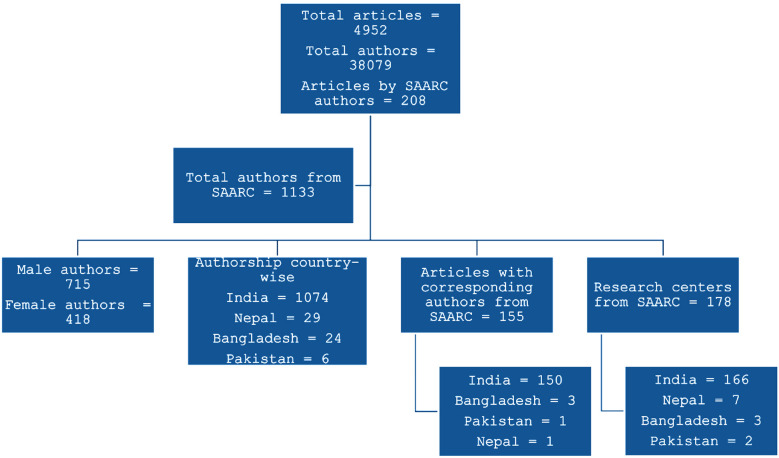 Fig.1
Fig.1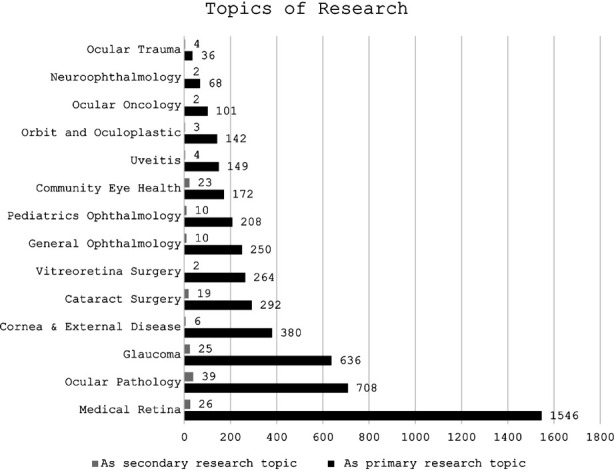 Fig.2
Fig.2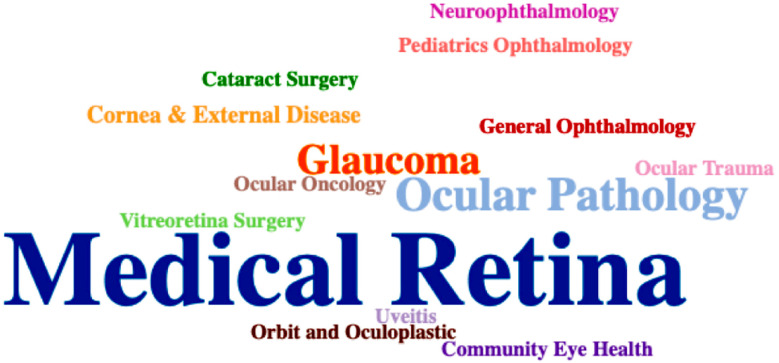 Fig.3
Fig.3| Year 2021 | Year 2022 | ||||||
|---|---|---|---|---|---|---|---|
| Rank | Journal name | SJR | Country of origin | Rank | Journal name | SJR | Country of origin |
| 1 | Progress in Retinal and Eye Research | 6.022 | United Kingdom | 1 | Progress in Retinal and Eye Research | 4.939 | United Kingdom |
| 2 | Ophthalmology | 4.412 | United States | 2 | Ophthalmology | 3.913 | United States |
| 3 | Annual Review of Vision Science | 3.038 | United States | 3 | Annual Review of Vision Science | 2.727 | United States |
| 4 | JAMA Ophthalmology | 2.311 | United States | 4 | JAMA Ophthalmology | 2.349 | United States |
| 5 | American Journal of Ophthalmology | 2.301 | United States | 5 | Ocular Surface | 1.983 | United States |
| 6 | Survey of Ophthalmology | 2.063 | United States | 6 | American Journal of Ophthalmology | 1.895 | United States |
| 7 | Ophthalmology Retina | 1.843 | United States | 7 | British Journal of Ophthalmology | 1.733 | United Kingdom |
| 8 | British Journal of Ophthalmology | 1.800 | United Kingdom | 8 | Ophthalmology Retina | 1.622 | United States |
| 9 | Ocular Surface | 1.685 | United States | 9 | Survey of Ophthalmology | 1.595 | United States |
| 10 | Current Opinion in Ophthalmology | 1.653 | United States | 10 | Ophthalmology Glaucoma | 1.280 | United States |
| 11 | Retina | 1.648 | United States | 11 | Asia-Pacific journal of Ophthalmology | 1.277 | Netherlands |
| 12 | Eye | 1.427 | United Kingdom | 12 | Investigative Ophthalmology and Visual Science | 1.259 | United States |
| 13 | Investigative Ophthalmology and Visual Science | 1.399 | United States | 13 | Eye and Vision | 1.223 | United Kingdom |
| 14 | Journal of Cataract and Refractive Surgery | 1.367 | United States | 14 | Retina | 1.206 | United States |
| 15 | Cornea | 1.336 | United States | 15 | Eye | 1.176 | United Kingdom |
| 16 | Acta Ophthalmologica | 1.314 | United Kingdom | 16 | Current Opinion in Ophthalmology | 1.132 | United States |
| 17 | Graefe’s Archive for Clinical and Experimental Ophthalmology | 1.305 | Germany | 17 | Acta Ophthalmologica | 1.128 | United Kingdom |
| 18 | Journal of Refractive Surgery | 1.298 | United States | 18 | Eye and Brain | 1.020 | New Zealand |
| 19 | Eye and Brain | 1.251 | New Zealand | 19 | Ophthalmology and Therapy | 1.020 | United Kingdom |
| 20 | Ophthalmologica | 1.245 | Switzerland | 20 | Graefe’s Archive for Clinical and Experimental Ophthalmology | 1.019 | Germany |
| Year 2021 | Year 2022 | ||||||||
|---|---|---|---|---|---|---|---|---|---|
| Rank | Journal name | Authors from SAARC | Corresponding authors from SAARC | Research centers from SAARC | Rank | Journal name | Authors from SAARC | Corresponding authors from SAARC | Research centers from SAARC |
| 1 | Progress in Retinal and Eye Research | Excluded | 1 | Progress in Retinal and Eye Research | Excluded | ||||
| 2 | Ophthalmology | India=28 | India=4 | India:6 Nepal:2 | 2 | Ophthalmology | India =16 | 0 | India=3 |
| 3 | Annual Review of Vision Science | Excluded | 3 | Annual Review of Vision Science | Excluded | ||||
| 4 | JAMA Ophthalmology | 0 | 0 | 0 | 4 | JAMA Ophthalmology | India=25 | India=2 | India=4 |
| 5 | American Journal of Ophthalmology | India=114 | India=16 | India=13 | 5 | Ocular Surface | India=1 | 0 | 0 |
| 6 | Survey of Ophthalmology | Excluded | 6 | American Journal of Ophthalmology | India=54 | India=7 | India=7 | ||
| 7 | Ophthalmology Retina | India=13 | India=1 | India=3 | 7 | British Journal of Ophthalmology | India=68 | India=8 | India= 8 |
| 8 | British Journal of Ophthalmology | India=98 Bangladesh=7 | India=14 Bangladesh=1 | India=13 Bangladesh=1 | 8 | Ophthalmology Retina | India=22 | India=1 | India=7 |
| 9 | Ocular Surface | India=11 | India=1 | India=1 | 9 | Survey of Ophthalmology | Excluded | ||
| 10 | Current Opinion in Ophthalmology | Excluded | 10 | Ophthalmology Glaucoma | India=36 | India=6 | India=6 | ||
| 11 | Retina | India= 46 | India=8 | India=7 | 11 | Asia-Pacific journal of Ophthalmology | Bangladesh=17 | Bangladesh=2 | Bangladesh=2 |
| 12 | Eye | India=114 Pakistan=1 | India=16 | India=15 | 12 | Investigative Ophthalmology and Visual Science | India=9 | India=2 | India=2 |
| 13 | Investigative Ophthalmology and Visual Science | India=47 | India=7 | India=7 | 13 | Eye and Vision | India=1 | 0 | India=1 |
| 14 | Journal of Cataract and Refractive Surgery | India=23 | India=7 | India=7 | 14 | Retina | India:46 Pakistan=3 | India=8 Pakistan=1 | India=8 Pakistan=1 |
| 15 | Cornea | India=17 | India=3 | India=4 | 15 | Eye | India=76 | India=15 | India=16 |
| 16 | Acta Ophthalmologica | India=8 | India=1 | India=1 | 16 | Current Opinion in Ophthalmology | Excluded | ||
| 17 | Graefe’s Archive for Clinical and Experimental Ophthalmology | India=102 | India=13 | India=13 | 17 | Acta Ophthalmologica | India=4 | India=1 | India=1 |
| 18 | Journal of Refractive Surgery | 0 | 0 | 0 | 18 | Eye and Brain | 0 | 0 | 0 |
| 19 | Eye and Brain | 0 | 0 | 0 | 19 | Ophthalmology and Therapy | India=29 | India=1 | India=5 |
| 20 | Ophthalmologica | India=6 | India=1 | India=1 | 20 | Graefe’s Archive for Clinical and Experimental Ophthalmology | India=60 | India=7 | India=7 |
Peer Reviews
No public reviews on file for this paper yet. If you reviewed it on a platform where reviews are public (OpenReview, ICLR, NeurIPS, ICML), you can paste yours below so the community can read it here.
Videos
No videos yet. Explain this paper in a talk, walkthrough, or lecture? Add one.
Taxonomy
TopicsRetinal and Optic Conditions · Retinal Imaging and Analysis · Ophthalmology and Visual Health Research
INTRODUCTION
Health research plays a vital role in defining a nation’s progress. The field of ophthalmology is constantly evolving to address complex eye health and vision impairment issues. Studies on the contribution of ophthalmic research have been conducted both globally as well as in Asia.1,2 Ophthalmology research is crucial in addressing eye health issues and improving clinical outcomes, particularly in the South Asian Association for Regional Cooperation (SAARC) region where a significant portion of the global population resides. SAARC accounted for 5.21% (US$ 4.47 trillion) of the world economy, 21% of the world’s population, and 3% of the world’s land area as of 2021.3 Previous studies have shown that countries from the SAARC region accounts for a small percentage of the world’s scientific output and lacks representation among the top-cited ophthalmology research.4 Despite making up 21% of the global population, just 4.14% of the world’s overall scientific output comes from South Asian nations.5
The SAARC region, founded in 1985, consists of eight member nations (Afghanistan, Bangladesh, Bhutan, India, Maldives, Nepal, Pakistan, and Sri Lanka). There have been research contributions from these countries in the field of ophthalmology, but it is unclear how much of that contribution has been published by top ophthalmology journals. There is a lack of in-depth understanding of the current state of ophthalmology research contribution from the SAARC region. Bibliometric analysis provides quantitative insights into the impact, trends, and quality of research, helping identify influential studies, authors, and emerging fields efficiently.6,7 This emphasizes the need for a comprehensive bibliometric analysis to characterize the state of ophthalmology research, identify dominant patterns, evaluate research publications, and pinpoint areas that require further improvement.
Since SAARC ophthalmologists’ publications in high-impact factor international journals have the potential to greatly impact the global landscape of ophthalmology research, therefore it is vital to explore publications in these journals. To the best of our knowledge, this is the first bibliometric analysis focusing on ophthalmology publications from the SAARC region in top ranked journals. Through a critical examination of the literature, this study aims to conduct a bibliometric analysis of top 20 ophthalmology journals and determine the contributions from the SAARC region. We hypothesize that the contributions of the SAARC region to top-tier ophthalmology journals are significantly less than its share of the world’s population and research output, and further research is needed to improve the field’s contribution to global ophthalmology research. This study will provide stakeholders, decision-makers, scholars, and medical professionals with information regarding the status of ophthalmology research in the SAARC area, hence stimulating efforts to improve eye health and vision care for the many populations it serves.
METHODS
This study was conducted at the department of ophthalmology of Hayatabad Medical Complex, Peshawar. The 20 highest-ranking ophthalmology journals based on impact factor by SCImago (www.scimagojr.com) for the years 2021 and 2022 were selected.8,9 SCImago journal rankings (SJR) were preferred over other databases because it is an open access system. Only original research articles were included in this study to explore the research generation from primary source data from SAARC nations. Those articles which were retracted were excluded from our study. The information extracted from the selected articles included: the total number of authors, the number of authors from the SAARC region, gender-wise distribution of these authors, the number of research centres from SAARC countries, and the topic of research. All the data were recorded using an Excel spreadsheet. Data were collected by two independent investigators (RK and HW). Confusion and disagreement were resolved by a third investigator (YJM). The authors were stratified into SAARC countries based on their countries of affiliation. This was also applied to corresponding authors. To determine the gender of the authors accurately, a Google search was applied to find the authors’ profile page from their affiliated institution’s website. In cases of unavailability of this, a Google search was done to determine whether a name was associated with a male or female gender based on popular usage of a certain name on the internet as done in a previous study.10 The topics of research included: General Ophthalmology; Paediatric ophthalmology and Strabismus; Uveitis; Glaucoma; Cornea and External Diseases; Medical Retina; Vitreo-Retinal Surgery; Oculoplastic; Cataract Surgery; Ocular Oncology; Neuro-Ophthalmology; Ocular Pathology; Community Eye Health, and trauma. One topic of research was allocated to most articles. However, when varied subjects were discussed in an article, two topics of research (primary and secondary) were assigned accordingly. The frequency of authorships from SAARC countries was then calculated. In addition, the gender-wise distribution and contributions of each gender were determined.
RESULTS
The characteristics of the top 20 ophthalmology journals included for year 2021 and 2022 are shown in Table-I. In 2022 rankings: Cornea, Journal of Refractive and Cataract Surgery, Journal of Refractive Surgery, and Ophthalmologica lost their spot in the top 20 and were superseded by Ophthalmology Glaucoma, Eye and Vision, Asia-Pacific Journal of Ophthalmology, and Ophthalmology and therapy. Therefore, the new entries were also considered. Most of the journals (n=13; 65%) in 2021 and (n=11; 55%) in 2022 were published from United States. Only the original articles were included from these years. As a result, the articles from the Journal of Progress in Retinal and Eye Research, Annual Review of Vision Science, Survey of Ophthalmology, and Current Opinion in Ophthalmology were excluded because these journals contained only review articles.
A total of 4952 ophthalmic original research articles published in 2021 and 2022 in top 20 journals were written by 38079 authors. There were 1133 (2.97%) authors from the SAARC region and 208 (4.2%) articles had authorship from the member countries. Male authors contributed more to SAARC region (n=715; 63.1%). Based on country-wise contribution, 1074 (94.8%) authors were from India, 29 (2.56%) authors from Nepal and 24 (2.12%) from Bangladesh. In 155 (3.13%) articles, the corresponding authors were from the SAARC region, among which 150 (96.78%) were from India. Out of 178 research centres involved from the SAARC region in 167 articles, 166 (93.26%) centres were in India. The details of authorship are shown in Fig.1. The country-wise contributions in top 20 ophthalmology journals based on SCImago rankings for year 2021 and 2022 is shown in Table-II.
Details of authorship and contribution from SAARC region.
The primary and secondary topics for research for all articles screened were also analysed and are shown in Fig.2, medical retina (n=1546; 31.22%) was the most common topic followed by ocular pathology (n=708; 14.3%) and glaucoma (n=636; 12.84%) as primary topics of research. Ocular pathology (n=39; 0.79%), medical retina (n=26; 0.52%), and glaucoma (n=25; 0.5%) were the leading secondary topics of research in these articles. Fig.3 highlights the overall representation of research topics as word cloud.
Topics of research interest (this includes contribution of all authors).
Word cloud representation of the topics of research.
DISCUSSION
Investigating the authors’ contributions to the top 20 ophthalmology journals for two years (2021 and 2022) from the SAARC region was the goal of this study. Although the proportion of SAARC authors relative to the global author population was 2.97%, they contributed to 4.2% of the original research articles published during these years. While there are no prior studies that are explicitly about the contributions of ophthalmic research from the SAARC region that we can compare with, we found a study on the state of research and development in the region. In four key scientific categories, Ahmad et al. revealed that 4.14% of articles in Nature Index journals came from the SAARC region.5 Our findings are in line with theirs, which indicates that the contribution to ophthalmic research is equivalent to that of other scientific fields. According to a study by Heng Wong and colleagues, they did not find citations from the SAARC region among the top 100 most-cited ophthalmology articles.11 Likewise, Fonteno and Liu found that the top 10 contributors to publications of original research, such as clinical trials, did not include any representation from the SAARC region in their study based on a PubMed search.12 This low level of contribution from the SAARC region to ophthalmic research could be attributed to several reasons, including policy and governance, education and training, access to technology and innovation, inadequate research infrastructure, resource constraints, and collaboration and networking.
According to a previous report, the tendency of collaborative research is lower in the SAARC region than outside of it (2.2% versus 20%), and this may be an important contributing factor.5 The under representation of SAARC region work on the international scene could be due to the absence of high impact factor journals from the region as highlighted by our results (Table-I). Prior research has indicated that authors from the United States and the United Kingdom who publish in top journals tend to cite their own journals more frequently than any other country.13 Additionally, American reviewers significantly favour publications from the United States.14 These could be the explanations for the high number of citations to US and UK authors.
India contributed more than any other country in the SAARC region to ophthalmic research: 94.8% of authors, 96.78% of corresponding authors, and 93.26% of research centres. In the SCImago country rankings for ophthalmology in 2021 and 2022, India was ranked third. In 2022, India published a total of 2472 documents in the field of ophthalmology, up from 2262 in 2021.15,16 In the top 100 most-cited publications from Asia, India dominated the SAARC region, accounting for 8-10% of the citations.1 India’s substantial contribution could be attributed to many factors, including its large population, prevalence of disease, distinguished academic and medical institutions, global collaboration, private sector engagement, and economic prosperity.
Evidence highlights a strong positive association between the nation’s economic growth and its scientific output or publications.17 India has shown significant improvement in its gross domestic product (GDP) in the last few years.18 Another important indicator is Gross Expenditure on Research and Development (GERD) where India is excelling in the SAARC region.19 The recent development of the BRICS (Brazil, Russia, India, China and South Africa) countries-of which India is one of the founding members-might be another significant explanation. Menon et al compared the India’s scientific research presentations in pharmacoeconomic and health outcomes research to those of the BRICS and SAARC countries.20 They concluded that the BRICS countries have seen a noticeable increase in pharmacoeconomic and health outcomes research over the last ten years. Research in this area shows that the BRICS nations are developing on a forward-leaning path. Overall, compared to other SAARC nations, India produces more ophthalmology research, which can be because of its robust research infrastructure, rapid economic growth, and extensive networks of collaboration in the field. India’s experience must be emulated by other SAARC nations who also need to boost their research output.
The other SAARC nations that contributed to ophthalmic research in these journals in 2021 and 2022 were Bangladesh, Nepal, and Pakistan. In the SCImago country rankings for ophthalmology, Bangladesh, Nepal, and Pakistan were ranked 80^th^, 52^nd^, and 36^th^ in 2021 and 61^st^, 52^nd^, and 35^th^ in 2022, respectively. In 2021, Bangladesh, Nepal, and Pakistan contributed 10, 33, and 85 papers; in 2022, those numbers increased to 20, 37, and 92 documents, respectively.15,16 While these countries have shown improvement in contribution to ophthalmic research they need a lot of hard work. Pakistan contributed to the emerging topics of research from Asia.1 The low output of these countries may be due to the same challenges faced by ophthalmologists from Sub-Sahara countries like limited funding, research training, access to quality journals, and research incentives.21 A comparable study of Arabs’ contributions to ophthalmic research between 1900 and 2012 was carried out by Arab researchers. They reported that during the study period, 2035 original articles were retrieved from the 21 Arab nations.22 The authors suggested that Arabs working in the field of ophthalmology should connect and cooperate on research with other highly developed nations. In our study, most research topics focused on medical retina, glaucoma, and ocular pathology. Prior research has also demonstrated that glaucoma and retina consistently rank among the most popular topics for study.1,4,23,24 The reasons may be that there are constantly evolving therapeutic and diagnostic procedures in these two fields, as well as the presence of the retina, glaucoma, and ocular surface journals, which ranked higher than other subspecialties in the top 20, and may have influenced these findings.
To the best of our knowledge, no other study has investigated the contribution of ophthalmologists from the SAARC region to ophthalmic research. One advantage of our study is that, by examining the contribution of ophthalmologists from the SAARC to research, our work pioneers a new territory. This unique perspective broadens our understanding of the field and enhances the existing literature. Our study offers a thorough review of the research contributions of ophthalmologists in the SAARC region. Our research may help shape policies intended to improve ophthalmology’s research capacity. Our study is likely to facilitate future collaborations between researchers and organizations in the SAARC region and rest of the world.
Limitations:
Our study has certain limitations, for example, our data may have been constrained because we focused on the top 20 ophthalmology journals as per SCImago journal rankings. The authors from the SAARC region may have contributed to top non-ophthalmology journals but due to our stringent inclusion criteria, they have not been counted. We only included the original research articles that excluded the other types of research contributions like editorials, reviews, meta-analyses, and case reports so the SAARC region’s authors’ contribution may be underrepresented. Research articles from the SAARC area may be published in languages other than English which could make it difficult to access and include them in our analysis. Language barriers could cause our findings to be skewed and result in insufficient coverage of pertinent research.
SAARC ophthalmologists may encounter difficulties in publishing their research in top international journals because of factors like low institutional support, language limitations, and resource accessibility. Publication bias may have an impact on how research contributions are represented in our analysis, which could lead to underestimation of the actual volume of ophthalmic research conducted in the area. The ophthalmologists of SAARC may focus on a variety of subspecialties, from public health and epidemiology to clinical practice. The scope and breadth of our study may have been affected by researchers’ varying research interests, which makes it difficult to reach firm conclusions on the total amount of research contributed.
CONCLUSION
Despite hosting quarter of the whole world’s population, the SAARC region makes a small contribution to ophthalmic research in top 20 ophthalmology journals. Research contribution seems to be proportional to region’s economic contribution to that of world’s economy with India representing the maximum contribution to the original research published.
Future Recommended:
It is recommended that a valuable global perspective should be obtained by comparing the scientific contributions of ophthalmologists from the SAARC region with those from other regions. This comparative analysis might contribute to more extensive debates in the field and identify the opportunities and challenges experienced by ophthalmologists in the SAARC area. There is not a single ophthalmology journal in top 20 from SAARC region which South Asian Academy of Ophthalmology must consider an important area to work on. By addressing this challenge, it will open doors for the researchers from the region to share their work on global platform. Moreover, to address the obstacles that the researchers face; governments, universities, funding organizations, and international organizations from the SAARC region would need to work together to invest in research infrastructure, offer chances for training and education, encourage collaboration, and put supportive policies in place. This will help advance ophthalmic research in the SAARC region.
Authors’ Contribution:
YJM: Concepts, Data acquisition, Manuscript drafting, Manuscript editing,
RK & HW: Design, Data acquisition Data analysis & interpretation, Manuscript drafting, Manuscript editing, Final approval and agreed to be accountable.
SF & RZ: Concepts, Design, Manuscript drafting, Manuscript editing, Final approval and agreed to be accountable.
YJW, RK, HW, SF and RZ: Final approval and agreed to be accountable.
The reference list from the paper itself. Each links out to its DOI / PubMed record.
- 1Koh BMQR Banu R Sabanayagam C The 100 Most Cited Articles in Ophthalmology in Asia Asia-Pacific J Ophthalmol 20209537939710.1097/APO.000000000000032532956190 · doi ↗ · pubmed ↗
- 2Bro T Worldwide ophthalmological research production 2000–2020, with special focus on the Nordic contribution Acta Ophthalmol 20221008 e 176017663567037510.1111/aos.15200 PMC 9796427 · doi ↗ · pubmed ↗
- 3Wikimedia Foundation I South Asian Association for Regional Cooperation - Wikipedia [Internet]2004[cited 2024 Apr 14]Available from: https://en.wikipedia.org/wiki/South_Asian_Association_for_Regional_Cooperation
- 4Fu Y Mao Y Jiang S Luo S Chen X Xiao WA bibliometric analysis of systematic reviews and meta-analyses in ophthalmology Front Med (Lausanne)2023101135592 doi:10.3389/fmed.2023.11355923693624110.3389/fmed.2023.1135592 PMC 10017479 · doi ↗ · pubmed ↗
- 5Ahmad A Ashraf S Abbas Z Current Status of Research and Development in the SAARC Region Sci Technol Dev 20163526366
- 6Akhtar S Shah SWA Rafiq M Khan A Research design and statistical methods in Pakistan Journal of Medical Sciences Pak J Med Sci 2016321151154 doi:10.12669/pjms.321.90332702236510.12669/pjms.321.9033 PMC 4795858 · doi ↗ · pubmed ↗
- 7Baladi ZH Umedani LV Pakistan Journal Of Medical Sciences:A bibliometric assessment 2001-2010 Pak J Med Sci 2017333714719 doi:10.12669/pjms.333.132582881180110.12669/pjms.333.13258 PMC 5510133 · doi ↗ · pubmed ↗
- 8Journal Rankings on Ophthalmology [Internet]Scimago J Country Rank 2022[cited 2024 Apr 14]Available from: https://www.scimagojr.com/journalrank.php?category=2731&year=2021