Typhoniummorangense (Araceae), a new species from the tropical forest of Eastern Nepal

Abstract
Genes, proteins, chemicals, diseases, species, mutations and cell lines named across the full text — each resolved to its canonical identifier and authoritative record.
Click any figure to enlarge with its caption.
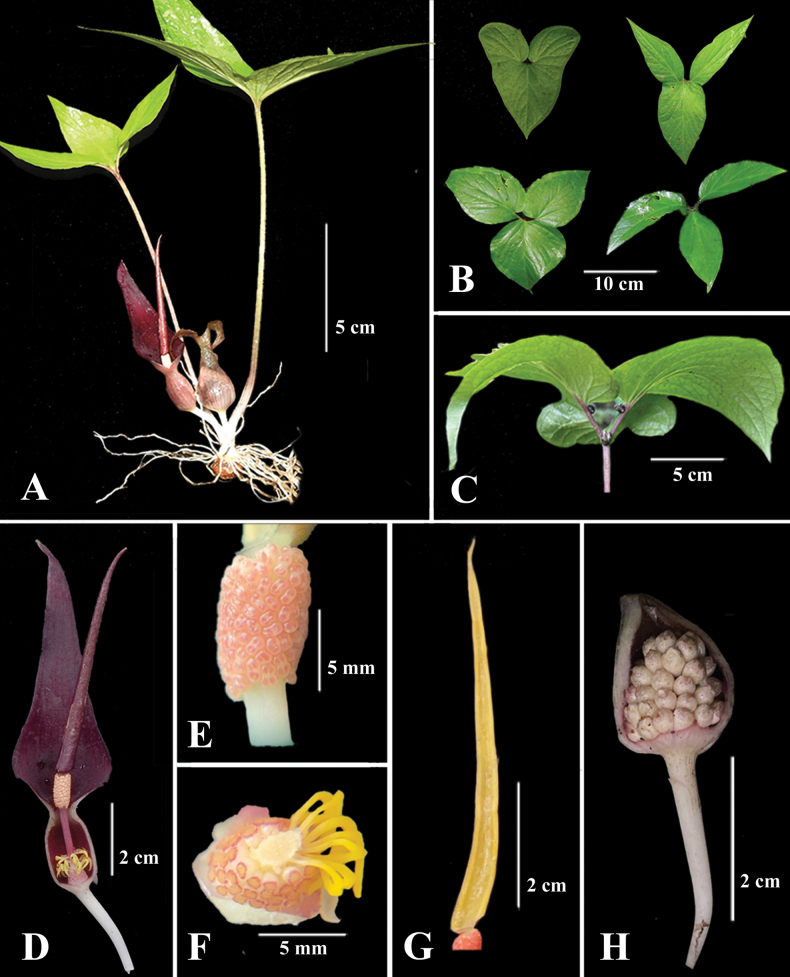 Figure 1
|
|
|
|
|
| |
|---|---|---|---|---|---|
|
| 10–24 cm | 15–30 cm | - | 10–45 cm | 10–35 cm |
|
| hastate or tri-lobed or trifoliolate, entire, 5–11 × 2–12 cm | triangular hastate, sagittate or cordate, mid lobe 5–8 × 3–6 cm | narrowly ovate-elliptic to elliptic, 4–25 × 1.5–4 cm | ovate to triangular or hastate, entire, 8 × 2 cm long | hastate, triangular, shallowly or deeply tri-lobed, 5–17 × 4–14 cm |
|
| globose, black on the top of the petiole and leaves base | globose to linear bulbils | present on the apex of the leaf | absent | absent |
|
| 6.5–9.5 cm long, sessile, as long as spathe limb | slender, as long as spathe | as long as spathe | 4.3–9 cm long, shorter than spathe limb | subequaling the spathe |
|
| 2.7–7.7 cm long, dark-reddish purple, usually sessile, base obliquely truncate, apex acute | 7–14 cm long, | 3.6–7.7 cm long, brick orange-colored, base not truncate | 4–6 cm long, yellow, yellowish-brown, subsessile, base truncate | 12–15 cm, narrowly conical, dark purple, truncate, pale red stipe |
|
| ovoid to cylindrical, 1–1.5 cm long, 1–1.7 cm in diameter, outside grayish pink, inside reddish purple | oblong, 1–2 cm long. | 1.2 × 1 cm long | ovoid, 2 cm cm long, 1.5 cm wide, greenish inside and outside | - |
|
| narrowly triangular, 4.5–10.5 × 1–3 cm, grayish pink outside, dark reddish purple inside, acute apex | linear-lanceolate, 7–16 × 2–4 cm, hyaline or pale rose, acuminate at apex | narrowly triangular-ovate, 5–9 × 3 cm, dark reddish purple to purplish brown, apex acuminate, upright or recurved, and curled apically | narrowly ovate to lanceolate, 9–10 × 4.5 cm, greenish (light purple outside), green with dark purple streaks and spots inside, apex acute to acuminate | broadly triangular-ovate, 13–15 × ca. 5 cm, purple or purple mixed with a dirty green flush outside, inside deep rich purple, usually twisted apex |
|
| coral pink to sandy brown | - | creamy white | pale yellow | yellow |
|
| thick sickle-shaped, arranged in three whorls, half-length curved downwards, acute tip | acinaciformis, curved, uniseriate | cylindrical, spreading, obtuse tip | filiform, horizontally spread and slightly curved, bifurcated pointed or entire tip | filiform, weakly papillose, arranged in 3 whorls, horizontally spread, pointing downward, acute tips |
Peer Reviews
No public reviews on file for this paper yet. If you reviewed it on a platform where reviews are public (OpenReview, ICLR, NeurIPS, ICML), you can paste yours below so the community can read it here.
Videos
No videos yet. Explain this paper in a talk, walkthrough, or lecture? Add one.
Taxonomy
TopicsPlant Taxonomy and Phylogenetics · Plant tissue culture and regeneration · Plant and Biological Electrophysiology Studies
Introduction
The moderately species-rich aroid genus Typhonium Schott is expected to comprise around 100 species (Hetterscheid and Sookchaloem 2012), of which 72 species currently have accepted names, according to Plants of the World Online (POWO 2024). Phylogenetic studies have confirmed the placement of this genus in the tribe Areae, belonging to the subfamily Aroideae (Zhao et al. 2023). The genus is widely distributed across tropical to subtropical Asia, extending from the central Himalayas to New Guinea and Australia. More than half of the currently accepted Typhonium species are found in the Indochina region (Pham et al. 2023). Due to the high diversity and endemism of the genus in the Indochina region, it has long been considered the center of origin for the genus Typhonium. This is further supported by a recent biogeographic reconstruction study by Low et al. (2020), which suggests a middle to early Miocene origin (approximately 17.24 Ma) of the genus in the Indochina region. Within this region, the highest diversity (33 species) and endemism (23 species) are found in Thailand (Hetterscheid and Sookchaloem 2012; Sookchaloem and Maneeanakekul 2018). This center of biodiversity likely harbors several undiscovered species, as indicated by the recent discovery of Typhoniumhangiae V.D.Nguyen, D.D.Nguyen & V.C.Nguyen and Typhoniumobtusum Luu, X.B. Nguyen-Le & H.C. Nguyen in Vietnam (Pham et al. 2023; Luu et al. 2024). Given the known distribution of the genus, only a few species are found in the Himalayas. For example, only one species, Typhoniumtrilobatum (L.) Schott, has been reported in Nepal (Shrestha et al. 2022). As the northwestern distribution border of the genus, Nepal stands out as an important area for studying the diversity of Typhonium.
As part of our ongoing efforts to document the diversity of Araceae in Nepal, field surveys were conducted in the tropical forests of Eastern Nepal (Rajapaksha et al. 2023; Rai et al. 2024). In early 2024, a population of small aroids with 2–5 hastate to trilobate leaves and a pinkish-brown inflorescence was encountered. At first glance, these plants resembled the widespread T.roxburghii Schott or the more narrowly distributed T.inopinatum Prain, known to occur in India, Myanmar, and Thailand, due to the shape of their leaves, the inner color of the spathe, and the appearance of the spadix. However, detailed morphological examinations revealed these plants to be distinct from these two species and any previously described species. Thus, we introduce these plants as a new species endemic to Eastern Nepal.
Materials and methods
To provide detailed information about the plant, we observed several individuals across different patchy stands. Mature individuals were collected to be deposited as herbarium specimens, while some inflorescences were preserved as pickled samples for further study. The morphometric study included a total of 20 individuals. Measurements of various parts of the living plants were taken in the field and photographs were captured using a Nikon Coolpix P900 camera. Micro-morphological measurements of flower parts of the specimens were examined using a dissection microscope. The images of these structures were taken using a mobile phone camera. Relevant literature was consulted to compare the morphology with closely related species and other species of the genus found in neighboring countries (Murata et al. 2010; Hetterscheid and Sookchaloem 2012; Venu and Rao 2014; Nirola and Das 2014; Manudev and Nampy 2022; Pham et al. 2023). Images of Typhonium specimens available in virtual herbaria and databases, including KATH (http://plantdatabase.kath.gov.np), CAL, ARUN, BM, P, PE (http://www.cvh.ac.cn), US, and others accessible through https://www.gbif.org and https://plants.jstor.org, were also examined (herbarium acronyms follow Thiers 2024). In addition to studying images of type specimens and protologs, the morphological characterization of putatively related species was based on descriptions provided by Li and Hetterscheid (2010) for T.roxburghii; King and Prain (1898), Venu and Rao (2014), and Luu et al. (2024) for T.inopinatum; Manudev and Nampy (2022) for T.bulbiferum Dalzell; and Murata et al. (2010) for T.cordifolium S.Y.Hu.
Taxonomic treatment
Typhonium
morangense
Taxon classificationPlantaeAlismatalesAraceae
R.Ojha & S.Rai sp. nov.
5D16B807-328C-5DD5-BAB3-0A90CF90306A
urn:lsid:ipni.org:names:77355953-1
Type.
NEPAL, Koshi Province, Morang District, Pathari Shanishchare Municipality; 26°39'59"N, 87°33'29"E; ca.150 m; 2024.06.03; Sudeep Rai MP011 [holotype KATH! isotypes KATH! [MP012], TUCH!, TURH!].
Typhoniummorangense sp. nov. A whole plant B different forms of leaf blade C bulbils D inflorescence E male zone F female zone and staminodes G longitudinal section of appendix H fruits.
Diagnosis.
Typhoniummorangense is morphologically closely related to T.inopinatum but it differs significantly from the latter species in having (1) smaller habit, 10–24 cm height (vs. 10–45 cm in T.inopinatum); (2) globose bulbils on top of petiole and leaves (vs. bulbils absent); (3) a sessile appendix (vs. subsessile); (4) thick, sickle-shaped staminodes (vs. filiform); (5) staminodes half curved downwards (vs. horizontally spread or, slightly curved); (6) ovary white (vs. yellowish) and (7) stigma pink (vs. yellow).
Description.
Seasonally dormant small herb, 10–24 cm tall; Tuber 0.8–2 cm long, 1–2 cm diameter, upright, sub-globose to sub-cylindrical with many filiform roots, without rhizomatous offsets. Leaves 2–5 together; petiole 10–23 cm long, light brown, grayish brown at base to light green at apex, globose black bulbil on the top of petiole. Leaf blade entire, hastate or shallowly or deeply tri-lobed or trifoliolate, glabrous, adaxially green, abaxially lighter green, 5–11 cm long, 2–7 cm wide when hastate, 10–12 cm when deeply trilobed, globose black bulbil on the basal margin of the leaf. Inflorescence solitary, usually 1–2 together, shorter than petiole; peduncle subterranean, white, 1.2–3.8 cm long; spathe 5.5–12 cm long, tube and limb separated by a constriction, grayish pink outside, inside dark reddish purple color; spathe tube ovoid to cylindric, 1–1.5 cm long, 1–1.7 cm diameter, outside grayish pink, inside reddish purple; spathe limb narrowly triangular, 4.5–10.5 cm long, 1–3 cm wide, smoothly tapering from below middle, apex acute; spadix 6.5–9.5 cm long, as long as spathe or slightly longer, sessile; female zone conical, 2–6 mm long, 4–5 mm diameter at the base, slightly pink, ovary unilocular, white with one dark yellow basal ovule, style absent, stigma sessile, disc shape with dark pink over the periphery; staminodes arranged in three whorls, free at the base, thick sickle-shaped, half-length curved downwards, yellow, glabrous, cover 1/3^th^ of the female zone; male zone 5–8 mm long, 3–5 mm diameter, cylindrical, stamens congested, thecae two, irregular, coral pink to sandy brown color with apical short slits or pores; appendix usually sessile, 2.7–7.7 cm long, narrowly elongated conical, dark reddish purple, base obliquely truncate, top acute, inside semisolid. Fruits ovoid to capsule-shaped, 0.2–0.3 cm diameter, 0.3–0.4 cm long, slightly light green at initial stages while turning white after maturity.
Phenology.
Flowering in May to June, fruiting July to August.
Etymology.
The specific epithet is based on the locality of its discovery, the Morang district of Eastern Nepal.
Distribution and habitat.
The new species is known from Pathari Shanishchare municipality, Morang district, growing under the canopy of dense Shorearobusta Gaertn. forest at ca. 150 m asl. This species prefers moist shady floors under the dense canopy of forest.
Uses.
No reports for utilization by the local human population are known.
Conservation status.
The new species has been recorded only from its type locality, where it forms patchy stands of approximately 150 individuals. However, it is highly likely to be present in similar nearby habitats. Together with the type locality, these undiscovered sites are expected to contain several hundreds of individuals. Until further investigation, the species is provisionally designated as “Data Deficient” (DD) following the IUCN standards (IUCN 2024). Conservation biologists active in Eastern Nepal may want to consider this species as requiring attention, as it is a local endemic known only from this region.
Taxonomic notes.
The hastate leaf shape, small inflorescence size, and presence of a few staminodes are shared characteristics between Typhoniuminopinatum and T.morangense. However, apart from key differences presented in diagnosis, T.morangense can be distinguished from T.inopinatum by the color of the spathe (grayish pink outside and reddish purple inside vs. basally brownish, apically green), the color of appendix (reddish purple vs. yellow, yellowish-brown), the length of the spadix (as long as or slightly longer than the spathe vs. shorter than the spathe), the female flowers (without style vs. with style). T.morangense also shares several similarities with T.roxburghii, in the habit and the color of spathe. However, T.morangense differs from T.roxburghii in several characteristics: the size of the inflorescence (spathe limb 4.5–10.5 × 1–3 cm vs. 13–15 × ~5 cm; appendix 2.7–7.7 cm vs. 12–15 cm), the arrangement of the staminodes (arranged in three whorls vs. more than three whorls; half-length curved downward vs. only the tips pointing downward), the appendix (sessile vs. stipitate), the shape of the ovule (ellipsoid vs. ovoid), and the color of the stigma (pink vs. purple). Although T.inopinatum and T.roxburghii share several similar characters with T.morangense, neither has bulbils.
Bulbils have also been reported in the Indian endemic T.bulbiferum and T.cordifolium distributed in Myanmar, Thailand, Vietnam, and Cambodia (Nguyen et al. 2022). These two species differ from T.morangense by having triangular to sagittate or cordate leaves in T.bulbiferum and ovate to elliptic leaves in T.cordifolium (vs. hastate, tri-lobed, or trifoliolate leaves in T.morangense). Additionally, T.bulbiferum has a linear-lanceolate, pale rose spathe with an acuminate apex, and T.cordifolium has a narrowly triangular-ovate, dark reddish-purple to purplish spathe with an acuminate and apically curled apex (vs. narrowly triangular, grayish-pink spathe with a dark reddish-purple interior and an acute apex in T.morangense).
It is noted that a plant from India with globose bulbils on the lower leaf margin and the petiole apex, which was identified as T.roxburghii by Nirola and Das (2014), was recently confirmed to be a misidentification (Manudev and Nampy 2022). This indicates uncertainty in identification due to the presence of bulbils.
A comprehensive morphological comparison of the new species with these related species is presented in Table 1.
For now, the new species is considered endemic to Nepal, but further research is necessary to confirm its distribution range, particularly the potential occurrence in India. Special attention should be given to critically studying specimens with globose bulbils.
Supplementary Material
XML Treatment for Typhonium morangense
The reference list from the paper itself. Each links out to its DOI / PubMed record.
- 1Hetterscheid WLA Sookchaloem D (2012) Typhonium. In: Santisuk T Larsen K (Eds) Flora of Thailand, Vol.11 Part 2, Acoraceae and Araceae. The Forest Herbarium, Department of National Parks, wildlife and Plant Conservation, Bangkok, 298–321.
- 2IUCN (2024) Guidelines for using IUCN Red List Categories and Criteria, Version 16. Prepared by the Standards and Petitions Committee of the IUCN Species Survival Commission. https://www.iucnredlist.org/documents/Red List Guidelines.pdf
- 3King G Prain D (1898) Descriptions of some new plants from the north-eastern frontiers of India.Journal of the Asiatic Society of Bengal 67: 284–305.
- 4Li H Hetterscheid WLA (2010) Typhonium. In: Wu ZY Raven PH Hong DY (Eds) Flora of China, Vol.23. Beijing and St. Louis: Science Press and Missouri Botanical Garden Press, 34–36.
- 5Low SL Yu CC Ooi IH Eiadthong W Galloway A Zhou ZK Xing YW (2020) Extensive Miocene speciation in and out of Indochina: The biogeographic history of Typhoniumsensu stricto (Araceae) and its implication for the assembly of Indochina flora.Journal of Systematics and Evolution 59(3): 419–428. 10.1111/jse.12689 · doi ↗
- 6Luu HT Nguyen-Phi N Nguyen QD Nguyen HC Van HT Nguyen-Le XB (2024) A new species of Typhonium (Araceae) from Vietnam.Phyto Keys 238: 119–126. 10.3897/phytokeys.238.11297338406663 PMC 10892196 · doi ↗ · pubmed ↗
- 7Manudev KM Nampy S (2022) Taxonomic identity of Typhoniumroxburghiivar.longispathum (Araceae) and notes on the extended distribution of T.bulbiferum.Rheeda 32(1): 55–58. 10.22244/rheedea.2021.32.01.05 · doi ↗
- 8Murata J Ohi-Toma T Tanaka N (2010) New or noteworthy plant collections from Myanmar (4): Typhoniumcordifolium and two new species, T.neogracile and T.praecox (Araceae).Shokubutsu Kenkyu Zasshi 85(1): 1–7.