Tiliasaxatilis (Malvaceae), a new species from limestone areas of Guangxi, China

Abstract
Genes, proteins, chemicals, diseases, species, mutations and cell lines named across the full text — each resolved to its canonical identifier and authoritative record.
Click any figure to enlarge with its caption.
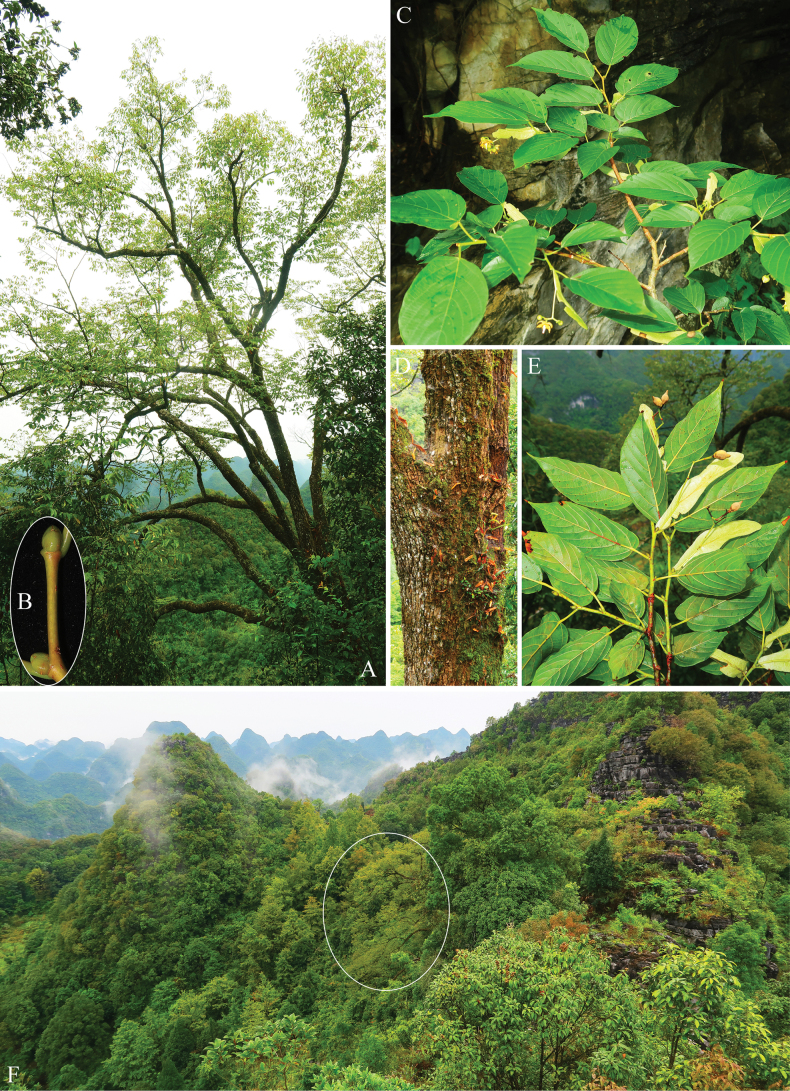 Figure 1
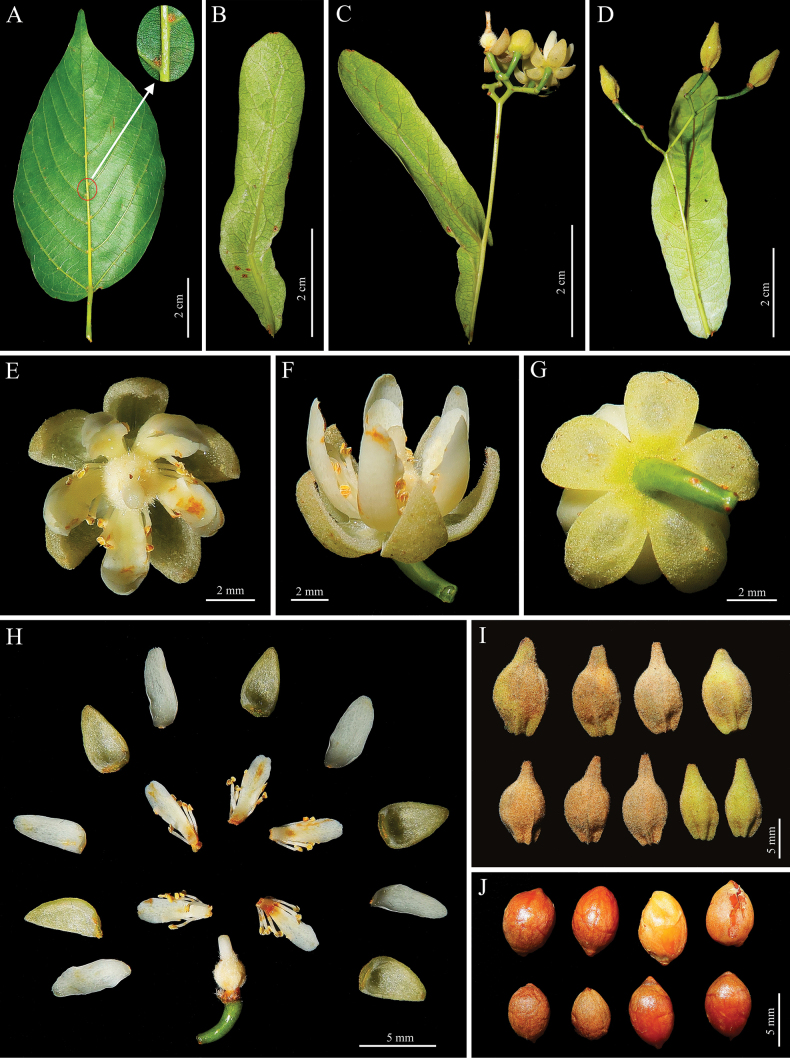 Figure 2
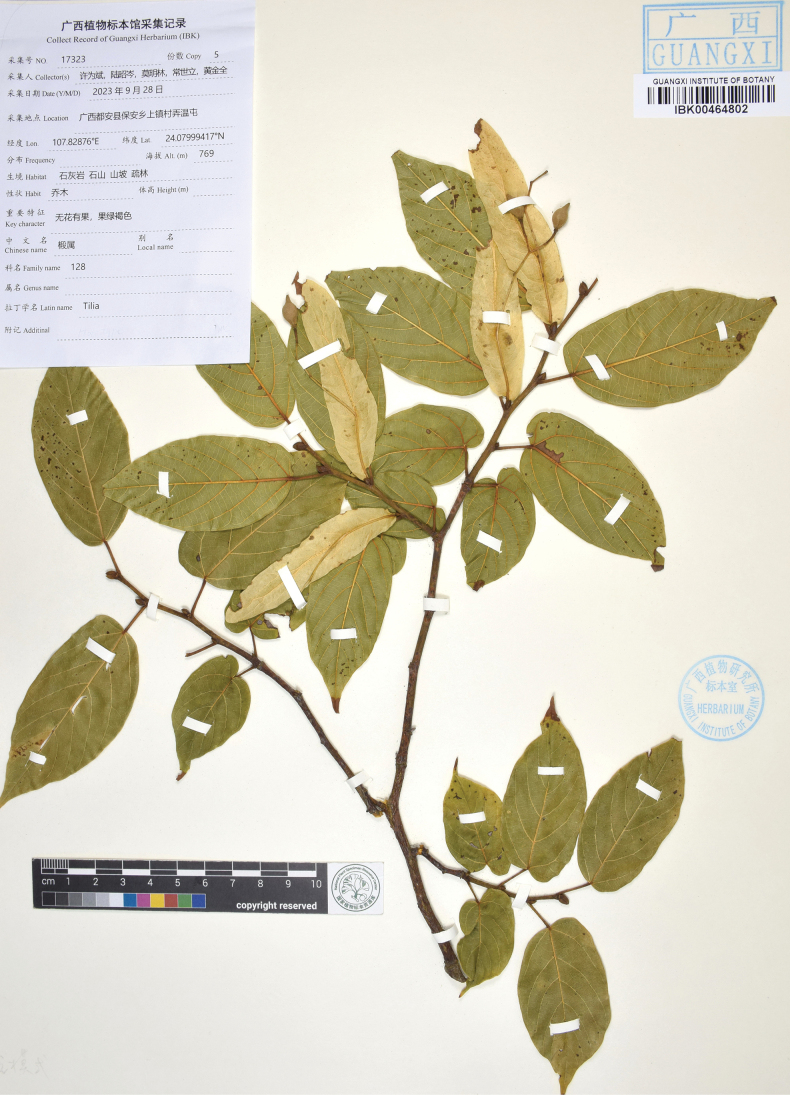 Figure 3
| Characters |
|
|
|---|---|---|
| Branchlets | Glabrous | Glabrous or tomentose |
| Leaf blades | Oblong or ovate-oblong, margin entire | Narrowly ovate or ovate-oblong to ovate-orbicular, margin entire or with a few minute teeth near apex or prominently dentate |
| Cymes | 5–16-flowered, 3.5–6 cm long | 3–22-flowered, 5–14 cm long |
| Bracts | 3.8–9 cm long, 1–2 cm wide, sessile | 6–16 cm long, 1–3 cm wide, sessile or with stalks 5–8 mm long |
| Pedicel | 2–4 mm long | 4–9 mm long |
| Fruit | Ellipsoid, 5-angled, apex acute | Globose or obovoid-globose, not ridged, apex rounded |
Peer Reviews
No public reviews on file for this paper yet. If you reviewed it on a platform where reviews are public (OpenReview, ICLR, NeurIPS, ICML), you can paste yours below so the community can read it here.
Videos
No videos yet. Explain this paper in a talk, walkthrough, or lecture? Add one.
Taxonomy
TopicsPlant and Fungal Species Descriptions · Plant Diversity and Evolution · Plant Ecology and Taxonomy Studies
Introduction
The genus Tilia L. with 23–40 species in the family Malvaceae is distributed in Europe, North America and East Asia where in occurs primarily in temperate and subtropical regions (Zhuge and Tang 1995; Tang and Zhuge 1996; Pigott 2002; Tang et al. 2007; Pigott 2012). Tilia is easily recognised by its unique tongue-like bracts adnate to the peduncle of the inflorescence and leaf blades base oblique (Chang 1989; Tang et al. 2007).
The genus Tilia was firstly described by Linnaeus (1753) in the "Species Plantarum" and the earlier taxonomic treatments mainly focused on European and American species. Chang (1989) presented a comprehensive treatment of Chinese Tilia in the "Flora Republicae Popularis Sinicae", which included a key and descriptions of 32 species. Pigott (2012) provided a very comprehensive taxonomic treatment of Tilia in his monograph, accepted 23 species, of which two species were in North American, four species ranging from Europe to West Asia and 17 species in East Asia and also confirmed China is the centre of species diversity for the genus Tilia, with 15 species (11 endemic).
During the investigation of plant diversity in the assessment area of Southwest Karst National Park (which is currently being prepared) in July, September and October 2023, we collected a species of Tilia with flowers and mature fruits from limestone forests in Dahua County and Du’an County, Hechi City, Guangxi, China. After carefully checking the morphological characters of the specimens, comprehensively consulting relevant literature (Chang 1989; Zhuge and Tang 1995; Tang and Zhuge 1996; Pigott 2002; Tang et al. 2007; Pigott 2012), consulting herbarium specimens and examining the other related species of Tilia, we confirmed it is a new species. It is described below.
Materials and methods
Specimens of this new species were collected from Dahua County and Du’an County, Hechi City, Guangxi, China. After that, we carefully studied relevant literature and the morphological characters of the specimens, which involved measuring and recording the size, shape and colour of bark, branchlets, winter buds, leaves, cymes, bracts, pedicel, sepals, petals, stamens, ovary, fruit, seeds and so on. We examined herbarium specimens at BJFC, IBK, IBSC, IFP, HIB, KUN, PE and WUK (Herbarium codes follow Thiers 2024). The other related species of Tilia were examined in online images from the Chinese Virtual Herbarium (https://www.cvh.ac.cn/), JSTOR Global Plants (https://plants.jstor.org/) and Kew Herbarium Catalogue (http://apps.kew.org/herbcat/gotoHomePage.do). The morphological description for the new species is based on the cited type specimens (holotype, isotypes and paratypes) below and general terminology follows the "Flora of China" (Tang et al. 2007).
Taxonomic treatment
Tilia
saxatilis
Taxon classificationPlantaeMalvalesMalvaceae
Z.C.Lu & W.B.Xu sp. nov.
F6CAD151-C840-54CF-8014-305006360C57
urn:lsid:ipni.org:names:77355914-1
Figs 1 , 2 , 3 Chinese name: shí shān duàn (石山椴)
Diagnosis.
This new species is similar to Tiliatuan Szyszyl., but differs in having leaf blades that are oblong or ovate-oblong (vs. narrowly ovate or ovate-oblong to ovate-orbicular), margins entire (vs. entire or with a few minute teeth near apex or prominently dentate); fruit ellipsoid (vs. globose or obovoid-globose), 5-angled (vs. not ridged), apex acute (vs. rounded).
Tiliasaxatilis sp. nov. A habit B winter buds C flowering branches D trunk E fruiting branches F habitat (White circle shows where the new species grow).
Type.
China • Guangxi: Hechi City, Du’an County, Bao’an Town, Shangzhen Village, Nongwen, around the point 24.07999417°N, 107.82876°E, limestone slope, alt. 769 m, 28 September 2023, W. B. Xu, Z. C. Lu, M. L Mo, S. L. Chang & J. Q. Huang 17323 (holotype: IBK00464802; isotypes: IBK00464803, IBK00464804, IBSC, PE).
Description.
Trees 5–15 m tall, DBH 10–80 cm. Bark dark grey; branchlets glabrous; winter buds ovoid, glabrous or slightly hairy at tip. Petiole 0.8–2 cm long, glabrous; leaf blades oblong or ovate-oblong, (3.5–)4.5–10(–14.4) cm long, 2–5.5(–6.2) cm wide, thickly papery, glabrous on both sides, with brown tuft domatia in vein axils of abaxial surface, lateral veins 7–8 pairs, raised on abaxial surface, reticulate veins distinct abaxially, base oblique, truncate or cordate, margins entire, apex acuminate. Cymes 5–16-flowered, 3.5–6 cm long, peduncles glabrous. Bracts narrowly oblong, 3.8–9 cm long, 1–2 cm wide, adnate to peduncle for 1/3–2/5 of its length, glabrous or adaxially slightly hairy along mid-vein, apex obtuse, sessile. Pedicels 2–4 mm long, glabrous. Sepals 5, ovate, 4.5–5 mm long, abaxially tomentose, adaxially tomentose or with long tomentose at base. Petals oblong, 5–6 mm long, glabrous. Stamens ca. 2 mm long, glabrous; staminodes 5, slightly smaller than petals, glabrous. Ovary densely tomentose; style 1–2 mm long, glabrous. Fruit ellipsoid, 5-angled, 8–12 mm long, 5–6 mm wide, densely appressed tomentose, apex acute; exocarp woody, hard, indehiscent. Seed ellipsoid, ca. 5 mm long.
Tiliasaxatilis sp. nov. A leaf in abaxial view (Red circle shows tuft domatia in vein axils) B bract in abaxial view C bract and cyme D bract and infructescence E flower in frontal view F flower in lateral view G flower in dorsal view H dissection of flower I fruits J seeds.
Etymology.
The specific epithet ‘saxatilis’ refers to the limestone habitats of this new species.
Phenology.
Flowering July and fruiting from September to October.
Distribution and habitat.
Tiliasaxatilis has only been collected from five localities restricted to central Guangxi of China. It grows sporadically in forests on limestone slopes, rare on peaks, at an elevation of 700–950 m. The type localities are typical limestone karst landform and belong to the southern subtropical monsoon climate areas, the average annual temperature being 18–21 °C; the annual sunshine duration is 1220–1590 hours and the annual accumulated temperature is about 6300 °C; the annual average relative humidity is 74–80%; the average annual rainfall is 1250–1680 mm and the evaporation is 1210–1650 mm.
The holotype sheet of Tiliasaxatilis (IBK).
Conservation status.
The new species has been found in two localities in Du’an County and three localities in Dahua County, Guangxi, China. These five localities are in the assessment area of Southwest Karst National Park, which is currently being prepared. The extent of occurrence is about 960 km^2^ (< 5000 km^2^) and its occupancy area is predicted to continuously decline in the future due to grazing and firewood collection by local people. Therefore, according to the IUCN Red List Categories and Criteria (IUCN Standards and Petitions Committee 2022), Tiliasaxatilis should be considered in the Endangered (EN) [B1ab(iii)] category at present.
Additional specimens examined (paratypes).
China • Guangxi: Dahua County, Qibainong Town, Nonghe Village, Nongge, around the point 24.121001°N, 107.727671°E, limestone slope; alt. 880 m; 19 July 2023; W. B. Xu, Z. C. Lu, M. L Mo, S. L. Chang & J. Q. Huang 16285 (IBK, KUN, PE) • ibid.; 19 July 2023; W. B. Xu, Z. C. Lu, M. L Mo, S. L. Chang & J. Q. Huang 16312 (IBK, CSH, IBSC) • Du’an County, Bao’an Town, Shangzhen Village, Nongwen, around the point 24.07999417°N, 107.82876°E, limestone slope; alt. 769 m; 28 September 2023; W. B. Xu, Z. C. Lu, M. L Mo, S. L. Chang & J. Q. Huang 17300 (IBK) • ibid.; 28 September 2023; W. B. Xu, Z. C. Lu, M. L Mo, S. L. Chang & J. Q. Huang 17301 (IBK, GXMG, GXMI) • ibid.; 28 September 2023; W. B. Xu, Z. C. Lu, M. L Mo, S. L. Chang & J. Q. Huang 17302 (IBK, GXMI) • ibid.; 28 September 2023; W. B. Xu, Z. C. Lu, M. L Mo, S. L. Chang & J. Q. Huang 17303 (IBK, GXMG, CSH) • ibid.; 28 September 2023; W. B. Xu, Z. C. Lu, M. L Mo, S. L. Chang & J. Q. Huang 17322 (IBK, PE, KUN) • Du’an County, Bao’an Town, Yuanli Village, Nongkou, around the point 24.10944°N, 107.811669°E, limestone slope; alt. 860 m; 30 September 2023; W. B. Xu, Z. C. Lu, M. L Mo, S. L. Chang & J. Q. Huang 17367 (IBK) • ibid.; 30 September 2023; W. B. Xu, Z. C. Lu, M. L Mo, S. L. Chang & J. Q. Huang 17368 (IBK) • Dahua County, Bansheng Town, Nongcong Village, Nongji, around the point 24°13′21.75″N, 107°45′25.99″E, limestone slope; alt. 936 m; 1 October 2023; W. B. Xu, Z. C. Lu, M. L Mo, S. L. Chang & J. Q. Huang 17403 (IBK) • Dahua County, Qibainong Town, Nongjing Village, Baxiang, around the point 24.088763°N, 107.773282°E, limestone peak; alt. 920 m; 4 October 2023; W. B. Xu, Z. C. Lu, M. L Mo, S. L. Chang & J. Q. Huang 17503 (IBK).
Notes.
Tiliasaxatilis has glabrous branchlets, leaf blades base oblique, truncate or cordate, abaxially hairy only in vein axils, bracts narrowly oblong, adnate to inflorescence peduncle, sessile, staminodes 5 and fruits indehiscent. Based on these morphological characters, T.saxatilis is similar to T.tuan (Tang et al. 2007), but differs from the latter in having leaf blades that are oblong or ovate-oblong, margin entire, fruit ellipsoid, 5-angled, apex acute. The morphological differences between T.saxatilis and T.tuan are shown in Table 1.
In addition, several schemes for subdividing the genus Tilia have been described (Chang 1989; Zhuge and Tang 1995; Pigott 2012) and, according to the different morphological characteristics, T.saxatilis would be placed in different position. Chang (1989) gave two sections for Tilia in the "Flora Republicae Popularis Sinicae"; T.saxatilis would be placed in the sect. Tilia L. based on the fruit indehiscent when dry. Zhuge and Tang (1995) divided Tilia into three sections; T.saxatilis would be placed in the sect. Lindnera Reichb. based on the woody fruit exocarp. In Pigott’s (2012) monograph, the genus Tilia was divided into four sections; T.saxatilis would be placed in the section Astrophilyra V. Engler based on the leaf blades upper surface green, glabrous, lower surface pale green, hairy only in vein axils, fruits not splitting, flowers with staminodes.
Supplementary Material
XML Treatment for Tilia saxatilis
The reference list from the paper itself. Each links out to its DOI / PubMed record.
- 1Chang HT (1989) Tilia. In: Chang HT Miau RH (Eds) Flora Republicae Popularis Sinicae.Vol. 49 (1). Science Press, Beijing, 51–76.
- 2IUCN Standards and Petitions Committee (2022) Guidelines for using the IUCN Red List Categories and Criteria. Version 16. Prepared by the Standards and Petitions Committee of the IUCN Species Survival Commission. https://www.iucnredlist.org/resources/redlistguidelines [accessed on 13 November 2024]
- 3Linnaeus C (1753) Species Plantarum I.Imprensis Laurentii Salvii, Stockholm, 514 pp.
- 4Pigott CD (2002) A review of chromosome numbers in the genus Tilia (Tiliaceae).Edinburgh Journal of Botany,59(2): 239–246. 10.1017/S 0960428602000057 · doi ↗
- 5Pigott CD (2012) Lime-trees and basswoods: A biological monograph of the genus Tilia. Cambridge University Press, Cambridge, 45–247. 10.1017/CBO 9781139033275 · doi ↗
- 6Tang Y Zhuge R (1996) Geographical distribution of Tilia L.Acta Phytotaxonomica Sinica,34(3): 254–264.
- 7Tang Y Gilbert MG Dorr LJ (2007) Tilia. In: Wu ZY Raven PH Hong DY (Eds) Flora of China.Vol. 12. Science Press, Beijing and Missouri Botanical Garden Press, St. Louis, 240–248.
- 8Thiers B (2024) Index Herbariorum: A global directory of public herbaria and associated staff. New York Botanical Garden’s Virtual Herbarium. http://sweetgum.nybg.org/science/ih/ [accessed 12 November 2024]