Improving the diagnostic of absorptive hypercalciuria: a comparative analysis of calcium load tests at 2-hour and 4-hour intervals
Lara Cabezas, Pierre Letourneau, Aurélie De Mul, Justine Bacchetta, Laurence Chardon, Laurence Derain Dubourg, Sandrine Lemoine

TL;DR
This study shows that a 4-hour calcium load test is more effective than a 2-hour test for diagnosing absorptive hypercalciuria.
Contribution
The study demonstrates that extending the calcium load test to 4 hours significantly improves the detection of absorptive hypercalciuria.
Findings
The 4-hour CLT diagnosed 25.6% more cases of absorptive hypercalciuria compared to the 2-hour CLT.
The urinary calcium/creatinine ratio increased significantly after 4 hours of calcium ingestion.
Patients diagnosed at 4 hours showed similar clinical and biological profiles to those diagnosed at 2 hours.
Abstract
The calcium load test (CLT) was developed by Pak et al. in 1974 to better discriminate hypercalciuria. Absorptive hypercalciuria (AH) is defined by an increase of the difference between urinary calcium/creatinine ratio (ΔUCa/Cr) of more than 0.5 mmol/mmol with a 4-hour CLT. In clinical practice and more recent studies, CLT is a 2-hour test. We hypothesized that the 4 h timepoint is more efficient in AH diagnosis. We report a single-centre retrospective study including all patients who underwent CLT because of hypercalciuria or hyperparathyroidism. After a 3-day low-calcium diet and a 12-hour fast, 24-hour urines were collected. Blood and urinary samples were done at arrival and after 2 h and 4 h of oral ingestion of 1 g of calcium. AH was diagnosed by ΔUCa/Cr between baseline and 2 h or 4 h of more than 0.05 mmol/mmol. We included 328 patients. Baseline UCa/Cr ratio was 0.3 ± 0.2…
Genes, proteins, chemicals, diseases, species, mutations and cell lines named across the full text — each resolved to its canonical identifier and authoritative record.
Click any figure to enlarge with its caption.
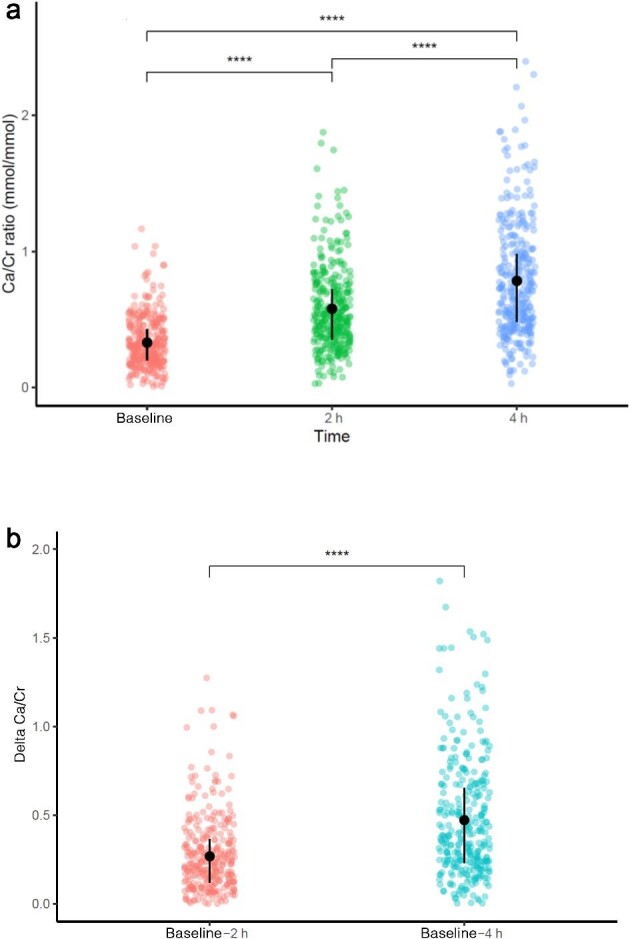 Figure 1
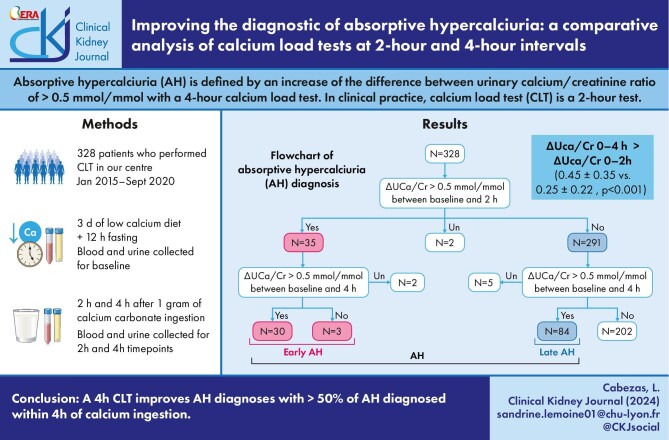 Figure 1
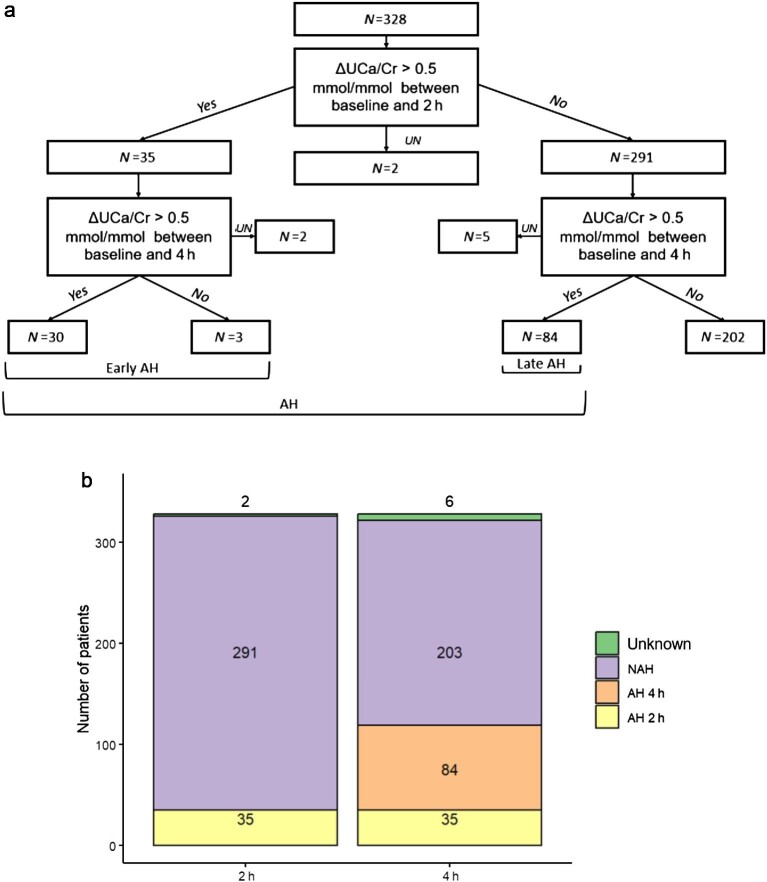 Figure 2
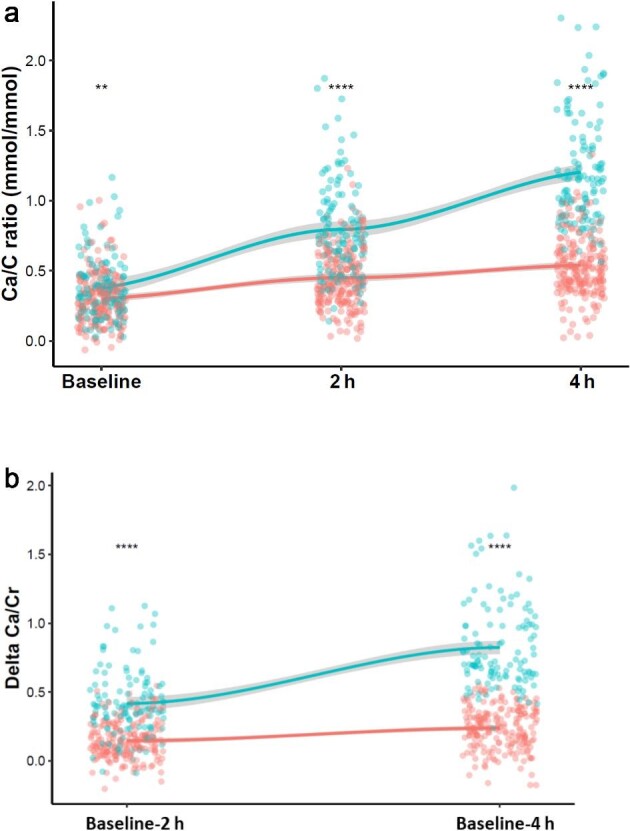 Figure 3
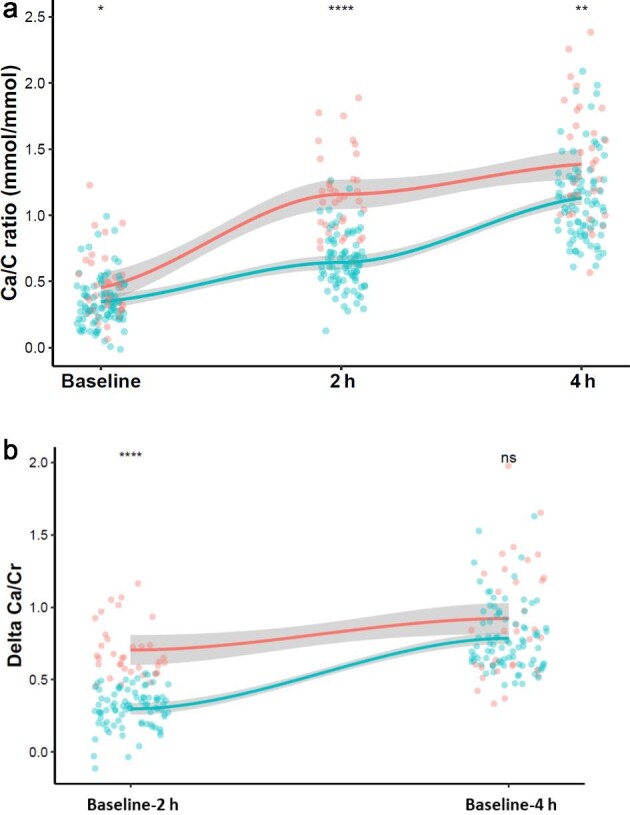 Figure 4
Peer Reviews
No public reviews on file for this paper yet. If you reviewed it on a platform where reviews are public (OpenReview, ICLR, NeurIPS, ICML), you can paste yours below so the community can read it here.
Videos
No videos yet. Explain this paper in a talk, walkthrough, or lecture? Add one.
Taxonomy
TopicsKidney Stones and Urolithiasis Treatments · Poisoning and overdose treatments · Potassium and Related Disorders