Feasibility and Applicability of Implementing the Framework for Comprehensive Understanding of Structural Stigma in Mental Healthcare Systems: A Case Example of Nepal
Dristy Gurung, Bhawana Subedi, Binita Acharya, Mani Neupane, Brandon A. Kohrt, Graham Thornicroft, Petra C. Gronholm

TL;DR
This study evaluates a framework for measuring structural stigma in Nepal's mental healthcare system, finding it feasible but needing refinement for better clarity and comparison.
Contribution
The study demonstrates the feasibility of applying a structural stigma measurement framework in a low-resource mental healthcare setting.
Findings
Most indicators were rated as yellow or red, indicating mid to high structural stigma in Nepal's mental healthcare system.
Stakeholders found the framework acceptable but noted challenges with indicator clarity and the three-color rating system.
Engaging stakeholders and adapting the framework to the local context are essential for successful implementation.
Abstract
Mental health‐related structural stigma is a multifaceted issue that significantly impacts access to quality mental healthcare, particularly in low‐resource settings like Nepal. Therefore, there is a clear need to understand the complexities and identify gaps for targeted interventions through evaluations of various dimensions of structural stigma within healthcare systems. This study aimed to assess the feasibility and applicability of a mental health‐related structural stigma measurement framework through its implementation in Nepal's healthcare system. A mixed‐methods approach was employed, involving data mapping, key informant interviews and rating exercises with diverse stakeholders, including policymakers, health workers and people with lived experience (PWLEs). A visual analogue scale or Red/Amber/Green (RAG) rating scale was used to rate each indicator within the framework for…
Genes, proteins, chemicals, diseases, species, mutations and cell lines named across the full text — each resolved to its canonical identifier and authoritative record.
Click any figure to enlarge with its caption.
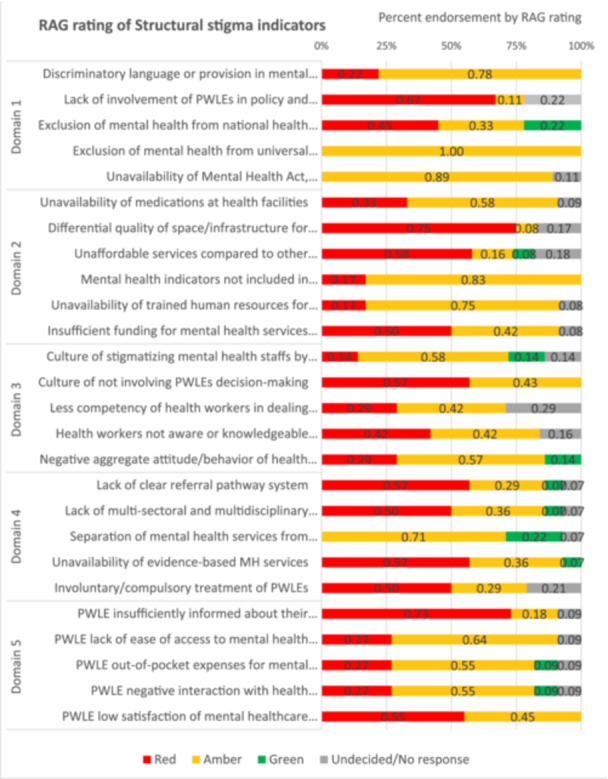 Figure 1
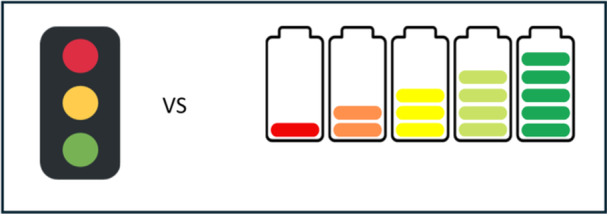 Figure 2
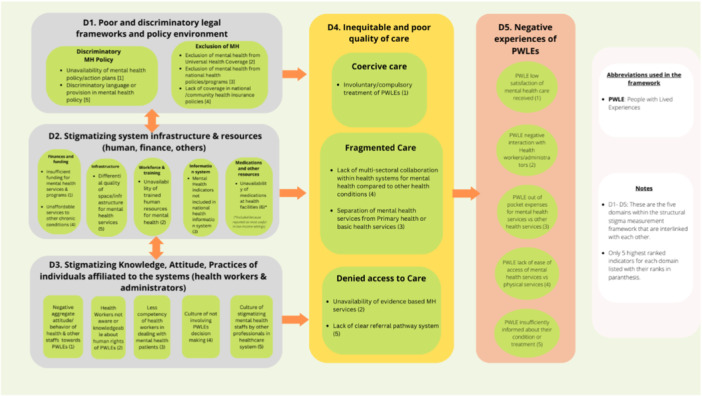 Figure 3
Peer Reviews
No public reviews on file for this paper yet. If you reviewed it on a platform where reviews are public (OpenReview, ICLR, NeurIPS, ICML), you can paste yours below so the community can read it here.
Videos
No videos yet. Explain this paper in a talk, walkthrough, or lecture? Add one.
Taxonomy
TopicsMental Health Treatment and Access · Employment and Welfare Studies · Health, psychology, and well-being