Influence of Right Atrial Pressure on the Prognosis of Patients with Rheumatic Mitral Stenosis Undergoing Percutaneous Mitral Balloon Valvuloplasty
Daniella Cian Nazzetta, Larissa Christine Gomes de Sousa, Vitor Emer Egypto Rosa, Fernanda Castiglioni Tessari, Carlos M. Campos, Maria Antonieta Albanez Medeiros Lopes, Carlos Viana Poyares Jardim, Luís Gustavo Mapa, Layara Fernanda Vicente Pereira Lipari, Mariana Pezzute Lopes

TL;DR
This study found that right atrial pressure, not pulmonary vascular resistance, predicts poor outcomes in patients with rheumatic mitral stenosis undergoing balloon valvuloplasty.
Contribution
The study identifies right atrial pressure as an independent predictor of adverse outcomes in rheumatic mitral stenosis patients undergoing PMBV.
Findings
Right atrial pressure was the only independent predictor of adverse outcomes in patients with rheumatic mitral stenosis undergoing PMBV.
Pulmonary vascular resistance did not show prognostic significance in these patients.
The optimal right atrial pressure cutoff for predicting adverse outcomes was 9.5 mmHg.
Abstract
Background: Pulmonary hypertension (PH) often complicates mitral stenosis (MS). The prognostic impact of pulmonary vascular resistance (PVR) in MS patients remains unclear. Previous study has demonstrated the prognostic impact of right atrial pressure (RAP) in patients with primary PH. We aim to determine the prognostic impact of PVR and RAP in patients with rheumatic MS undergoing percutaneous mitral balloon valvuloplasty (PMBV). Methods: A total of 58 patients with symptomatic severe rheumatic MS who underwent PMBV between 2016 and 2020 were included. Patients were divided into two groups: PVR ≤ 2WU (N = 26) and PVR > 2WU (N = 32). The composite endpoint included death, reintervention or persistent NYHA functional class III-IV during follow-up. Results: The median age was 50 (42–60) years, with 82.8% being female. Median pulmonary artery systolic pressure (PASP) was 42 (35–50.5) mmHg.…
Genes, proteins, chemicals, diseases, species, mutations and cell lines named across the full text — each resolved to its canonical identifier and authoritative record.
Click any figure to enlarge with its caption.
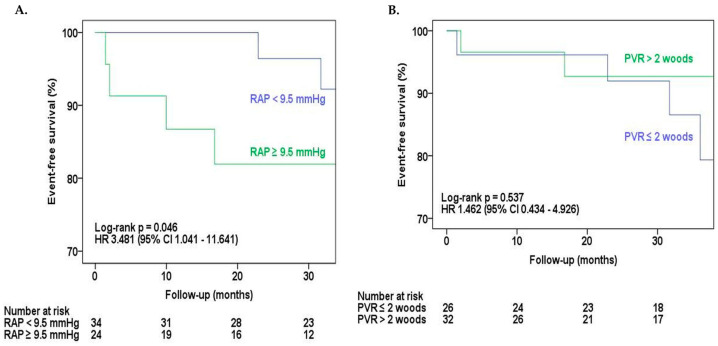 Figure 1
Peer Reviews
No public reviews on file for this paper yet. If you reviewed it on a platform where reviews are public (OpenReview, ICLR, NeurIPS, ICML), you can paste yours below so the community can read it here.
Videos
No videos yet. Explain this paper in a talk, walkthrough, or lecture? Add one.
Taxonomy
TopicsPulmonary Hypertension Research and Treatments · Cardiac Valve Diseases and Treatments · Cardiovascular Function and Risk Factors