Real-World Adherence to a Delirium Screening Test Administered by Nurses and Medical Staff during Routine Patient Care
Rashad Soboh, Meital Rotfeld, Sharon Gino-Moor, Nizar Jiries, Shira Ginsberg, Ron Oliven

TL;DR
This study examines how consistently a delirium screening test is used in real-world hospital settings and how missed tests affect its effectiveness.
Contribution
The study introduces a practical delirium screening test (RMA) and evaluates its real-world adherence and diagnostic performance.
Findings
RMA was administered completely on 88.8% of days, with physicians omitting more tests than nurses.
Omitted tests reduced RMA's sensitivity and specificity for delirium detection compared to 4AT.
Maintaining over 85% test administration ensures acceptable diagnostic performance for RMA.
Abstract
Delirium is often the first symptom of incipient acute illness or complications and must therefore be detected promptly. Nevertheless, routine screening for delirium in acute care hospital wards is often inadequate. We recently implemented a simple, user-friendly delirium screening test (RMA) that can be administered during ward rounds and routine nursing care. The test was found to be non-inferior to 4AT in terms of sensitivity and specificity. However, the dominant factors to take into account when assessing the performance of a test added to the routine work of busy acute care hospital wards are ease of administration, real-life amenability and the ability of the staff to adhere to testing requirements. In this study, we evaluated the prevalence of daily RMA tests that were not administered as scheduled and the impact of these omissions on the overall real-world performance of RMA.…
Genes, proteins, chemicals, diseases, species, mutations and cell lines named across the full text — each resolved to its canonical identifier and authoritative record.
Click any figure to enlarge with its caption.
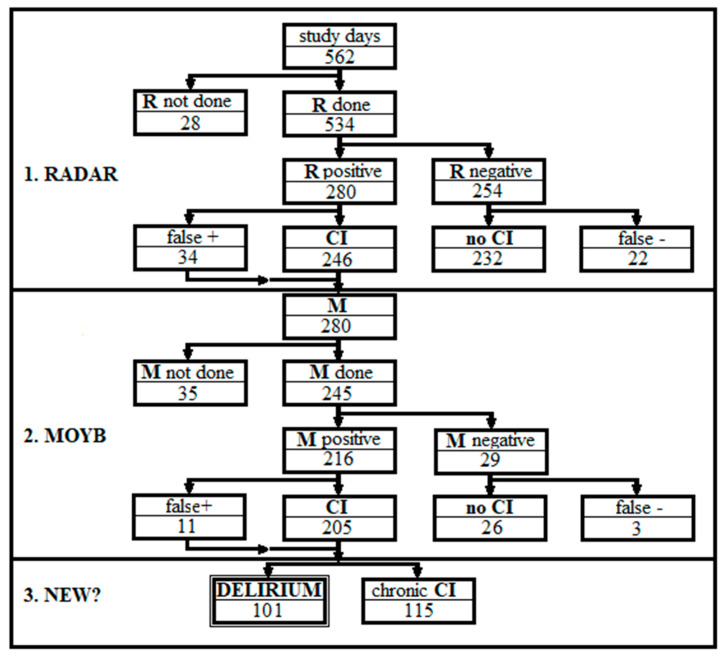 Figure 1
Peer Reviews
No public reviews on file for this paper yet. If you reviewed it on a platform where reviews are public (OpenReview, ICLR, NeurIPS, ICML), you can paste yours below so the community can read it here.
Videos
No videos yet. Explain this paper in a talk, walkthrough, or lecture? Add one.
Taxonomy
TopicsIntensive Care Unit Cognitive Disorders · Anesthesia and Sedative Agents · Healthcare Decision-Making and Restraints