The Association between Specimen Neuromuscular Characteristics and Urinary Incontinence after Robotic-Assisted Radical Prostatectomy
Tomer Bashi, Jonathan Margalioth, Ziv Savin, Ron Marom, Snir Dekalo, Ibrahim Fahoum, Rabab Naamneh, Roy Mano, Ofer Yossepowitch

TL;DR
This study examines whether neuromuscular characteristics in prostate specimens are linked to urinary incontinence after prostate surgery.
Contribution
The study investigates histologic neuromuscular features as potential predictors of postoperative urinary incontinence after robotic-assisted radical prostatectomy.
Findings
No significant associations were found between neuromuscular characteristics and postoperative urinary incontinence.
Peripheral nerves and ganglia were observed in prostate specimens, but their presence did not predict incontinence outcomes.
The proportional area of detrusor and striated muscle fibers was quantified but not linked to incontinence severity.
Abstract
Urinary incontinence after robotic-assisted radical prostatectomy (RARP) has been associated with older age, a longer operative time, a higher BMI, a short membranous urethral length and preoperative erectile function. The authors sought to assess the association between the neuromuscular characteristics and postoperative urinary incontinence. Methods: RARP specimens from 29 men who underwent bilateral nerve sparing were reanalyzed. Urinary incontinence was evaluated using the International Consultation on Incontinence Questionnaire—Short Form (ICIQ-SF) at 6 weeks post surgery and last follow-up. Linear and logistic regression analyses were performed to assess neuromuscular characteristics and incontinence. Results: At the 1-year follow-up, 11 patients (38%) reported severe incontinence (>12 ICIQ-SF score). The median number of peripheral nerves observed at the base and apex in the…
Genes, proteins, chemicals, diseases, species, mutations and cell lines named across the full text — each resolved to its canonical identifier and authoritative record.
Click any figure to enlarge with its caption.
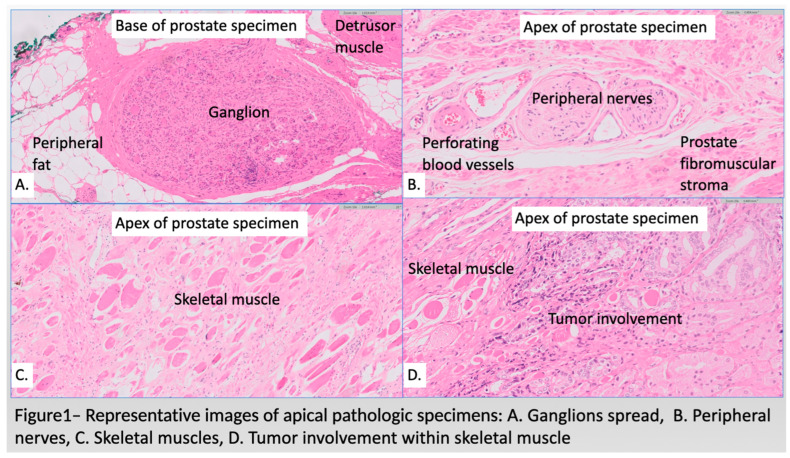 Figure 1
Peer Reviews
No public reviews on file for this paper yet. If you reviewed it on a platform where reviews are public (OpenReview, ICLR, NeurIPS, ICML), you can paste yours below so the community can read it here.
Videos
No videos yet. Explain this paper in a talk, walkthrough, or lecture? Add one.
Taxonomy
TopicsProstate Cancer Diagnosis and Treatment · Pelvic floor disorders treatments · Urinary Bladder and Prostate Research