Increased Frequency of Circulating Activated FOXP3+ Regulatory T Cell Subset in Patients with Chronic Lymphocytic Leukemia Is Associated with the Estimate of the Size of the Tumor Mass, STAT5 Signaling and Disease Course during Follow-Up of Patients on Therapy
Zlatko Roškar, Mojca Dreisinger, Evgenija Homšak, Tadej Avčin, Sebastjan Bevc, Aleš Goropevšek

TL;DR
This study finds that higher levels of a specific type of regulatory T cell in chronic lymphocytic leukemia patients are linked to larger tumor size, STAT5 signaling, and more severe disease progression.
Contribution
The study identifies aTreg expansion and STAT5 signaling as potential markers for severe disease progression in CLL patients.
Findings
Increased aTreg frequency correlates with advanced CLL stages and larger tumor mass.
Higher aTreg levels are associated with more severe infections during follow-up.
STAT5 phosphorylation is significantly linked to aTreg expansion in CLL patients.
Abstract
Patients with chronic lymphocytic leukemia (CLL) are more susceptible to infections, which are also the most common cause of death in these patients. Previous studies in patients with CLL described elevated levels of FOXP3+ regulatory T cells (Tregs), which also correlated with decreased T cell responses to microbial antigens. As the activation of the STAT5 transcription factor induces the expression of FOXP3 and human CD4+FOXP3+ T cells that also contain nonsuppressive T cells, we analyzed STAT5 phosphorylation (pSTAT5) and suppressive subpopulations, including activated Tregs (aTregs). We found a significantly increased frequency of aTregs in patients with advanced stages, which significantly correlated with the total tumor mass score. aTreg expansion in vitro was associated with significantly higher aTreg pSTAT5 responses to SARS-CoV-2 antigen-specific stimulation in vitro. Finally,…
Genes, proteins, chemicals, diseases, species, mutations and cell lines named across the full text — each resolved to its canonical identifier and authoritative record.
Click any figure to enlarge with its caption.
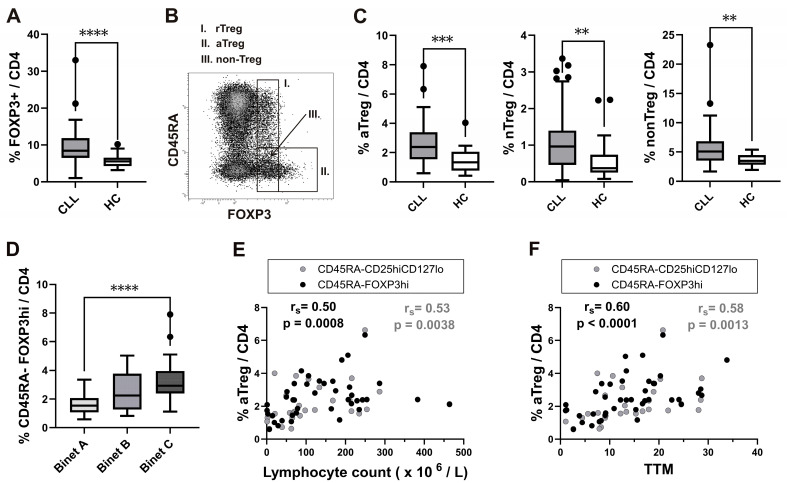 Figure 1
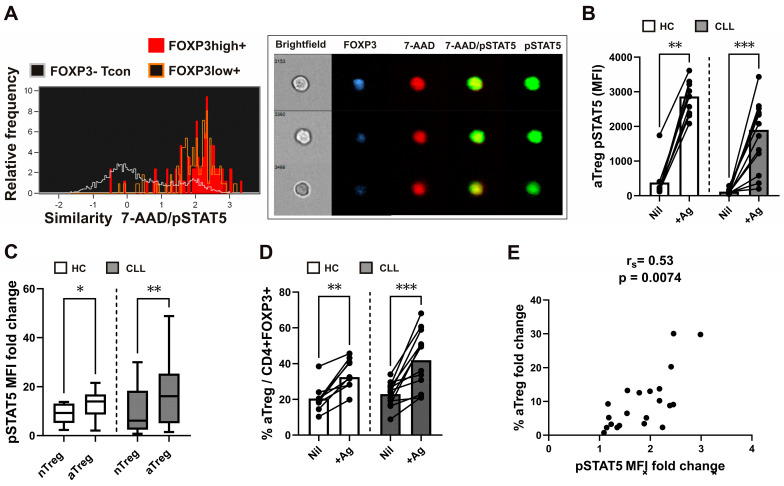 Figure 2
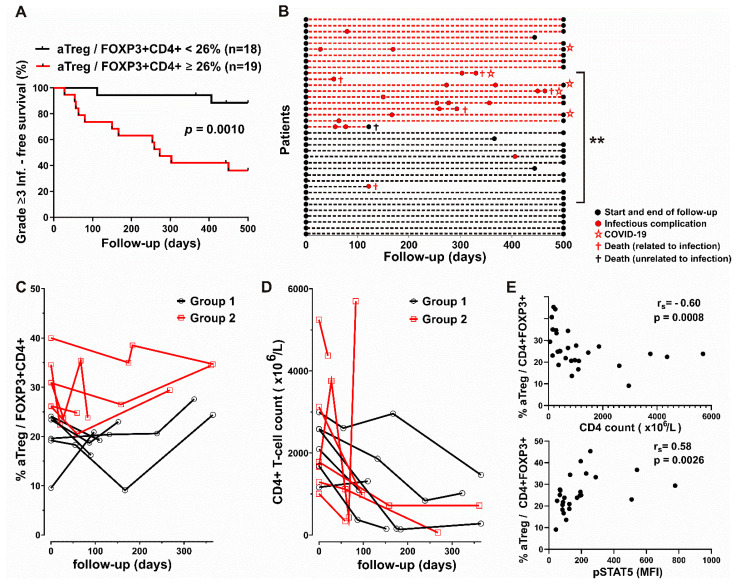 Figure 3
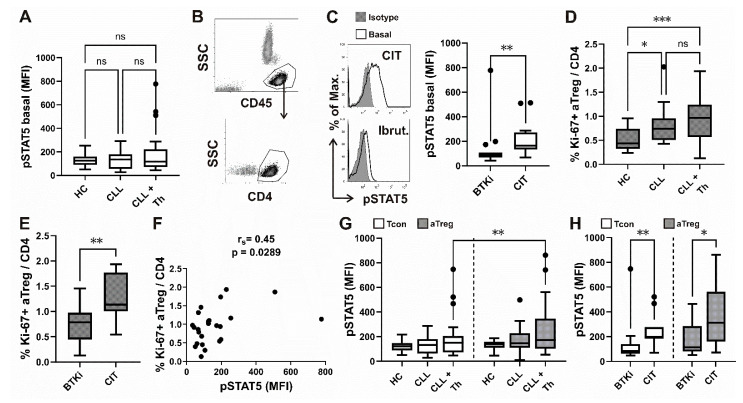 Figure 4
Peer Reviews
No public reviews on file for this paper yet. If you reviewed it on a platform where reviews are public (OpenReview, ICLR, NeurIPS, ICML), you can paste yours below so the community can read it here.
Videos
No videos yet. Explain this paper in a talk, walkthrough, or lecture? Add one.
Taxonomy
TopicsChronic Lymphocytic Leukemia Research · Immune Cell Function and Interaction · Galectins and Cancer Biology