Telehealth exercise for continence after gynaecological cancer treatment (TELE-CONNECT): a protocol for a co-designed pragmatic randomised controlled trial
Helena C Frawley, Kim Bennell, Rachel K. Nelligan, Angela Ravi, Nipuni Susanto, Simon Hyde, Orla McNally, Shih-Ern Yao, Karen E Lamb, Peixuan Li, Linda Denehy, Mark Merolli, Mark Merolli, Tom Jobling, Jennifer Kruger, Martha Hickey, Helen Brown, Lesley McQuire, Rowan Cockerell

TL;DR
This study tests if a telehealth pelvic floor muscle training program with biofeedback reduces urinary incontinence in gynaecological cancer survivors.
Contribution
The study introduces a novel telehealth-delivered PFM training program with biofeedback for post-cancer urinary incontinence.
Findings
The trial will assess if telehealth PFM training with biofeedback reduces UI frequency and impact.
Secondary outcomes include quality-of-life improvements and pelvic floor pressure changes.
Results may support integrating telehealth PFM training into post-cancer care pathways.
Abstract
Urinary incontinence (UI) is the most prevalent pelvic floor disorder following treatment for gynaecological cancer with a distressing impact on quality-of-life in survivors. Physiotherapist-supervised pelvic floor muscle (PFM) training is recommended as the first-line intervention for UI in community-dwelling women. However, it is not known if this intervention is effective in women following treatment for gynaecological cancer, nor whether PFM training can be delivered entirely remotely. The primary aim of this study is to investigate if a telehealth-delivered PFM training program incorporating a novel biofeedback device reduces UI compared with usual care, following gynaecological cancer. This is a pragmatic, two-arm parallel-group, stratified superiority randomised controlled trial recruiting 72 participants (ACTRN12622000580774). Recruitment sites include gynaecology-oncology…
Genes, proteins, chemicals, diseases, species, mutations and cell lines named across the full text — each resolved to its canonical identifier and authoritative record.
Click any figure to enlarge with its caption.
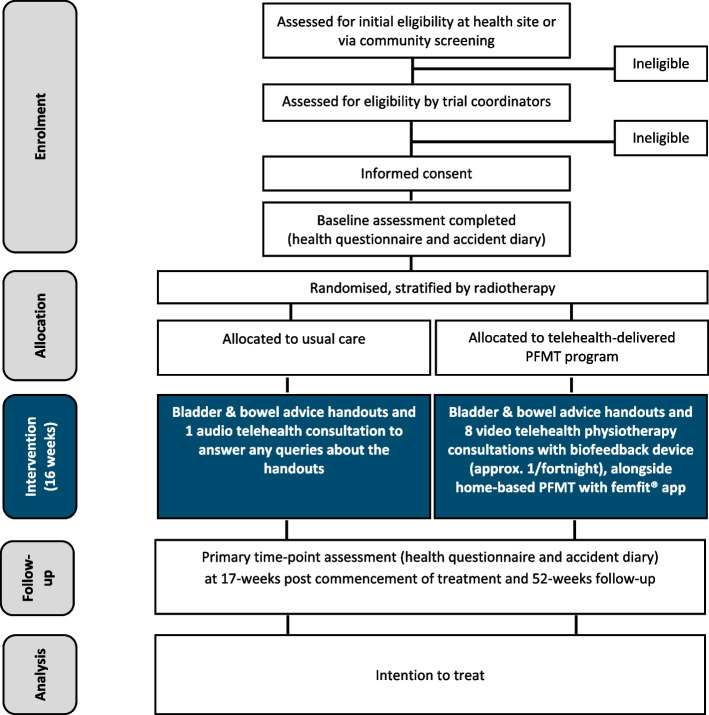 Figure 1
 Figure 2
Peer Reviews
No public reviews on file for this paper yet. If you reviewed it on a platform where reviews are public (OpenReview, ICLR, NeurIPS, ICML), you can paste yours below so the community can read it here.
Videos
No videos yet. Explain this paper in a talk, walkthrough, or lecture? Add one.
Taxonomy
TopicsPelvic floor disorders treatments · Cancer survivorship and care · Clinical practice guidelines implementation