Differential Impact of WM Load on Attention in Young Adults Versus Children and Adolescents
Hyojin Park, So-Yeon Kim

TL;DR
This study shows that working memory load affects attention differently in young adults compared to children and adolescents, with effects becoming more adult-like as children age.
Contribution
The study reveals developmental differences in how working memory load interacts with attention processing.
Findings
Adults showed increased Stroop effects when working memory load overlapped with target processing.
Children/adolescents did not show significant changes in Stroop effects under dual-task conditions.
Age correlated with reduced interference effects under working memory loads that share resources with distractor processing.
Abstract
Background: This study aimed to examine how concurrent working memory (WM) loads affect selective attention, and to explore developmental differences between young adults and children/adolescents aged 10 to 14 years. Methods: We employed a modified Stroop task with verbal or spatial WM loads to assess their impact on attention. Results: In adults, we found increased Stroop effects when WM load overlapped with target processing and decreased Stroop effects when WM load overlapped with distractor processing. Conversely, in children/adolescents, WM loads did not significantly impact target or distractor processing, indicating no change in Stroop effects under dual-task conditions. Interestingly, results from the correlational analyses revealed that as participants’ ages increase, the interference effect under the WM load that shares resources with distractor processing in the attention…
Genes, proteins, chemicals, diseases, species, mutations and cell lines named across the full text — each resolved to its canonical identifier and authoritative record.
Click any figure to enlarge with its caption.
 Figure 1
 Figure 2
 Figure 3
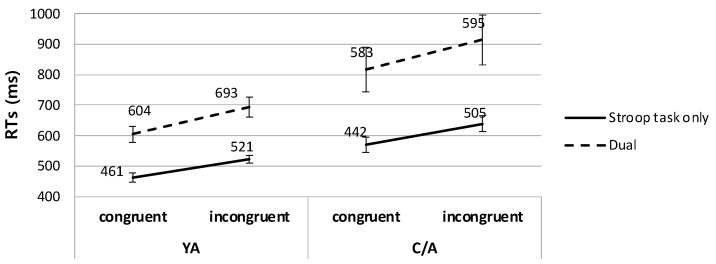 Figure 4
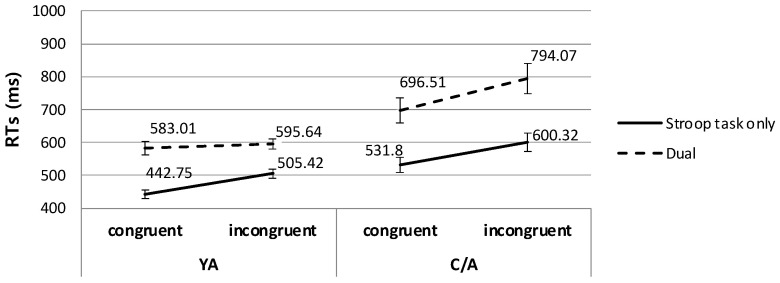 Figure 5
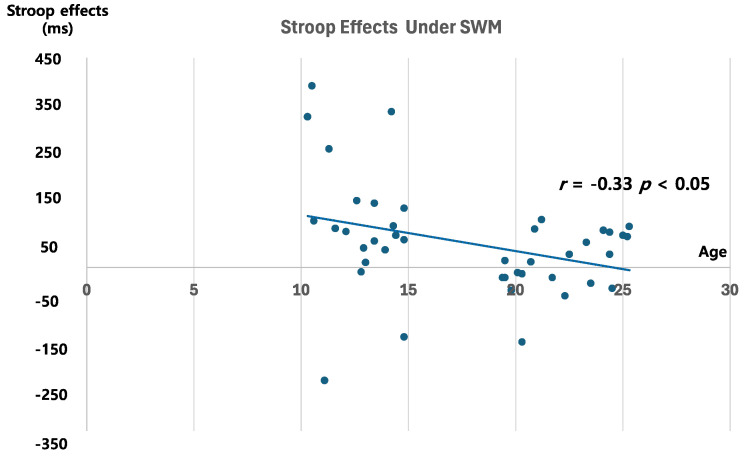 Figure 6
Peer Reviews
No public reviews on file for this paper yet. If you reviewed it on a platform where reviews are public (OpenReview, ICLR, NeurIPS, ICML), you can paste yours below so the community can read it here.
Videos
No videos yet. Explain this paper in a talk, walkthrough, or lecture? Add one.
Taxonomy
TopicsNeuroscience and Music Perception · Neural and Behavioral Psychology Studies · EEG and Brain-Computer Interfaces