Growth and development and trends in overweight and obesity among 7–12 years old Hmong children in China: an analysis of eight successive national surveys from 1985 to 2019
Qi Pan, Yuyu Li, Xiaolong Chen, Xinyi Dai, Xueliang Zhang, Chunjing Tu

TL;DR
This study tracks the growth and rising obesity rates in Hmong children in China from 1985 to 2019 and predicts future trends.
Contribution
The paper provides a longitudinal analysis and future prediction of body shape and obesity trends in Hmong children using national surveys.
Findings
From 1985 to 2019, height, weight, and BMI of Hmong children increased significantly, with weight and BMI growing faster than height.
Overweight and obesity rates rose from 5.2% and 1.2% in 1991 to 12.4% and 8.7% in 2014, showing a rapid increase after 2000.
Projections indicate continued growth in height, weight, and BMI through 2030, with overweight and obesity expected to rise rapidly.
Abstract
To explore the dynamic changes and trends in the body shape of Hmong children aged 7–12 years from 1985 to 2019, and to predict them, to provide a reference for the physical health level of Hmong children. The body shape data of Hmong children aged 7–12 years old from the Chinese National Survey on Students’ Constitution and Health (CNSSCH) in 1985, 1991, 1995, 2000, 2005, 2010, 2014, and 2019 were used for longitudinal comparative analysis, and the grey GM(1,1) model was established based on this as a time series. Forecast the future development trend in 2025 and 2030. 1) From 1985 to 2019, all indicators of body shape of Hmong primary school students showed an upward trend, the increase in height (FBoys = 3.91, p > 0.05; FGirls = 3.91, p > 0.05), weight (FBoys = 8.04, p < 0.01; FGirls = 6.36, p < 0.05) and BMI (FBoys = 19.15, p < 0.01; FGirls = 10.24, p < 0.01) increased with age,…
Genes, proteins, chemicals, diseases, species, mutations and cell lines named across the full text — each resolved to its canonical identifier and authoritative record.
Click any figure to enlarge with its caption.
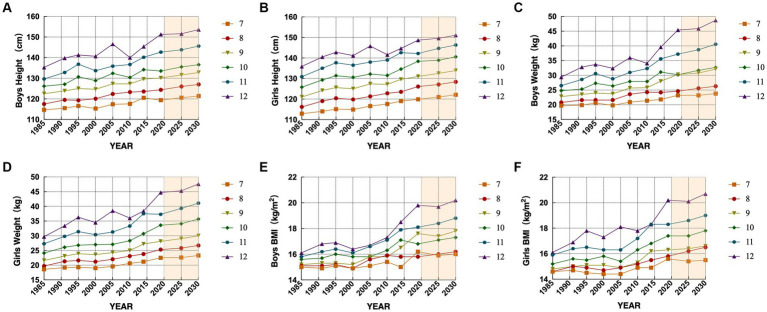 Figure 1
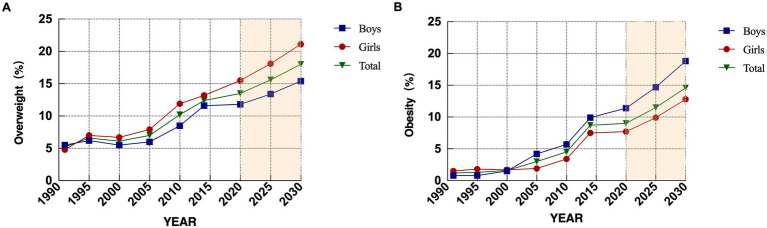 Figure 2
Peer Reviews
No public reviews on file for this paper yet. If you reviewed it on a platform where reviews are public (OpenReview, ICLR, NeurIPS, ICML), you can paste yours below so the community can read it here.
Videos
No videos yet. Explain this paper in a talk, walkthrough, or lecture? Add one.
Taxonomy
TopicsChild Nutrition and Water Access · Obesity, Physical Activity, Diet · Cardiovascular Health and Risk Factors