Time-specific lipid and gene expression responses to chilling stress in panicoid grass
Artik Elisa Angkawijaya

TL;DR
The study explores how panicoid grasses respond to cold stress over time, focusing on changes in lipids and gene expression.
Contribution
The novelty lies in identifying rhythmic and time-specific lipid and gene expression responses to chilling in panicoid grasses.
Findings
Lipid and gene expression responses to chilling are rhythmic and time-specific in panicoid grasses.
These responses suggest a dynamic regulatory mechanism in adapting to cold stress.
The findings highlight the importance of timing in plant stress response pathways.
Abstract
This article comments on: Kenchanmane Raju SK, Zhang Y, Mahboub S, Ngu DW, Qiu Y, Harmon FG, Schnable JC, Roston RL. 2024. Rhythmic lipid and gene expression responses to chilling in panicoid grasses. Journal of Experimental Botany 75, https://doi.org/10.1093/jxb/erae247
Genes, proteins, chemicals, diseases, species, mutations and cell lines named across the full text — each resolved to its canonical identifier and authoritative record.
Click any figure to enlarge with its caption.
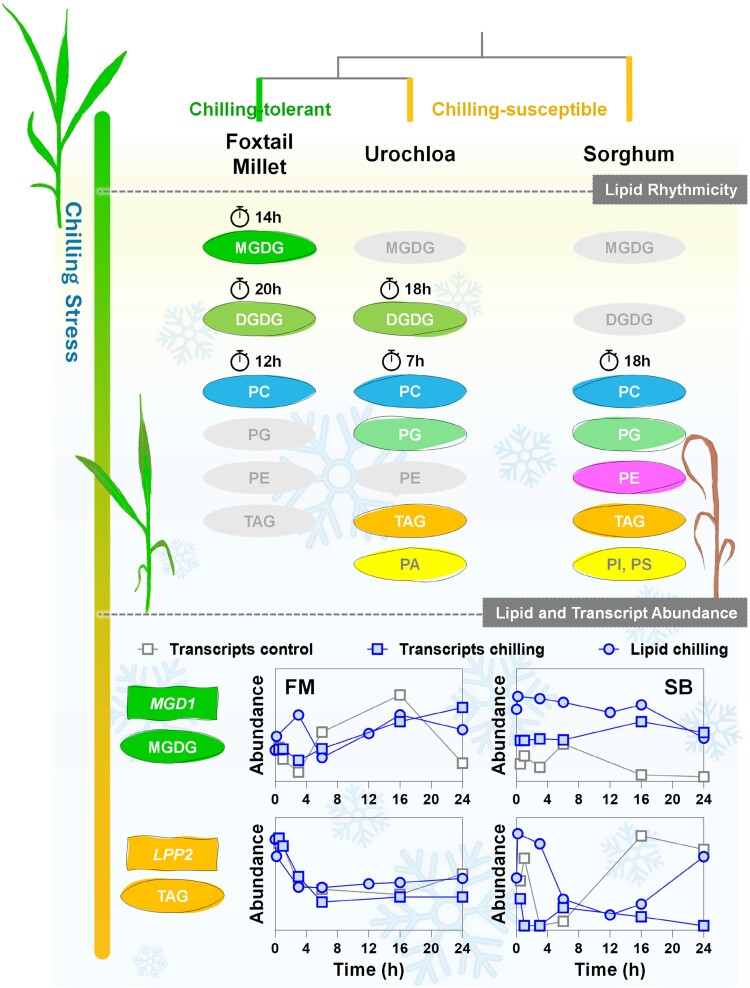 Figure 1
Peer Reviews
No public reviews on file for this paper yet. If you reviewed it on a platform where reviews are public (OpenReview, ICLR, NeurIPS, ICML), you can paste yours below so the community can read it here.
Videos
No videos yet. Explain this paper in a talk, walkthrough, or lecture? Add one.
Taxonomy
TopicsPlant Stress Responses and Tolerance · Plant Reproductive Biology · Plant Molecular Biology Research