Treatment of Klippel-Feil syndrome with symptomatic atlantoaxial instability in a 7-year-old boy: A case report
W. Pepke, T. Renkawitz, S. Hemmer

TL;DR
A 7-year-old boy with Klippel-Feil syndrome was successfully treated for spinal instability and myelopathy using a surgical procedure involving decompression and stabilization.
Contribution
The paper presents a successful treatment approach for juvenile Klippel-Feil syndrome with symptomatic atlantoaxial instability.
Findings
The patient showed improvement after C1 decompression and CT-guided C1/C2 stabilization.
Intraoperative neuromonitoring was safely used during the procedure.
Symptomatic myelopathy due to C1 posterior arch stenosis was effectively addressed.
Abstract
Klippel-Feil syndrome (KFS) is a congenital deformity of the cervical spine. Clinical symptoms of KFS are reduced range of motion, short neck and low hairline. In adult KFS patients the deformity can lead to adjacent segmental instability with spinal canal stenosis, radiculopathy and myelopathy. This article reports about the diagnostics and treatment management of juvenile KFS patient with myelopathy due to instability of the C1/C2 segment, subsequent stenosis through the posterior arch of C1 and symptomatic myelopathy. This 7‑year-old boy could be successfully treated with C1 decompression and computer tomography (CT) guided C1/C2 stabilization with pedicle screws under intraoperative neuromonitoring.
Genes, proteins, chemicals, diseases, species, mutations and cell lines named across the full text — each resolved to its canonical identifier and authoritative record.
Click any figure to enlarge with its caption.
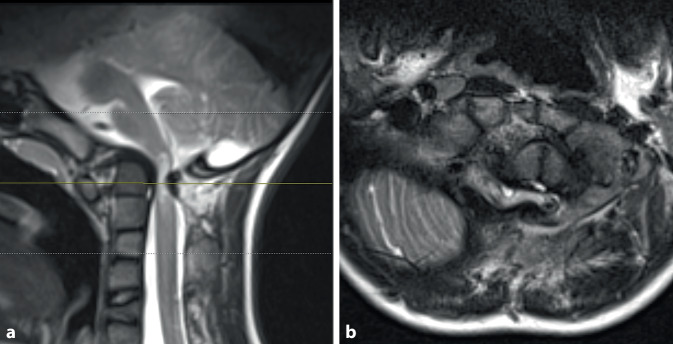 Figure 1
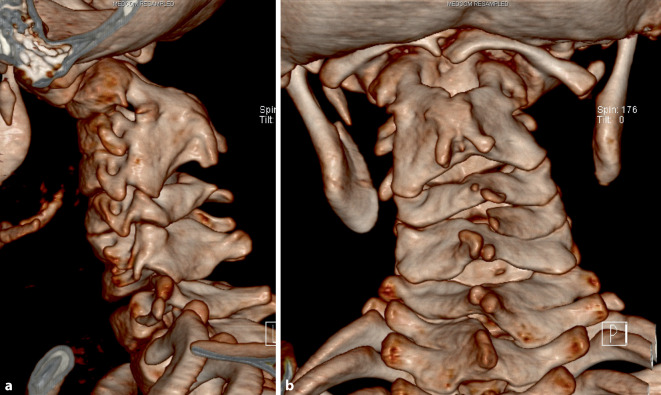 Figure 2
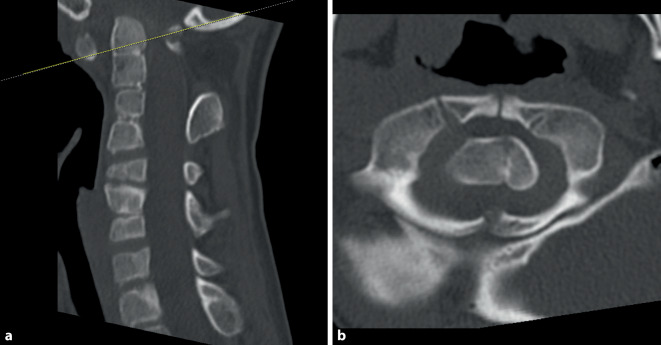 Figure 3
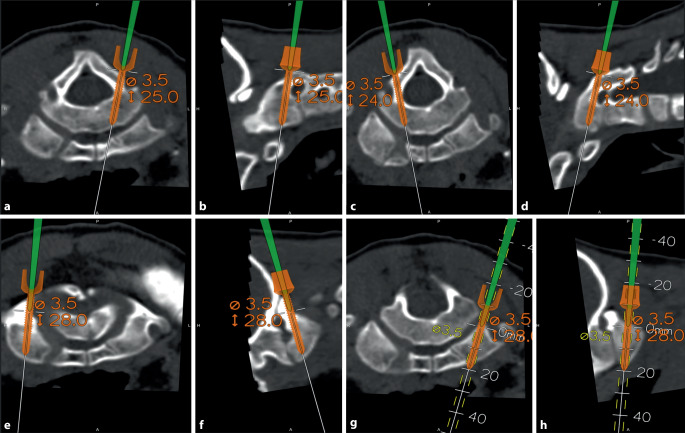 Figure 4
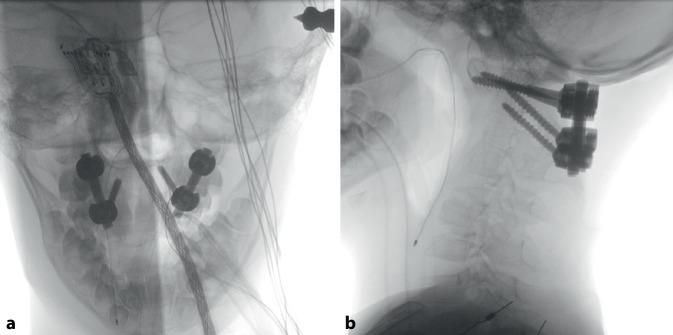 Figure 5
 Figure 6
Peer Reviews
No public reviews on file for this paper yet. If you reviewed it on a platform where reviews are public (OpenReview, ICLR, NeurIPS, ICML), you can paste yours below so the community can read it here.
Videos
No videos yet. Explain this paper in a talk, walkthrough, or lecture? Add one.
Taxonomy
TopicsSpinal Fractures and Fixation Techniques · Cervical and Thoracic Myelopathy · Spine and Intervertebral Disc Pathology