Two versus three magnesium screws for osteosynthesis of mandibular condylar head fractures: a finite element analysis
Daphne Schönegg, Günter T. Müller, Michael Blumer, Harald Essig, Maximilian E. H. Wagner

TL;DR
This study compares two- and three-screw magnesium osteosynthesis for mandibular condylar fractures using FEA, finding that three screws offer better mechanical stability.
Contribution
The novelty lies in evaluating the mechanical performance of three magnesium screws for mandibular condylar fractures, showing improved stability over two-screw configurations.
Findings
Three-screw configurations reduced von Mises stress by 30% in the top screw and 46% in the bottom screw compared to two-screws.
Three magnesium screws provided lower fragment deformation and fracture displacement than two-screw setups.
Magnesium screws may reduce the need for hardware removal surgery, but clinical validation is required.
Abstract
Previous finite element analyses (FEA) have shown promising results for using two titanium screws in treating mandibular condylar head fractures but limited mechanical stability of a two-screw osteosynthesis with magnesium screws. Given the potential benefits of magnesium screws in terms of biocompatibility and resorption, this study aimed to compare two- and three-screw osteosynthesis solutions for a right condylar head fracture (AO CMF type p) with magnesium screws with a FEA. A previously validated finite element model simulating a 350 N bite on the contralateral molars was used to analyze von Mises stress within the screws, fragment deformation, and fracture displacement. All screws were modeled with uniform geometric specifications mirroring the design of Medartis MODUS® Mandible Hexadrive cortical screws. The three-screw configuration demonstrated lower values for all three…
Genes, proteins, chemicals, diseases, species, mutations and cell lines named across the full text — each resolved to its canonical identifier and authoritative record.
Click any figure to enlarge with its caption.
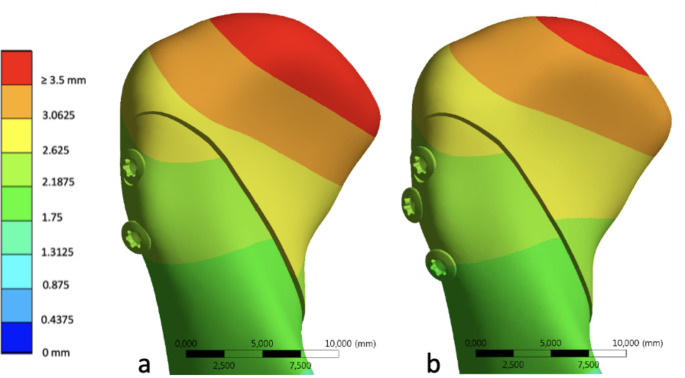 Figure 1
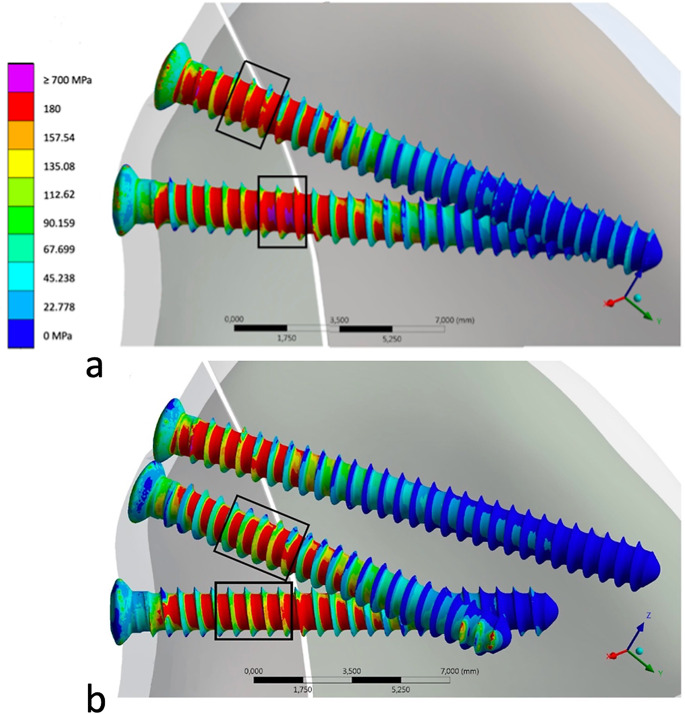 Figure 2
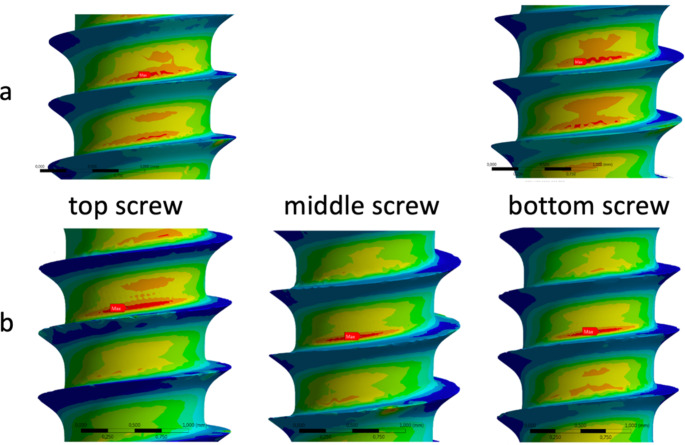 Figure 3
Peer Reviews
No public reviews on file for this paper yet. If you reviewed it on a platform where reviews are public (OpenReview, ICLR, NeurIPS, ICML), you can paste yours below so the community can read it here.
Videos
No videos yet. Explain this paper in a talk, walkthrough, or lecture? Add one.
Taxonomy
TopicsFacial Trauma and Fracture Management · Spinal Fractures and Fixation Techniques · Bone fractures and treatments