The complete plastome of Rorippa palustris Besser 1821 and its phylogenetic analysis
Xinhua Wang, Liqiang Wang, Jiaojiao Kong, Hongqin Li, Na Kong

TL;DR
This study presents the full genetic map of Rorippa palustris, a plant used in food and medicine, and shows its close genetic relationship to R. curvipes.
Contribution
The first complete plastome assembly and phylogenetic analysis of Rorippa palustris.
Findings
The plastome of R. palustris is 154,674 bp long and contains 128 genes.
Phylogenomic analysis shows R. palustris is closely related to R. curvipes.
The findings support future research on the plant's evolution and medicinal use.
Abstract
Rorippa palustris Besser 1821, a species of Brassicaceae, is widely distributed around the world and used for both food and traditional Chinese medicinal purposes. Despite the plant’s significance, its genetic diversity must be better understood. In this study, we have successfully assembled and characterized a complete plastome of R. palustris, marking a significant advancement toward comprehending its genetic composition. The plastome is 154,674 bp long and harbors 128 genes, including 83 protein-coding genes, 37 tRNA genes, and eight rRNA genes. Our phylogenomic analysis indicated that R. palustris is closely related to R. curvipes. These findings are crucial for conserving and utilizing this important plant species. They also highlight the potential for future research into the evolution and preservation of R. palustris, which could be advantageous in pharmaceutical applications.
Genes, proteins, chemicals, diseases, species, mutations and cell lines named across the full text — each resolved to its canonical identifier and authoritative record.
Click any figure to enlarge with its caption.
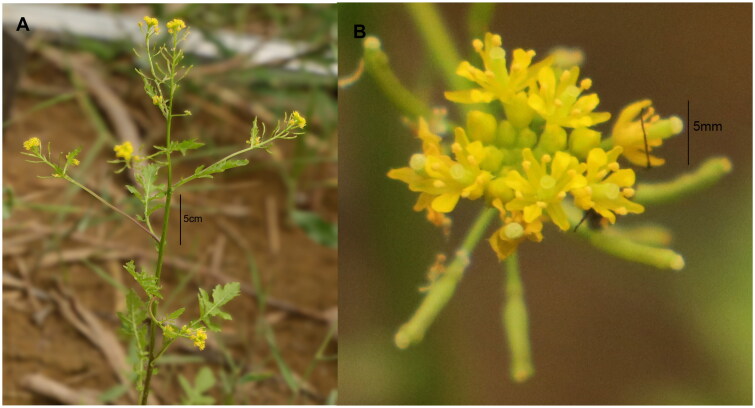 Figure 1
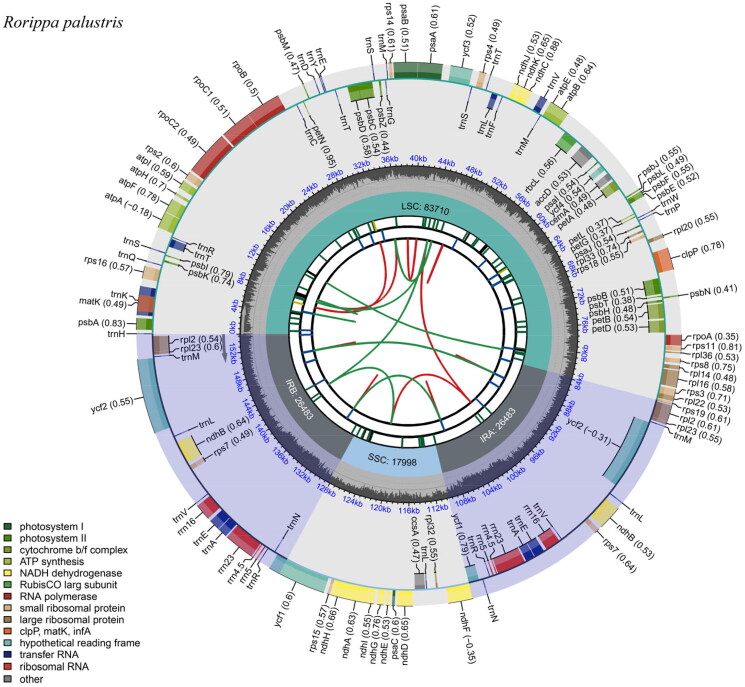 Figure 2
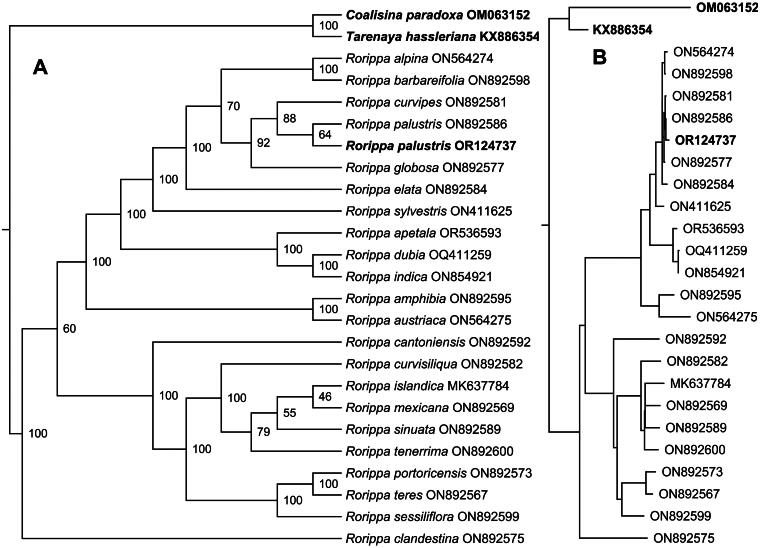 Figure 3
Peer Reviews
No public reviews on file for this paper yet. If you reviewed it on a platform where reviews are public (OpenReview, ICLR, NeurIPS, ICML), you can paste yours below so the community can read it here.
Videos
No videos yet. Explain this paper in a talk, walkthrough, or lecture? Add one.
Taxonomy
TopicsGenetic diversity and population structure · Aquatic Invertebrate Ecology and Behavior · Crustacean biology and ecology