Optimised syntheses and purifications of 3-aryl/heterocyclic dihydrobis- and hydrotris-(pyrazolyl)borate ligands as their alkali salts
Jarrod R. Thomas, Jonathan T. Mifsud, Scott A. Sulway

TL;DR
This paper presents improved methods for making and purifying specific borate ligands used in chemistry, avoiding toxic materials and achieving high purity and yield.
Contribution
The paper introduces optimized and safer synthesis and purification techniques for poly(pyrazolyl)borate ligands.
Findings
Fraction crystallisation from MeCN allows purification of TpR ligands with high purity.
An optimized procedure enables safe isolation of alkali salts of BpR ligands in high yields.
The methods avoid the use of highly toxic thallium(i) salts.
Abstract
Though poly(pyrazolyl)borate ligands, namely dihydrobis(pyrazolyl)borate (Bp) and hydrotris(pyrazolyl)borate (Tp), have been used in coordination chemistry for decades, their synthesis and purification are of great importance, when targeting high purity and yield of metal complexes. As borohydride substitutions is temperature and pyrazolyl dependent, determining the reaction conditions for each ligand is non-trivial and does not always result in a temperature where only the desired products form. Herein we report the purification of two known TpR (R = phenyl, 2′-thienyl), as their tris-substituted temperatures coincide with their tetrakis-temperatures via fraction crystallisation from MeCN, and an optimised safe procedure for 3-aryl/heterocyclic BpR ligands (R = 2′-pyridyl, 2′-furyl, 2′-thineyl). These novel techniques allow for the safe isolation of alkali salts of…
Genes, proteins, chemicals, diseases, species, mutations and cell lines named across the full text — each resolved to its canonical identifier and authoritative record.
Click any figure to enlarge with its caption.
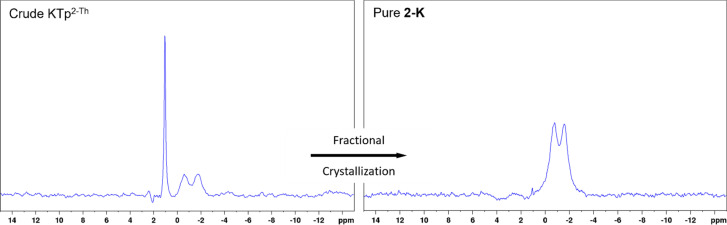 Figure 1
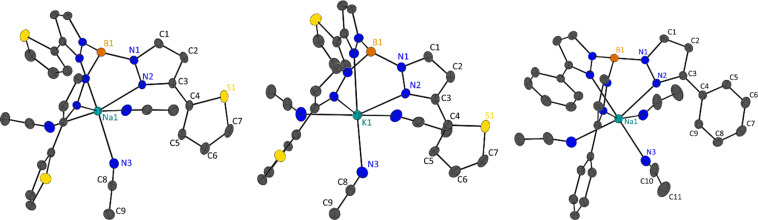 Figure 2
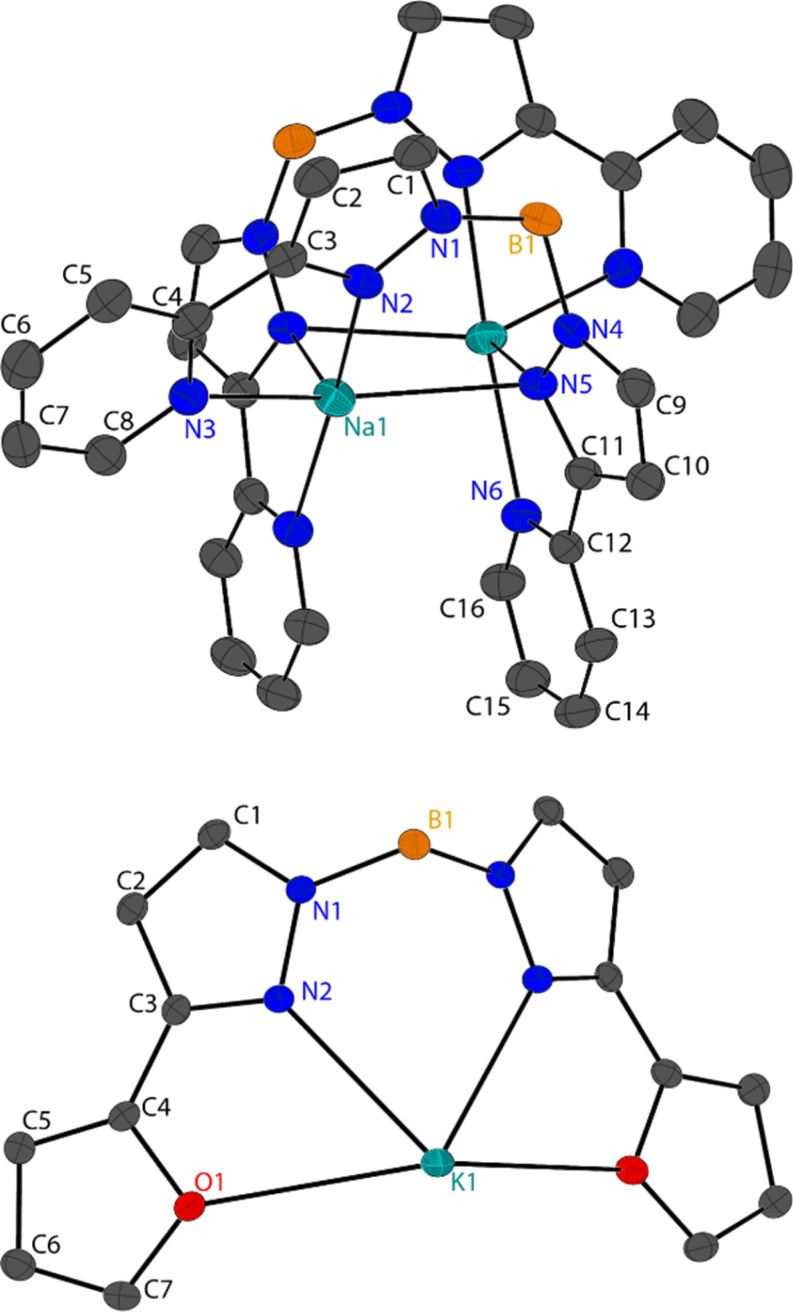 Figure 3
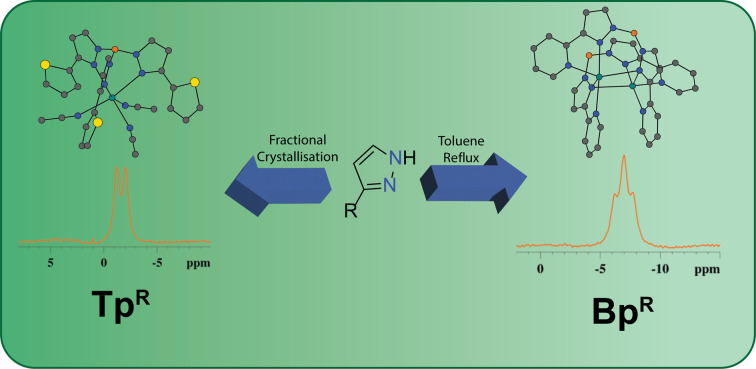 Figure 4
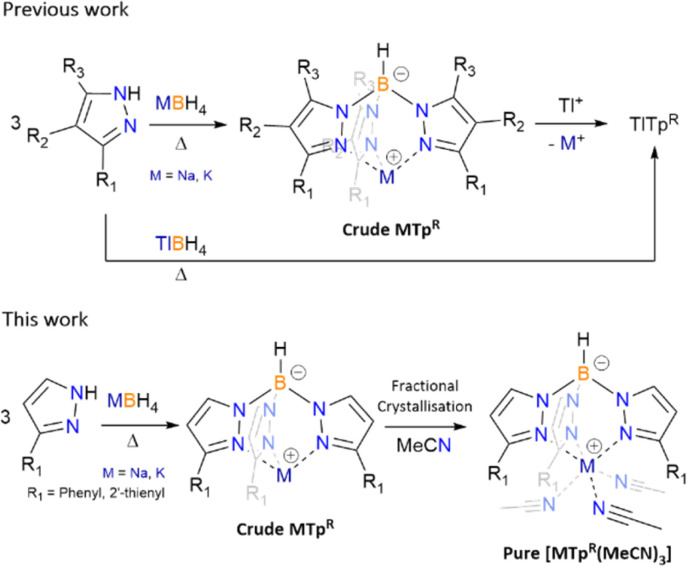 Figure 5
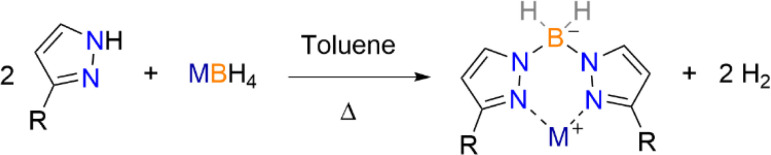 Figure 6
Peer Reviews
No public reviews on file for this paper yet. If you reviewed it on a platform where reviews are public (OpenReview, ICLR, NeurIPS, ICML), you can paste yours below so the community can read it here.
Videos
No videos yet. Explain this paper in a talk, walkthrough, or lecture? Add one.
Taxonomy
TopicsOrganometallic Complex Synthesis and Catalysis · Magnetism in coordination complexes · Lanthanide and Transition Metal Complexes