Reduced multiscale complexity of daily behavioral dynamics in autism spectrum disorder
Toru Nakamura, Tomiki Sumiyoshi, Yoko Kamio, Hidetoshi Takahashi

TL;DR
The study found that children with autism spectrum disorder (ASD) show less complex and more predictable daily behavior patterns compared to typically developing children, which could help in objective diagnosis.
Contribution
The study introduces multiscale entropy analysis as a novel objective metric for characterizing behavioral dynamics in ASD.
Findings
ASD children showed significantly lower multiscale entropy at timescales longer than 6 minutes, indicating reduced behavioral unpredictability.
Multiscale entropy positively correlated with prepulse inhibition levels, suggesting a link to sensorimotor gating.
A negative correlation was found between multiscale entropy and the SDQ total difficulty score, supporting its use as a mental health indicator in ASD.
Abstract
Autism spectrum disorder (ASD) is difficult to diagnose objectively due to its heterogeneous and complex manifestations. This study aimed to objectively characterize the behavioral phenotypes of ASD children by exploring the multiscale behavioral dynamics. We applied behavioral organization (BO) and multiscale sample entropy (MSE) analyses to physical activity data collected from ASD and typically developing children, using wearable monitors in their daily life. We also examined their correlation with auditory startle response measures and clinical questionnaires, including the Social Responsiveness Scale (SRS) and the Strengths and Difficulties Questionnaire (SDQ). A significant decrease in MSE at timescales longer than 6 min was observed in ASD children, suggesting decreased irregularity or unpredictability, potentially linked to repetitive behaviors or stereotyped patterns commonly…
Genes, proteins, chemicals, diseases, species, mutations and cell lines named across the full text — each resolved to its canonical identifier and authoritative record.
Click any figure to enlarge with its caption.
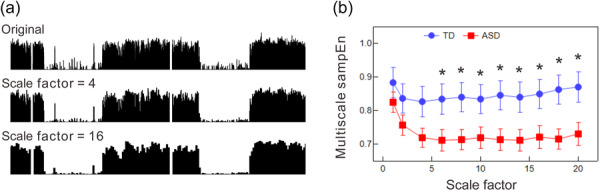 Figure 1
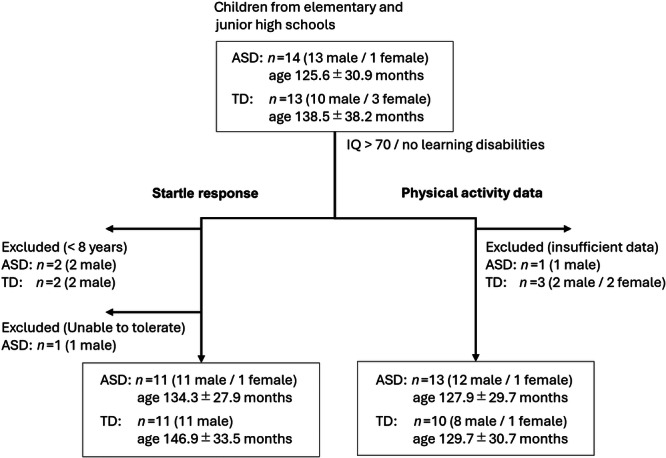 Figure 2
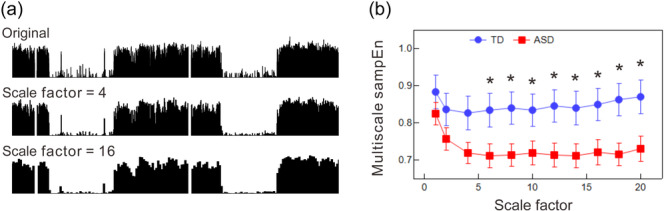 Figure 3
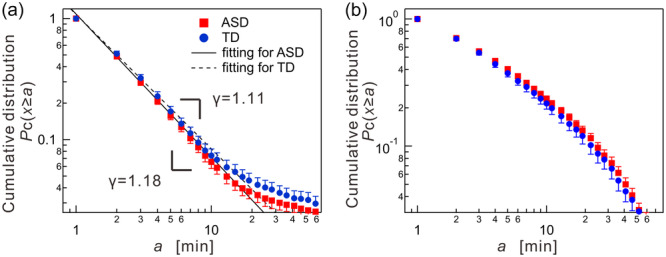 Figure 4
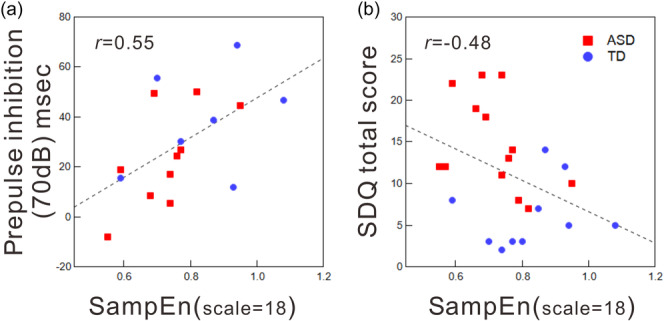 Figure 5
Peer Reviews
No public reviews on file for this paper yet. If you reviewed it on a platform where reviews are public (OpenReview, ICLR, NeurIPS, ICML), you can paste yours below so the community can read it here.
Videos
No videos yet. Explain this paper in a talk, walkthrough, or lecture? Add one.
Taxonomy
TopicsAutism Spectrum Disorder Research · Mental Health Research Topics · Functional Brain Connectivity Studies