Progressive Polycystic Kidney Disease in an Infant Girl With TSC2/PKD1 Contiguous Gene Syndrome
Kazuhiko Hashimoto, Takuya Hayashida, Yoshikazu Otsubo, Yo Niida, Sumito Dateki

TL;DR
This paper reports a case of a rare genetic syndrome in an infant girl that causes kidney disease and brain abnormalities, highlighting the need for early diagnosis and monitoring.
Contribution
The study emphasizes the importance of early genetic testing and longitudinal imaging for managing TSC2/PKD1 contiguous gene syndrome in infants.
Findings
The infant girl had TSC2/PKD1 contiguous gene syndrome confirmed by microarray analysis.
Polycystic kidney lesions enlarged rapidly, leading to early childhood hypertension.
Longitudinal abdominal imaging is crucial for tracking disease progression in this syndrome.
Abstract
TSC2/PKD1 contiguous gene syndrome is caused by deletions involving the TSC2 and PKD1 genes that lead to tuberous sclerosis complex and autosomal dominant polycystic kidney disease. It is characterized by early-onset severe cystic kidney disease with progressive enlargement of the kidneys and the cysts. As it can lead to early hypertension and an accelerated decline of kidney function, early genetic testing is needed for early diagnosis of this syndrome, and more frequent imaging-based examinations are necessary to assess disease progression and determine appropriate management. We report the case of an infant girl with TSC2/PKD1 contiguous gene syndrome who presented with epileptic seizures. Brain magnetic resonance imaging (MRI) revealed subependymal nodules and cortical tubers, and abdominal MRI revealed polycystic kidney lesions and enlargement of both kidneys. TSC2/PKD1 contiguous…
Genes, proteins, chemicals, diseases, species, mutations and cell lines named across the full text — each resolved to its canonical identifier and authoritative record.
Click any figure to enlarge with its caption.
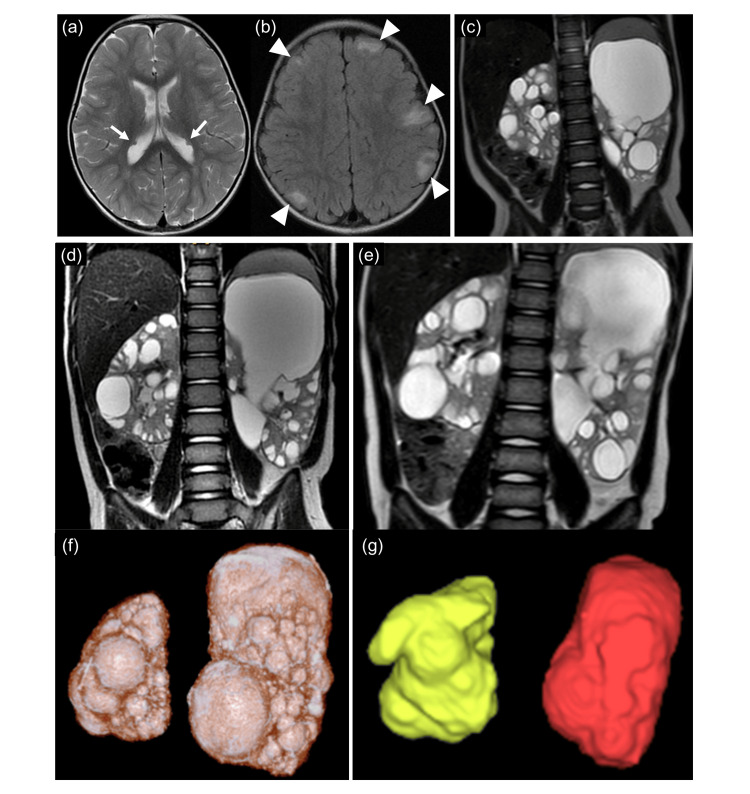 Figure 1
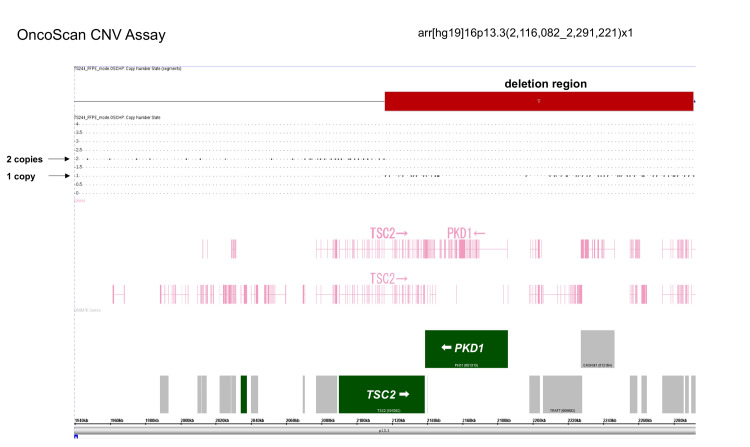 Figure 2
Peer Reviews
No public reviews on file for this paper yet. If you reviewed it on a platform where reviews are public (OpenReview, ICLR, NeurIPS, ICML), you can paste yours below so the community can read it here.
Videos
No videos yet. Explain this paper in a talk, walkthrough, or lecture? Add one.
Taxonomy
TopicsGenetic and Kidney Cyst Diseases · Tuberous Sclerosis Complex Research · Renal and related cancers