Closed–loop oxygen usage during invasive mechanical ventilation of pediatric patients (CLOUDIMPP): a randomized controlled cross-over study
Gulhan Atakul, Gokhan Ceylan, Ozlem Sandal, Ekin Soydan, Pinar Hepduman, Mustafa Colak, Jan M. Zimmermann, Dominik Novotni, Utku Karaarslan, Sevgi Topal, Hasan Aǧin

TL;DR
A closed-loop oxygen control system improves oxygen therapy in children on ventilators by maintaining target oxygen levels more consistently and reducing manual adjustments.
Contribution
This study demonstrates the effectiveness of a closed-loop system for oxygen control in pediatric mechanical ventilation.
Findings
Closed-loop control kept SpO2 within target ranges significantly more than manual adjustments.
The system reduced FiO2 and total oxygen use while improving the SpO2/FiO2 ratio.
Manual adjustments were nearly eliminated with the closed-loop system.
Abstract
The aim of this study is the evaluation of a closed-loop oxygen control system in pediatric patients undergoing invasive mechanical ventilation (IMV). Cross-over, multicenter, randomized, single-blind clinical trial. Patients between the ages of 1 month and 18 years who were undergoing IMV therapy for acute hypoxemic respiratory failure (AHRF) were assigned at random to either begin with a 2-hour period of closed-loop oxygen control or manual oxygen titrations. By using closed-loop oxygen control, the patients' SpO2 levels were maintained within a predetermined target range by the automated adjustment of the FiO2. During the manual oxygen titration phase of the trial, healthcare professionals at the bedside made manual changes to the FiO2, while maintaining the same target range for SpO2. Following either period, the patient transitioned to the alternative therapy. The outcomes were…
Genes, proteins, chemicals, diseases, species, mutations and cell lines named across the full text — each resolved to its canonical identifier and authoritative record.
Click any figure to enlarge with its caption.
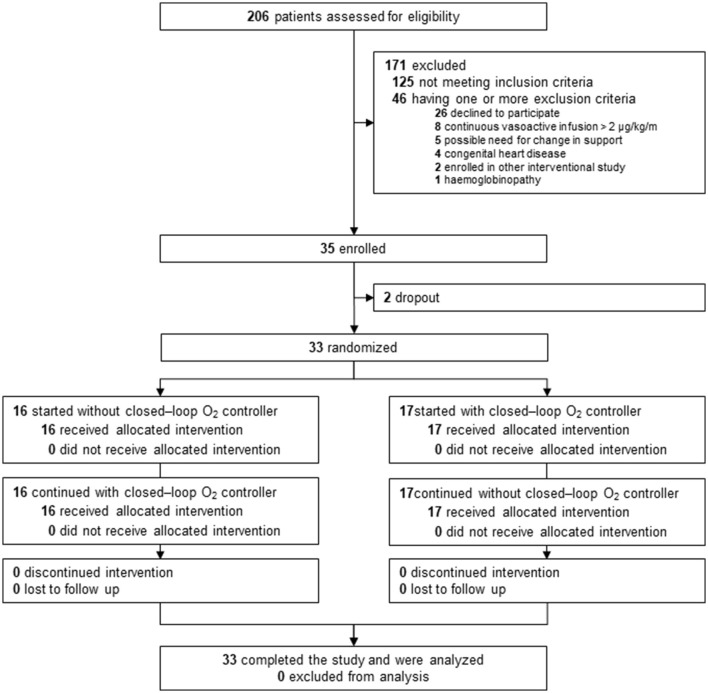 Figure 1
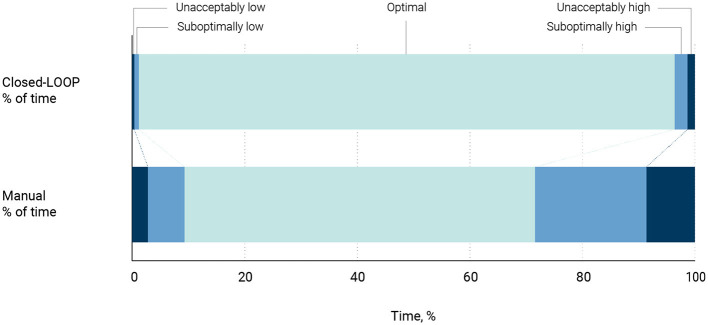 Figure 2
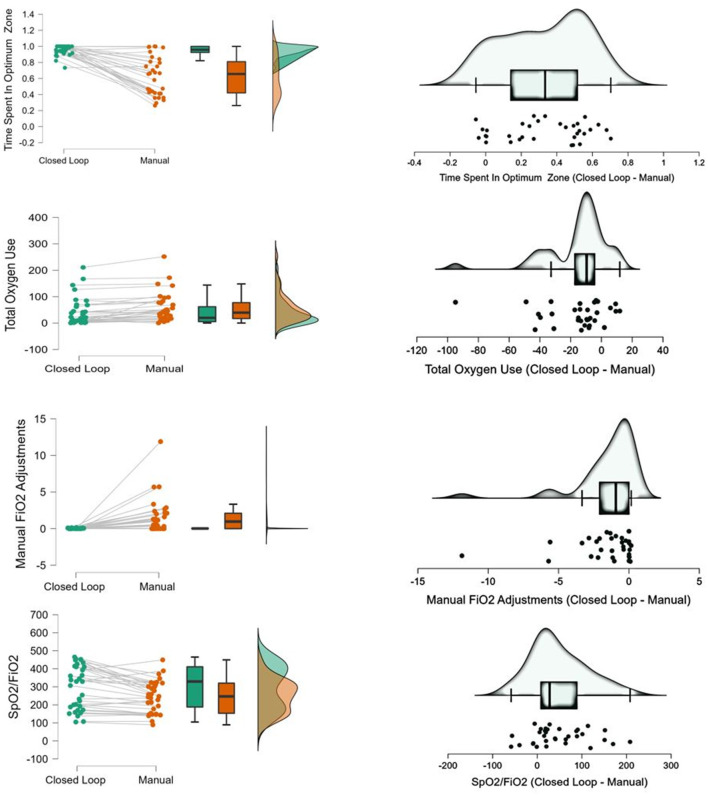 Figure 3
|
|
|
|---|---|
| Gender ratio (%f/%m) | 43/57 |
| Age (months) | 17 (13–55.5) |
| IBW (kg) | 13 (10.3–20) |
| PIM3 | 10.5 (0.8–20.6) |
| PELOD | 12.9 (1–32.7) |
| PICU duration (days) | 18 (8–22.5) |
| PEEP (cmH2O) | 7 (5–8) |
| PIP (cmH2O) | 25.3 (19.9–33.1) |
|
| |
| Respiratory | 15 (45) |
| Sepsis | 8 (24) |
| Neurologic | 5 (15) |
| Renal/Metabolic | 3 (9) |
| Cardiovascular | 2 (7) |
|
| |
| Obstructive | 5 (15) |
| Restrictive | 10 (30) |
| Mixed | 18 (55) |
|
| |
| APV-SIMV | 19 (57) |
| P-SIMV | 8 (24) |
| ASV | 5 (15) |
| SPONT | 1 (3) |
|
|
|
|
|
|
|---|---|---|---|---|
|
| ||||
| Time spent in optimal SpO2 range (%) | 95.7 (92.1 to 100) | 65.6 (41.6 to 82.5) | 33.4 (24.5 to 42) | <0.001 |
|
| ||||
| Time spent in suboptimal SpO2 range (%) | ||||
| Low | 0.2 (0 to 1.2) | 0.3 (0 to 5.6) | −1.7(−10.6 to 0.1) | 0.147 |
| High | 0.3 (0 to 3.6) | 14.2 (2.3 to 31.4) | −18.6 (−27.3 to −11.4) | 0.001 |
| Total | 1.7 (0 to 5.1) | 27.2 (10.3 to 39.5) | −22.8 (−29.4 to −15.8) | <0.001 |
| Mean FiO2 (%) | 32.1 (23.9 to 54.1) | 40.6 (31.1 to 62.8) | −6 (−8 to −3.9) | <0.001 |
| Mean SpO2/FiO2 | 329.4 (180 to 411.1) | 246.7 (151.1 to 320.5) | 44.5 (20 to 69.8) | <0.001 |
| Manual Adjustments (n/h) | 0 (0 to 0) | 1 (0 to 2.2) | −1.7 (−3 to −1.2) | <0.001 |
| Alarms (n/h) | 0 (1 to 1.3) | 0 (0 to 0.8) | −0.3 (−3.8 to 2.5) | 0.69 |
| Percentage of time SpO2 available | 99.9 (99.3 to 100) | 99.9 (98.7 to 100) | 0.8 (−0.003 to 3.4) | 0.05 |
| Percentage of time SpO2 <88% | 0 (0 to 0.2) | 0 (0 to 0.4) | −0.3 (−1.8 to 0.1) | 0.22 |
| Percentage of time SpO2 <85% | 0 (0 to 0.07) | 0 (0 to 0.2) | −0.4 (−0.9 to −0.06) | 0.02 |
| Number of events SpO2 <88% | 0 (0 to 0.4) | 0 (0 to 0.5) | −0.2 (−0.9 to 0.4) | 0.29 |
| Percentage of time FiO2 <40% | 83.9 (0 to 1) | 48.6 (0 to 99.9) | 15.9 (−1.6 to 36) | 0.07 |
| Percentage of time 40% ≤ FiO2 ≤ 60% | 0.5 (0 to 60.2) | 0.7 (0 to 64.9) | 1.3 (−25.5 to 16.5) | 0.94 |
| Percentage of time FiO2 >60% | 0 (0 to 10.9) | 0 (0 to 35.1) | −5.6 (−30.7 to −0.01) | 0.05 |
| Total Oxygen Use (L/h) | 19.8 (4.6 to 64.8) | 39.4 (16.8 to 79.9) | −11.7 (−20.9 to −7.7) | <0.001 |
Peer Reviews
No public reviews on file for this paper yet. If you reviewed it on a platform where reviews are public (OpenReview, ICLR, NeurIPS, ICML), you can paste yours below so the community can read it here.
Videos
No videos yet. Explain this paper in a talk, walkthrough, or lecture? Add one.
Taxonomy
TopicsEducation and Digital Technologies
Introduction
When it comes to the treatment of respiratory failure of any type, oxygen is a fantastic drug to use. The Pediatric Mechanical Ventilation Consensus Conference (PEMVECC) recommends that all ventilated children should have their peripheral oxygen saturation (SpO_2_) monitored using pulse oximetry, and that patients with moderate to severe conditions should have their partial arterial oxygen pressure (PaO2) measured (1). This is done in order to prevent hypoxemia and hyperoxemia. On the other hand, this may need the manual adjustment of inspired oxygen, which may be an annoyance during time periods of high demand, such as the current epidemic of COVID-19. Furthermore, the pandemic has brought to light the need of increasing oxygen utilization in hospitals. This is due to the fact that it is probable that oxygen might become a scarce resource during times of such high demand (2, 3). The monitoring of SpO_2_ is the fundamental metric that is used to guide the treatment of acute respiratory failure in patients of all ages, including neonates, children, and adults. All of the recommendations that are now in place include specific sections on SpO_2_ monitoring, as well as ranges that are often imprecise but are up for debate based on the severity of the condition and the patient's age (1, 4, 5).
Both hypoxemia and hyperoxemia are conditions that pediatric intensivists often want to steer clear of (6–9). This precaution is rooted in previous research data has shown that there is a connection between excess or insufficient oxygen utilization and mortality in pediatric intensive care unit patients who have received oxygen treatment (10–14). Although the partial pressure of oxygen in the arterial system (PaO_2_) and the saturation of arterial oxygen (SaO_2_) are usually the measures that are used in the process of titrating oxygen, it is sometimes challenging to keep track of these values in pediatric patients. Pulse oximetry, often known as SpO_2_, is a potentially appealing option since it provides the benefit of ongoing tracking.
On November 29, 2023, a search was conducted in Embase, MEDLINE, CINAHL, and Web of Science using the keywords “closed-loop” or “automatic” and “oxygen” or “oxygen therapy.” There were no constraints placed on the search based on the publication date or language. The search resulted in the identification of 45 clinical investigations, of which 38 were randomized clinical trials. According to the findings of all of the investigations, SpO_2_ may be used by closed-loop oxygen systems in order to automatically modify the FiO_2_. The majority of these studies were conducted in neonates, with the remaining focus on adults; however, only two studies were carried out in pediatric patients. None of these research, on the other hand, investigated the effects of closed-loop oxygen regulation in pediatric patients while they were undergoing different modes of mechanical ventilation (15–56).
There is a current gap in research evaluating the effectiveness and safety of closed-loop oxygen systems in pediatric patients undergoing invasive mechanical ventilation for acute hypoxemic respiratory failure (AHRF), regardless of the applied ventilation mode. To address this gap, we conducted a randomized crossover study aimed at assessing the performance of a closed-loop oxygen control system integrated into a mechanical ventilator concerning the quality of oxygen therapy in pediatric patients. Our investigation also encompassed an evaluation of safety, determination of total oxygen consumption, and a comparison of manual adjustments between closed-loop oxygen control and manual oxygen titration. Our hypothesis postulated that the utilization of this closed-loop oxygen system would result in an increased duration within predefined optimal SpO_2_ ranges.
Methods
Study design
This study adopts a multicentre, single-blinded, randomized, crossover design to compare closed-loop oxygen control with manual oxygen titrations in the pediatric patient population across four medical facilities in Turkey. The eligible participants were carefully screened for inclusion in the PICUs at Dr Behcet Uz Children's Research and Training Hospital in Izmir, Aydin Obstetrics and Children Hospital in Aydin, Erzurum Territorial Training and Research Hospital in Erzurum, and Cam Sakura Research and Training Hospital in Istanbul. The enrolment period spanned from June 2022 to October 2022. Ethical approval was obtained from the Institutional Ethical Committee (Approval ID: 750/2022/29-09), and the study adhered to the principles outlined in the Declaration of Helsinki. Registration details for this study can be found on ClinicalTrials.gov (study identifier NCT05714527). Also the protocol including statistical plan was published online (57).
Participants
Patients were eligible if they were (1) aged 1 month to 18 years and (2) receiving IMV with FiO_2_ > 25% to maintain SpO_2_ within clinician-defined parameters. (3) We excluded patients who had diseases or conditions that could potentially impact the measurement of transcutaneous SpO_2_, such as chronic or acute dyshemoglobinemia (including methemoglobinemia), carbon monoxide (CO) poisoning, and sickle cell disease. Additionally, we excluded patients who required a continuous infusion of epinephrine or norepinephrine at rates exceeding 1 mg/h. The exclusion criteria for this study included patients who had an immediate need for non-invasive ventilation or high-flow oxygen therapy whether foreseeable or unforeseeable, those with poor quality SpO_2_ measurements using finger and ear sensors, individuals with severe acidosis, pregnant women, patients at high risk for needing non-invasive mechanical ventilation or transportation to another unit or hospital, those with a formalized ethical decision to withhold or withdraw life support, patients participating in another research study, and patients who had previously been enrolled in the study during a previous episode of acute respiratory failure. The establishment of these criteria was aimed at guaranteeing the study's integrity and dependability, as well as the safety and wellbeing of the participants.
Randomization and masking
Participants who were already intubated and receiving IMV due to the natural course and treatment of their disease, were assigned randomly to either begin with a 2-h session of closed-loop oxygen control or a 2-h session of manual oxygen titration. Subsequently, patients were transitioned to the alternative treatment. The randomization was conducted in a 1:1 ratio, using blocks of 4 and sealed opaque envelopes. The intervention design precluded the possibility of blinding healthcare professionals. Nonetheless, patients remained blinded about the specific techniques employed to regulate their oxygen levels.
Procedures
The patients underwent intubation using an endotracheal tube of appropriate size, which was inserted properly. Throughout the trial, the patients were maintained in a semi–recumbent position. Invasive mechanical ventilation was performed using a pediatric ventilator which included a closed-loop oxygen controller (Hamilton–C1 or C6, Hamilton Medical AG, Bonaduz, Switzerland). Patients were administered sedatives as required, achieving an appropriate amount of sedation for each individual. The amount of sedation-analgesia remained constant during the whole course of the study. Continuous patient care and routine tasks, such as suctioning secretions or providing nutrition, were carried out without interruption, and randomly throughout both periods. At the research locations, the doctor to patient ratios during daytime and night-time shifts were roughly 6:1 and 12:1, respectively. Similarly, the nurse to patient ratios were around 2:1 and 3:1 during daytime and night-time shifts, respectively. The overall setting remained equivalent throughout the trial, meaning that these ratios did not alter between the two crossover periods. Furthermore, there was an absence of additional research staff throughout these two phases.
Following randomization, the attending pediatric intensivist determined the optimum range of oxygen saturation (SpO_2_) for each patient, taking into account their specific clinical condition and medical background. The term “optimal SpO_2_ target” does not represent a universal optimal for all patients. Instead, the optimal range is the ideal SpO_2_ level tailored to the patient's particular condition, taking into account factors such as lung compliance, driving pressure (ΔP), plateau pressure (Pplat), and positive end-expiratory pressure (PEEP). This approach ensures sufficient oxygenation while mitigating the risks associated with excessively high or low oxygen levels. Prior to moving on to the second 2-h session using the alternative oxygen titration approach, a 30-min washout interval was instituted after the first 2 h with the initial oxygen titration approach (Supplementary Figure 1). By using closed-loop oxygen control, the patients' SpO_2_ levels were maintained within a predetermined target range by the automated adjustment of the FiO_2_. During the manual oxygen titration phase of the trial, healthcare professionals at the bedside made manual changes to the FiO_2_, while maintaining the same target range for SpO_2_. For the two crossover stages of the study, the ventilation settings were unchanged. The SpO_2_ target range was established by determining four thresholds: an upper and lower threshold for the “optimum” range, and an upper and lower threshold for the “suboptimal” range. The optimum thresholds ranged from 94% to 98%, 93% to 97%, 92% to 96%, or 88% to 92%. The respective suboptimal thresholds were reported in Supplementary Table 1. The operational concepts of the closed-loop control are elaborated in Supplementary Table 2 and in the protocol paper (57).
Data collection
Case report forms (CRFs) were used to record clinical and epidemiologic data. Using the ventilator's RS-232 interface connector, a Memory Box (Hamilton Medical AG) was attached to record ventilation data, including FiO_2_, SpO_2_, waveforms, alarms, and manual titrations, breath by breath. Patients' SpO_2_ was meticulously monitored using a Masimo Set sensor, specifically the Masimo RD model (Masimo Corp., Irvine, CA, USA), attached to their finger. This sensor provided the signal utilized by the closed-loop controller to ensure precise and automated FiO_2_ adjustments.
Definitions
Each SpO_2_ reading was categorized as either optimal if it fell within the patient's predetermined range, suboptimal high or low if it fell outside of the optimal range but still within the suboptimal cut-offs, or unacceptable if it fell outside of the suboptimal range (Supplementary Table 1).
Outcomes
The main aim of the research was to evaluate the efficacy of closed-loop oxygen control in the context of invasive ventilation for pediatric patients. Hence, the main objective was to determine the percentage of time spent within certain predetermined SpO_2_ goal ranges throughout each 2-h interval. The secondary outcomes included the percentage of time spent in suboptimal and unacceptable SpO_2_ ranges, the FiO_2_ and SpO_2_/FiO_2_ ratio, the frequency of manual oxygen changes, and the number of alarms.
The goal of the research was to assess the effectiveness of closed-loop oxygen control in the context of invasive ventilation for pediatric patients. Hence, we selected the primary objective to ascertain the proportion of time spent within predetermined SpO_2_ goal ranges during each 2-h interval. Secondary outcomes encompassed the percentage of time spent in suboptimal and unacceptable SpO_2_ ranges, the FiO_2_ and PaO2/FiO_2_ ratio, the frequency of manual oxygen adjustments, and the number of alarms. Furthermore, we evaluated the percentage of time with an available SpO_2_ signal to gauge the reliability of the oxygen monitoring system. Additionally, the study examined total oxygen consumption to provide insights into overall oxygen utilization during the research period.
Power calculation
The determination of the sample size was based on data recorded from the pilot study involving seven patients (7 × 4 h = 28 h). This initial investigation aimed to assess the same disparity in the percentage of time allocated to optimal SpO_2_ target ranges during closed-loop vs. manual oxygen titrations. Utilizing the data from this pilot study, G^*^Power analysis indicated the necessity of including an additional 32 patients to achieve a statistical power of 95% (with a two-tailed α of 0.05) for detecting an effect size of Cohen's d = 0.68 in a Wilcoxon signed–rank test (58).
To accommodate potential dropouts, defined as instances where patients required extubation or noninvasive ventilation support, withdrew consent, experienced poor SpO_2_ readings for over 1 h during either study phase, or encountered technical recording issues, we opted for a final sample size of 35 patients.
Statistical analysis
The normality of data distribution was assessed using Shapiro–Wilk, skewness, and kurtosis tests. Continuous data were presented as mean and standard deviation (SD) or median and interquartile range [IQR], depending on the nature of the distribution.
Statistical analysis involved the use of either a paired samples t-test or Wilcoxon test, selected based on appropriateness for the data. Specifically, the Wilcoxon signed–rank test was employed to compare the percentage of time spent within the target SpO_2_ range with manual FiO_2_ adjustments against the percentage with closed–loop FiO_2_ control.
A significance level of <0.05 was deemed statistically meaningful for all comparisons. Data were processed using MATLAB (version 2021b) by The MathWorks, Inc., Natick, Massachusetts, United States, while XLSTAT (version 2016) by Addinsoft, Paris, France, was utilized for statistical testing. Visual representations were generated using JASP (version 2022) by the JASP Team, Amsterdam, The Netherlands, and GraphPad PRISM (version 9) in San Diego, California, USA.
Results
Between June 2023 and December 2023, a total of 206 patients underwent screening. Out of these, 81 patients were found to be eligible, but 46 of them were excluded due to meeting one or more exclusion criteria. Ultimately, 35 patients were included in the study, with 2 patients dropping out. Therefore, a total of 33 patients were analyzed (Figure 1). Table 1 displays basic characteristics. The majority of patients were under 1.5 years old, weighed <15 kilograms, and in nearly half of the cases, AHRF was caused by a respiratory infection.
Trial profile.
When the oxygen controller was enabled, patients spent a significantly higher amount of time within the ideal SpO_2_ ranges compared to manual oxygen titrations (95.7% [IQR 92.1%−100%] vs. 65.6% [IQR 41.6%−82.5%], mean difference 33.4% [95%–CI 24.5 to 42]); P < 0.001) (Table 2; Figures 2, 3).
Time spent in optimal, suboptimal and unacceptable SpO2 ranges.
Effect of closed-loop control on time spent in optimum SpO2 zone, total oxygen use, manual FiO2 adjustments and SpO2/FiO2. The left panels collectively illustrate the effectiveness of the closed-loop system compared to manual adjustments across several parameters. The time spent in the optimum SpO2 zone is generally higher and more consistent with the closed-loop system, as indicated by the individual data points and box plots. Additionally, total oxygen use is lower with the closed-loop system, reflecting its efficiency in oxygen utilization. The need for manual FiO2 adjustments is significantly reduced when using the closed-loop system, highlighting its automation advantage. Furthermore, the SpO2/FiO2 ratio is higher and more stable with the closed-loop system, demonstrating better oxygenation efficiency. These findings suggest that the closed-loop system provides superior control and management of oxygen levels in patients. The right panels depict the differences between the closed-loop and manual methods for each parameter through density plots and scatter plots. For time spent in the optimum SpO2 zone, the closed-loop system shows a higher and more consistent distribution compared to manual adjustments. The total oxygen use is clearly lower with the closed-loop system, indicating its greater efficiency. The need for manual FiO2 adjustments is considerably fewer with the closed-loop system, as shown by the shift toward fewer adjustments. Lastly, the SpO2/FiO2 ratio is maintained at a higher level with the closed-loop system, reflecting better overall oxygenation. These visualizations confirm the advantages of the closed-loop system in providing efficient and effective oxygen management.
Upon activating the oxygen controller, patients spent considerably less time in the total unacceptably and suboptimal SpO_2_ ranges (Table 2, Figure 2). Also, this activation significantly reduced the duration patients were exposed to SpO_2_ levels considered unacceptably high and sub-optimally high (Table 2, Figure 2).
The adoption of closed-loop oxygen controller led to a significant reduction in both the mean fraction of inspired oxygen (FiO_2_) and total oxygen utilization (Table 2). Moreover, the SpO_2_/FiO_2_ ratio was significantly increased under the closed-loop oxygen controller (Table 2; Figure 3). Closed-loop controller also markedly decreased the frequency of manual interventions required (Table 2; Figures 2, 3).
Discussion
This multicenter randomized controlled crossover trial, focusing on pediatric patients treated with invasive mechanical ventilation for AHRF, reveals the following outcomes: The implementation of a closed-loop oxygen controller within a mechanical ventilator, as opposed to manual oxygen titration, brought about numerous significant benefits: The closed-loop system substantially increased the time that patients' SpO_2_ levels remained what we pre-defined as the optimal range. This precise regulation ensures that patients receive oxygen to maintain a reasonable range of oxygenation and avoid hypoxemia and hyperoxia. The closed-loop controller effectively reduced the periods during which patients' SpO_2_ levels were outside the physician predefined optimal range. This reduction in time spent at suboptimal levels means that patients are less likely to experience the adverse effects associated with inadequate or excessive oxygenation. The system's ability to swiftly respond to changes in the patient's condition ensures a higher level of care and reduces potential complications. One of the standout advantages of the closed-loop system is its efficiency in oxygen use. By delivering oxygen more precisely and only when necessary, the system reduces overall oxygen consumption. This not only has economic benefits but also lessens the burden on oxygen supply systems, making it particularly valuable in resource-limited settings. The meticulous management of FiO_2_ means that no excess oxygen is wasted, contributing to more sustainable healthcare practices. The closed-loop oxygen controller significantly lowered the need for manual adjustments by healthcare providers. This automation allows medical staff to focus more on other critical aspects of patient care, enhancing overall efficiency within the clinical environment. The reduction in manual intervention also means that there is less room for human error, thereby improving the safety and reliability of oxygen therapy. This feature is particularly beneficial in busy or understaffed medical settings, where it can greatly enhance the quality of patient management. In summary, the introduction of a closed-loop oxygen controller in mechanical ventilators offers a transformative approach to oxygen therapy, ensuring precise, efficient, and safe management of SpO_2_ levels. Its ability to maintain optimal oxygen saturation, reduce suboptimal periods, lower oxygen consumption, and minimize manual interventions makes it a superior alternative to traditional manual oxygen titration methods. Our research has several benefits, both conceptually and in terms of execution. We used a crossover approach to compare the effectiveness of closed-loop oxygen control and manual oxygen titrations for each participant, making our findings statistically more robust. We conducted the study across multiple centers, including universities and teaching hospitals, to increase the generalizability of our results. We adhered to a published protocol and used randomization mechanisms to minimize the risk of bias. Additionally, we established an analytic strategy before finalizing the database, which involved predefining optimal, suboptimal, and unacceptable SpO_2_ values based on previous consensus. This ensured the objectivity and reliability of our results. To the extent of our knowledge, this study is the inaugural effort to examine the effectiveness of closed-loop oxygen management in pediatric patients receiving invasive mechanical ventilation, regardless of ventilation mode reliance.
The results of our investigation are consistent with previous research studies that have evaluated the efficacy of closed-loop oxygen regulation in groups of premature infants, pediatric and adult patients undergoing either invasive or non-invasive mechanical ventilation for acute respiratory failure caused by various factors (15–56, 59–67).
Throughout these investigations, closed-loop oxygen control consistently exhibited superior efficacy compared to manual oxygen titration by healthcare personnel. This was demonstrated by improved adherence to target peripheral oxygen saturation (SpO_2_) ranges and decreased duration spent within potentially dangerous SpO_2_ levels. Our study enhances the current understanding of the effectiveness of closed-loop oxygen control in pediatric patients with acute hypoxemic respiratory failure (AHRF). It clarifies that closed-loop oxygen control is superior to manually adjusting the FiO_2_ in cases where there is clinical instability. This demonstrated superiority is particularly significant because to its potential to alleviate the onerous tasks carried by healthcare workers in the intensive care unit (ICU), whose workload is sometimes exacerbated by the need of patient stabilization (68, 69).
Our findings are also consistent with previous studies investigating closed-loop oxygen controllers in invasively ventilated neonates (19, 59–61). Similar results have been reported in the pediatric population (53) and adult patients (62–67). This body of research demonstrates the superiority of closed-loop oxygen control compared to manual titration methods in patients receiving respiratory support. Notably, oxygenation in these patients is influenced not only by FiO_2_, but also by factors such as delivered tidal volumes and airway pressures. Collectively, these findings suggest a broad applicability of closed-loop oxygen control for critically ill hypoxemic patients receiving various forms of respiratory support. This includes both passive and active breathers, too. Not all of our patients were under assisted mechanical ventilation; some were in a passive state. This variation in patient ventilation modes could be perceived as a limitation of our study, as it introduces a level of heterogeneity that might affect the generalizability of our findings. Additionally, the generalizability of our results is limited to similar settings, and this should be duly noted. It is widely recognized that medical professionals specializing in intensive care, including physicians and nurses, diligently prevent both hypoxemia and hyperoxemia due to numerous justifiable concerns. This approach is especially pertinent among healthcare providers who manage critically ill neonatal and pediatric patients (6–9). This strategy necessitates not only proficient health care providers but also a significant number of intensive care unit (ICU) staff directly attending to the patient. Minimizing hypoxemia can only be achieved if there is a consistent presence of a nurse who can do manual oxygen adjustments (59, 60). This condition can be deemed both unfeasible and costly, and may not be regularly fulfilled.
Recent investigations, including an older Canadian study and a more recent one from the Netherlands, have highlighted an asymmetrical approach by physicians in managing SpO_2_ levels beyond the optimal zones. While physicians strive to avert both hypoxemia and hyperoxemia, there is a greater focus on preventing hypoxemia. Consequently, this often leads to extended periods within suboptimal or high SpO_2_ ranges when manually adjusting oxygen levels (70, 71). In contrast, the implementation of a closed-loop oxygen control system in our experimental arm, demonstrates its efficacy by equally preventing deviations into both lower and higher SpO_2_ ranges, thus maintaining a more stable patient condition.
The observation that SpO_2_/FiO_2_ ratios were greater in the context of closed-loop oxygen control indicates that this method not only averts hypoxemic and hyperoxemic deterioration, but also enhances overall oxygenation. Concurrently, it achieves the same or better levels of oxygenation with reduced oxygen consumption, which might be crucial in contexts with limited resources or during times of increased demand, such as a pandemic. This finding aligns with several previous studies that have shown patients receiving closed-loop control of FiO_2_ got a lower quantity of FiO_2_ than those who underwent manual titration (51, 53, 60, 62, 63, 72). Moreover, the utility of automatizing oxygen delivery is especially significant in low- and middle-income countries (LMICs), where the lack of personnel and the high consumption of oxygen are prominent challenges. Automated systems can ensure consistent and precise oxygen delivery, thereby alleviating the burden on limited healthcare staff and conserving essential oxygen supplies. Even in high-resource countries, replacing the nursing workforce at the bedside has become increasingly difficult post-pandemic. The implementation of closed-loop oxygen controllers can therefore play a pivotal role in both high- and low-resource settings by optimizing oxygen use and reducing the dependency on manual titration, ultimately enhancing patient care and resource management.
We selected the same SpO_2_ target range for both the closed-loop group and the manual group. However, in the control arm, patients spent more time in the suboptimal high SpO_2_ range, indicating that the mean SpO_2_ was higher during the manual titration period. This discrepancy in SpO_2_/FiO_2_ ratios could potentially be attributed to denitrogenation atelectasis, as more than 25% of the patients in the manual arm were exposed to FiO_2_ levels exceeding 60% at some point during the study (73). Nevertheless, we lack concrete evidence to substantiate the occurrence of this type of atelectasis within our study group. Moreover, no significant changes were observed in driving pressure or tidal volume (TV) during the two phases of the study to support this hypothesis.
Surprisingly, we saw far fewer manual adjustments, yet a statistically significant reduction in the number of hourly alarms with closed-loop oxygen regulation. This may potentially result in decreased workloads, since our research indicates that the implementation of a closed-loop oxygen controller requires trained healthcare provider adjustments less than manual oxygen titration (74). Increased ICU staff workloads are correlated with higher mortality rates. Furthermore, our findings indicate a modification in the intensity of alarms toward a more tolerable level, thereby enhancing patient comfort and sleep hygiene while concurrently mitigating the likelihood of delirium (75, 76).
The study reported here has certain limitations that should be taken into account. Initially, the time allocated for both the manual and automated oxygen titration procedures was limited to a mere 2 h, which is not enough to cover the whole spectrum of everyday activities that patients go through. The restricted duration was selected to ensure uniformity in patient circumstances throughout both phases of the crossover trial, which is critical due to the fast fluctuations that may occur in pediatric patients. In addition, both stages were intentionally planned to be carried out inside a single shift, which unavoidably limits the thorough examination of each case within these time periods.
The crossover design of the study also restricts our ability to assess the effects of closed-loop oxygen control on pertinent clinical outcomes, such as the duration of invasive mechanical ventilation, the shift from invasive to non-invasive ventilation, and the process of gradually reducing respiratory support for patients. Furthermore, the nature of the intervention precluded the blinding of healthcare workers involved in the study. Nevertheless, in order to adhere to regular clinical procedures, predetermined SpO_2_ zones were used, mirroring the zones to which ICU nurses often adapt FiO_2_.
We did not include patients with skin types darker than Fitzpatrick scale 4 in this study. However, we acknowledge that there is a significant difference in melanin levels between Fitzpatrick skin types 1–2 and type 4. Consequently, it is possible that adjustments for skin pigmentation could be necessary even within the range of Fitzpatrick skin types included in our study. This represents a limitation of our study, as the continuum of melanin levels across the full Fitzpatrick scale, or more accurately, the Monk Skin Tone Scale, should be considered to better account for variations in skin pigmentation in future research It is important to note that pulse oximetry can overestimate true SaO_2_ in individuals with darker skin tones. While the clinical relevance of this bias remains unclear, its magnitude is likely to be more significant when SaO_2_ is lower (77). Consequently, future research should take into account skin color when defining personal optimal targets to ensure accuracy and efficacy in oxygen therapy across diverse patient populations.
Future research should prioritize investigating these clinical goals to improve comprehension of the consequences of closed-loop oxygen titration approaches in pediatric intensive and emergency care.
In many liberal vs. limited oxygen trials, such as the most recent OXY-PICU trial, researchers have struggled to maintain low SpO_2_ levels in the restricted arm. Although the restricted arm in the OXY-PICU study aimed for an SpO_2_ level of 88 to 92%, they could only achieve a median SpO_2_ of 94% (IQR 93–96) for the conservative group, compared to 97% (96–98) for the liberal oxygenation group (78). Therefore, closed-loop oxygen controllers may play a very important potential role in these types of studies in the future, ensuring more precise maintenance of target SpO_2_ levels. One significant limitation of our study is the use of the terms “optimal” and “ideal oxygenation” without sufficient nuance. Currently, there is insufficient data to definitively determine what constitutes ideal or optimal oxygenation. Furthermore, the impact of different oxygenation levels on clinical outcomes has not been evaluated in this study. Future research is needed to establish clear guidelines and evidence-based practices for optimal oxygenation to improve patient outcomes. Until such data are available, the terms “optimal” and “ideal” should be interpreted with caution, and our findings should be viewed as preliminary in this context.
In conclusion, when evaluating the efficacy of closed-loop oxygen control vs. manual oxygen titrations in pediatric patients undergoing invasive mechanical ventilation for AHRF, significant benefits are observed with the closed-loop system. Notably, it enhances the duration that patients remain within optimal SpO_2_ ranges and diminishes the periods spent in SpO_2_ zones that may pose risks. Furthermore, closed-loop oxygen control not only improves overall oxygenation but also conserves oxygen resources and reduces the necessity for manual adjustments. These findings suggest that implementing closed-loop systems could offer substantial clinical advantages in managing pediatric AHRF.
The reference list from the paper itself. Each links out to its DOI / PubMed record.
- 1Kneyber MC Jde Luca D Calderini E Jarreau P-H Javouhey E Lopez-Herce J. Recommendations for mechanical ventilation of critically ill children from the Paediatric Mechanical Ventilation Consensus Conference (PEMVECC). Intensive Care Med. (2017) 43:1764–80. 10.1007/s 00134-017-4920-z 28936698 PMC 5717127 · doi ↗ · pubmed ↗
- 2Shrestha GS Lamsal R. Rational Use of Oxygen in COVID-19 Pandemic - Are We Doing Enough? JNMA J Nepal Med Assoc. (2021) 59:429–31. 10.31729/jnma.647934508518 PMC 8369598 · doi ↗ · pubmed ↗
- 3Sindwani G Suri A. Acute hospital oxygen shortage during COVID-19 pandemic surge: how can we prevent the apocalypse? Brazilian J Anesthesiol. (2022) 72:311–2. 10.1016/j.bjane.2021.10.00334793783 PMC 8591984 · doi ↗ · pubmed ↗
- 4Group TPALICC. Pediatric acute respiratory distress syndrome: consensus recommendations from the pediatric acute lung injury consensus conference*. Pediatr Crit Care Med. (2015) 16:428–39. 10.1097/PCC.000000000000035025647235 PMC 5253180 · doi ↗ · pubmed ↗
- 5Emeriaud GLópez-Fernández YM Iyer NP Bembea MM Agulnik A Barbaro RP. Executive summary of the second international guidelines for the diagnosis and management of pediatric acute respiratory distress syndrome (PALICC-2). Pediatr Crit Care Med. (2023) 24:143–68.36661420 10.1097/PCC.0000000000003147 PMC 9848214 · doi ↗ · pubmed ↗
- 6Singer M Young PJ Laffey JG Asfar P Taccone FS Skrifvars MB. Dangers of hyperoxia. Critical Care. (2021) 25:440. 10.1186/s 13054-021-03815-y 34924022 PMC 8686263 · doi ↗ · pubmed ↗
- 7Palmer E Post B Klapaukh R Marra G Mac Callum NS Brealey D. The association between supraphysiologic arterial oxygen levels and mortality in critically ill patients. A multicenter observational cohort study. Am J Respir Crit Care Med. (2019) 200:1373–80. 10.1164/rccm.201904-0849 OC 31513754 PMC 6884048 · doi ↗ · pubmed ↗
- 8de Jonge E Peelen L Keijzers PJ Joore Hde Lange Dvan der Voort PH. Association between administered oxygen, arterial partial oxygen pressure and mortality in mechanically ventilated intensive care unit patients. Crit Care. (2008) 12:R 156. 10.1186/cc 715019077208 PMC 2646321 · doi ↗ · pubmed ↗