Kin selection as a modulator of human handedness: sex-specific, parental and parent-of-origin effects
Bing Dong, Silvia Paracchini, Andy Gardner

TL;DR
This paper explores how kin selection influences human handedness, showing how relatedness affects the evolution of left- and right-handedness.
Contribution
The paper introduces a novel kin-selection framework to explain sex-specific and genetic effects on handedness.
Findings
Relatedness influences the balance of right- and left-handedness depending on whether left-handedness is selfish or altruistic.
Sex differences in relatedness may explain sex differences in handedness.
Parent-offspring and intragenomic conflicts may lead to genetic effects on handedness.
Abstract
The frequency of left-handedness in humans is ~10% worldwide and slightly higher in males than females. Twin and family studies estimate the heritability of human handedness at around 25%. The low but substantial frequency of left-handedness has been suggested to imply negative frequency-dependent selection, e.g. owing to a ‘surprise’ advantage of left-handers in combat against opponents more used to fighting right-handers. Because such game-theoretic hypotheses involve social interaction, here we perform an analysis of the evolution of handedness based on kin-selection, which is understood to play a major role in the evolution of social behaviour generally. We show that: (1) relatedness modulates the balance of right-handedness vs. left-handedness, according to whether left-handedness is marginally selfish vs. marginally altruistic; (2) sex differences in relatedness to social partners…
Genes, proteins, chemicals, diseases, species, mutations and cell lines named across the full text — each resolved to its canonical identifier and authoritative record.
Click any figure to enlarge with its caption.
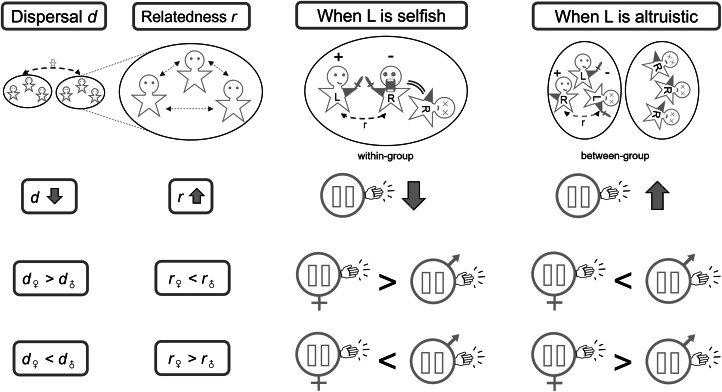 Figure 1
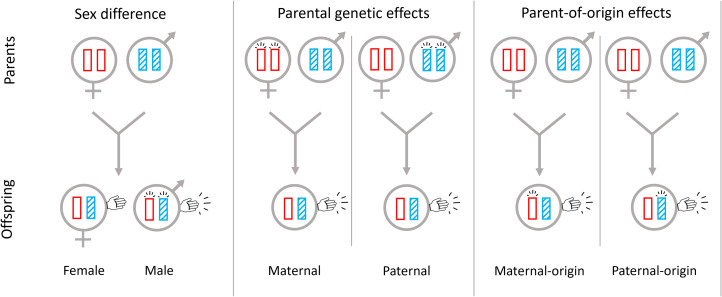 Figure 2
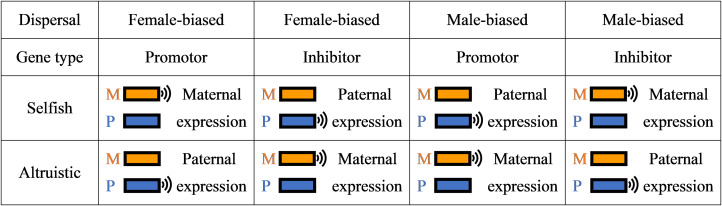 Figure 3
 Figure 4
Peer Reviews
No public reviews on file for this paper yet. If you reviewed it on a platform where reviews are public (OpenReview, ICLR, NeurIPS, ICML), you can paste yours below so the community can read it here.
Videos
No videos yet. Explain this paper in a talk, walkthrough, or lecture? Add one.
Taxonomy
TopicsHemispheric Asymmetry in Neuroscience · Evolutionary Psychology and Human Behavior · Primate Behavior and Ecology