Snapshot of Examination Usage in Emergency Medicine Clerkships
William D Alley, Iltifat Husain, Blake Briggs, David Story

TL;DR
This study surveyed emergency medicine clerkship directors to understand how exams are used to assess student knowledge, finding significant variability in exam types and grading practices.
Contribution
The study provides the first survey-based analysis of exam usage in emergency medicine clerkships, highlighting inconsistencies in assessment practices.
Findings
Most required clerkships and electives use exams, with NBME EM ACE and SAEM M4 being the most common.
Exam scores typically contribute 11-30% to the final grade, and many programs do not check if students have already taken the preferred exam.
There is significant variability in exam use and grading practices across institutions.
Abstract
Objective Emergency Medicine (EM) clerkships often use a written exam to assess the knowledge gained over the course of an EM rotation in medical school. Clerkship Directors (CDs) may choose the National Board of Medical Examiners (NBME) EM Advanced Clinical Science Subject Exam (ACE), the Society for Academic Emergency Medicine (SAEM) M4 exam, which has two versions, the SAEM M3 exam, or departmental exams. There are currently no published guidelines or consensus regarding their utility. This survey-based study was designed to collect data regarding current practices of EM clerkship exam usage to analyze trends and variability in what exams are used and how. Methods The authors designed a cross-sectional observational survey to collect data from EM CDs on exam utilization in clerkships. The survey population consisted of clerkship directors, assistant clerkship directors, or faculty…
Genes, proteins, chemicals, diseases, species, mutations and cell lines named across the full text — each resolved to its canonical identifier and authoritative record.
Click any figure to enlarge with its caption.
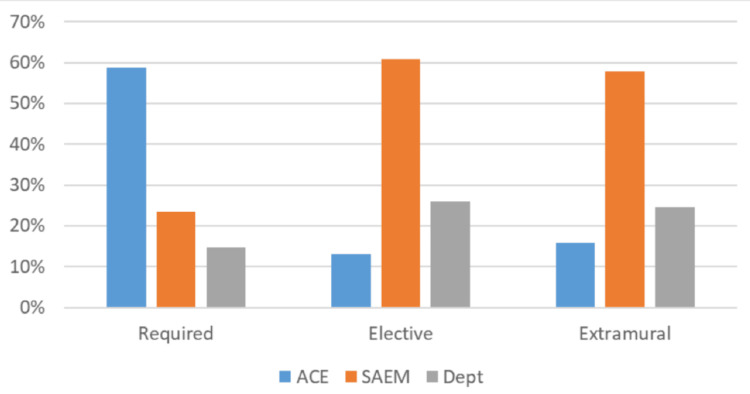 Figure 1
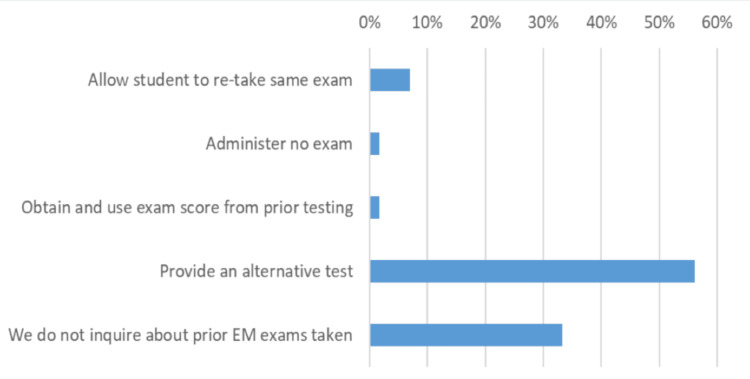 Figure 2
Peer Reviews
No public reviews on file for this paper yet. If you reviewed it on a platform where reviews are public (OpenReview, ICLR, NeurIPS, ICML), you can paste yours below so the community can read it here.
Videos
No videos yet. Explain this paper in a talk, walkthrough, or lecture? Add one.
Taxonomy
TopicsInnovations in Medical Education · Radiology practices and education · Ultrasound in Clinical Applications
Introduction
Across the United States, Emergency Medicine (EM) clerkships have been established to expose both third- and fourth-year medical students to the field of EM [1-3]. Knowledge-based exams are a core component of these clerkships. Multiple choice exams are often administered at the end of these clerkships to assess medical knowledge in EM [4,5]. Most of these exams are standardized and available to clerkship directors, including the National Board of Medical Examiners (NBME) Emergency Medicine Advanced Clinical Science Subject Exam (ACE) or the Society of Academic Emergency Medicine (SAEM) exam. The SAEM exam has three versions, EM-M4 versions 1 and 2 written for fourth-year students, and EM-M3, written for third-year students [6,7]. With a multitude of exams available, there is a paucity of literature showing what types are most being used.
Many students complete multiple EM clerkships in preparation for application into residency programs [8]. It has previously been documented that 59% of clerkship directors use a final, written exam, however this survey was performed in 2010 and before the ACE was created [6]. Due to a lack of consensus on the types of exams to use in EM clerkships, students may take the same exam in different clerkship locations. To our knowledge, there are no studies that evaluate the current exam structure on EM clerkships across the United States, as well as the implementation strategy in cases where students may have already completed the available exams.
In this study, we examine how clerkship directors (CDs) administer knowledge-based exams at the end of EM clerkships in order to identify trends and variability. Secondly, we look at what strategies are utilized when students have already taken a clerkship’s preferred exam. We believe these are important questions as these exams play a significant role in the overall evaluation of medical students, and variability in how these exams are used could insert a degree of unreliability in clerkship grades that are a factor used by residency programs in evaluating potential residency candidates, advantaging some while disadvantaging others. This variability could call into question the importance residency program directors place on the EM clerkship grade, potentially shifting it to other factors when evaluating residency applicants. At the same time, clerkship directors may use this data to spur a movement toward national consensus on exam usage to provide more consistency in the evaluation of medical students across institutions.
The abstract for this study was previously presented as a poster presentation at the 2023 CORD Academic Assembly in Las Vegas, Nevada on March 22, 2023.
Materials and methods
This was a cross-sectional observational survey targeting EM CDs at medical schools accredited by the Liaison Committee on Medical Education (LCME). EM CDs were identified by contact information available on the Emergency Medicine Residents’ Association (EMRA) Match website (https://webapps.emra.org/utils/spa/match#/search/map). Data was collected from surveys completed between February 2019 and August 2021. The study met criteria for exemption from informed consent by the Institutional Review Board of the Wake Forest School of Medicine (approval IRB00069527).
This survey was developed and disseminated based on best-practice principles described by Hoddinott et al. [9]. Survey items were first derived based on consensus of expert educators, including residency and clerkship leadership and the authors. Items were selected based on their relation to the use of exams as part of EM clerkship grading, including characteristics of the EM clerkship, whether an end-of-clerkship exam is used, relative weight of the exam grade in relation to the overall grade, and specific strategies used if a student has previously completed the preferred exam used by a clerkship. After review of preliminary items, comments on item comprehensibility, survey comprehensiveness, and content validity were obtained from independent EM medical student educators. Survey revisions were made based on this information, and the refined survey was then piloted with a small group of EM educators and clerkship directors. Adjustments were made based on respondent feedback and the survey finalized by consensus opinion. A complete copy of the survey is available online (https://www.surveymonkey.com/r/F2LWCLX).
Initial survey dissemination was conducted using an online survey service (SurveyMonkey,™ Palo Alto, CA, USA). First, a survey link was delivered to CDs over the Council of Residency Directors in Emergency Medicine (CORD) listserv. This community consists of 342 members. A second electronic correspondence was sent nine days later. Non-responders were identified and personalized emails containing a survey link were sent to clerkship directors at the email address listed on the EMRA Match website list of EM clerkships when accessed in April-June 2019. Responses were then analyzed for completion and program specificity. Duplicate responses from the same institution were evaluated and responses were prioritized as follows: clerkship director, assistant clerkship director, residency director, assistant residency director, other. Descriptive statistics were calculated and are reported.
Results
Ninety individuals completed the survey. Three institutions submitted two responses and duplicates were removed from the analysis. Two additional institutions submitted initially incomplete surveys that were subsequently completed in full. Data presented is based on the 87 responses out of an estimated total of 207 institutions contacted based on the number of clerkships listed on the EMRA Match website at the time of survey dissemination, resulting in a response rate of 42%. It should be noted that an accurate number of active EM clerkships is elusive due to variability from year to year, and a clerkship listing may remain despite inactivity. In order to evaluate for generalizability of the responses, an assessment of the regionality of respondents was performed. There were at least nine institutions responding from each U.S. region listed below, in addition to three international institutions.
CDs or assistant CDs completed 75 (86.2%) of the surveys, residency leadership five (5.7%) of the surveys, and the remaining seven (8.1%) of surveys were completed by someone in another role familiar with clerkship grading. Over half of respondents (46/87) reported that EM is a required rotation at their institution. Within the subset of programs with required EM rotations, 12 (26.1%) take place in the third year, 24 (52.2%) in the fourth year, and 10 (21.7%) in either the third or fourth years. Thirty-four (73.9%) institutions with required clerkships have their students take a written exam at the end of the rotation, with the ACE being the most commonly used in 20 (58.8%) of them. An SAEM exam (EM-M4 version 1, EM-M4 version 2 or EM-M3) is offered at eight (23.5%) and a departmental exam written by the home institution is offered at five (14.7%) (Figure 1). A single respondent was unable to specify the exam used. Most clerkships, 21 out of 34 (61.8%), weigh the exam at 11-30% of the final grade, six (17.7%) weigh it <10% of the final grade, five (14.7%) at 31-50% of the final grade, and two (5.9%) weigh it > 50% of the final grade.
Exam Offerings by Emergency Medicine Clerkship TypeExam Offerings by Emergency Medicine Clerkship Type (ACE, NBME Advanced Content Exam in Emergency Medicine; SAEM: Society of Academic Emergency Medicine M4 Exam, Dept: exams created by the clerkship faculty)
A great majority of institutions surveyed, 70/87 (80.5%), offer an elective in EM, with 48 (68.6%) of those programs administering an end-of-rotation exam. Most clerkships, 28 out of 46 (60.9%) who reported, use an SAEM exam at the end of the elective with 12 (26.1%) administering a departmental written exam and six (13.0%) utilizing ACE (Figure 1). Just over half of institutions, 25 out of 46 (54.4%), weigh that exam between 11-30% of the final grade, 18 (39.1%) at < 10% of the final grade and three (6.5%) between 31-50%. No elective exams constituted greater than 50% of the final grade calculation.
Extramural EM electives are available at 91.9% (79/86) of respondents’ institutions, with an end-of-rotation exam being a requirement at 58 (73.4%) of those. Nearly 60%, 34 out of 57 (57.9%), reported using a version of the SAEM exam, and nearly a quarter, 14 of 57 (24.6%), use departmental exams. Most of the remaining clerkships, nine (15.8%), use the ACE (Figure 1) with a single clerkship using an Objective Structured Clinical Exam (OSCE). The end-of-rotation exams are mostly weighted at either 0-10% of the final grade (20 of 57, 35.1%) or 11-30% of the final grade (33 of 57, 57.9%), with a much smaller proportion weighing 31-50% (3 of 57, 5.3%) or >50% (1 of 57, 1.8%).
The 57 clerkships that provide an end-of-rotation exam to extramural students were surveyed about practices for administering alternative exams if the student has already taken the exam offered. The majority of institutions, 32 (56.1%), provide an alternative exam, while one-third (19 of 57, 33.3%) do not inquire about prior tests taken, and four (7.0%) allow the student to retake an exam (Figure 2).
Responses to “What is your policy if an extramural (visiting) student has previously taken the given exam during a prior EM rotation?”EM: Emergency Medicine
Discussion
The use of end-of-clerkship exams to assess student performance is commonplace among US medical schools. This is consistent with prior literature findings [7]. However, our findings show variability in how these multiple-choice exams are used in both the test administered and their weighting in final rotation grade calculation. Additionally, more than a third of programs do not ask extramural students if they have taken a similar multiple-choice exam before.
Previous literature suggests that EM program directors place significant emphasis on student performance during EM clerkships in their selection criteria [8,10]. Our findings demonstrate that written exams are a major grading component contributing to clerkship grades. However, due to the variability in how these tests are used, EM program directors could be making comparisons among medical students based on unequal metrics, advantaging some and disadvantaging others. For example, a student who historically tests well is likely to earn a higher grade at a program that heavily weighs an exam score, while a student at an institution that weighs the exam minimally does not have the same opportunity to leverage an excellent test score to bolster their overall grade.
Multiple organizations recommend applicants to EM residency complete a total of two core EM clerkships, with allowances for individual circumstances that may benefit the student to complete three EM clerkships [11]. With each additional clerkship, our data suggests that a student is increasingly likely to be assessed with the same exam used in a previous clerkship. There is conflicting evidence on the effect of repeated exposure to questions on exams, but more robust scholarship in this area is needed to ensure the validity of the exam [12,13].
It is interesting to note that required clerkships are far more likely to use the ACE exam, while elective and extramural clerkships more commonly use SAEM exams or departmental exams. It is beyond the scope of this study to directly address the reasons for this, but some inferences can be cautiously made. First, NBME exams are commonly utilized in required clerkships for other specialties, making the natural consistency of using the ACE for EM attractive [14-16]. Second, the NBME has developed a reputation for its assessments across multiple specialties and levels of training, giving the impression of reliability and validity. Finally, cost may be a significant concern. At approximately 50 dollars per exam administration, offering the ACE comes with a large expense compared to the SAEM or departmental exams, which are offered at no additional cost.
Given these findings, it is apparent that the assessment of the knowledge base of students on EM clerkships varies amongst institutions, sometimes widely. This has implications for multiple stakeholders. First, residency program directors should be aware of this variability when using the clerkship grade as a major factor in evaluating potential residents. Clerkship directors should be clear about the metrics that are used to assign an overall clerkship grade and how they are used in order to provide a clearer assessment of a student’s clerkship performance.
This is a voluntary survey subject to selection and recall bias, and includes data from under half of the clerkships surveyed. However, the 42% response rate is consistent with the weighted mean response rate of online surveys in education-related fields, based on a meta-analysis by Wu et al. [17]. It also includes responses from a broad geographical distribution. Given the wide geographical distribution of respondents, we believe the data is at least reasonably representative of the whole.
Conclusions
We have found significant variability between EM clerkships in regards to the type of multiple choice exams used, the weighting of exam scores in relation to final grades, and the strategies used if a student has previously completed the preferred exam used by a clerkship. As end-of-clerkship exams are often used as a component of the overall clerkship grade, residency program directors should be aware of this variability when using the clerkship grade as a major factor in evaluating potential residents. Clerkship directors, too, should be aware of this variability as they consider how their approach to assessment presents an overall evaluation of a student compared to others within a residency interview pool.
The reference list from the paper itself. Each links out to its DOI / PubMed record.
- 1Report of the task force on national fourth year medical student emergency medicine curriculum guide Ann Emerg Med Manthey DE Coates WC Ander DS 0747200610.1016/j.annemergmed.2005.09.00216492483 · doi ↗ · pubmed ↗
- 2State of undergraduate education in emergency medicine: a national survey of clerkship directors Acad Emerg Med Khandelwal S Way DP Wald DA Fisher J Ander DS Thibodeau L Manthey DE 92952120142455252910.1111/acem.12290 · doi ↗ · pubmed ↗
- 3Self-efficacy beliefs and expectations during an emergency medicine clerkship Int J Emerg Med Cevik AA Cakal ED Alao D Elzubeir M Shaban S Abu-Zidan F 41520223506560810.1186/s 12245-021-00406-0PMC 8903584 · doi ↗ · pubmed ↗
- 4Anatomy of a clerkship test Acad Emerg Med Senecal EL Askew K Gorney B Beeson MS Manthey DE 0717 Suppl 2201010.1111/j.1553-2712.2010.00880.x 21199081 · doi ↗ · pubmed ↗
- 5Third-year medical student rotations in emergency medicine: a survey of current practices Acad Emerg Med Mulcare MR Suh EH Tews M Swan-Sein A Pandit K 0718 Suppl 2201110.1111/j.1553-2712.2011.01187.x 21999557 · doi ↗ · pubmed ↗
- 6A four-year perspective of Society for Academic Emergency Medicine tests: an online testing tool for medical students Acad Emerg Med Senecal EL Thomas SH Beeson MS 0516 Suppl 2200910.1111/j.1553-2712.2009.00594.x 20053210 · doi ↗ · pubmed ↗
- 7Emergency medicine student end-of-rotation examinations: where are we now?West J Emerg Med Miller ES Heitz C Ross L Beeson MS 1341361920182938306810.5811/westjem.2017.10.35144 PMC 5785180 · doi ↗ · pubmed ↗
- 8Emergency medicine residency selection criteria: an update and comparison AEM Educ Train Negaard M Assimacopoulos E Harland K Van Heukelom J 146153220183005108110.1002/aet 2.10089 PMC 6001734 · doi ↗ · pubmed ↗