Usefulness of unwinding the colonoscope shaft loop via the universal cord for colorectal endoscopic resections
Taiji Yoshimoto, Hiroshi Takihara, Ryuichi Yamamoto

TL;DR
This paper introduces a technique to maintain a clear view during colorectal endoscopic resections by unwinding the colonoscope shaft loop using the universal cord.
Contribution
A novel method for managing the colonoscope shaft loop to maintain consistent visualization during endoscopic procedures.
Findings
Unwinding the colonoscope shaft loop via the universal cord helps maintain the same endoscopic view.
This technique can be useful during colorectal endoscopic resections.
Abstract
The colonoscope shaft loop can be unwound by establishing a loop in the universal cord of the colonoscope to maintain the same endoscopic view during colorectal endoscopic resections.
Genes, proteins, chemicals, diseases, species, mutations and cell lines named across the full text — each resolved to its canonical identifier and authoritative record.
Click any figure to enlarge with its caption.
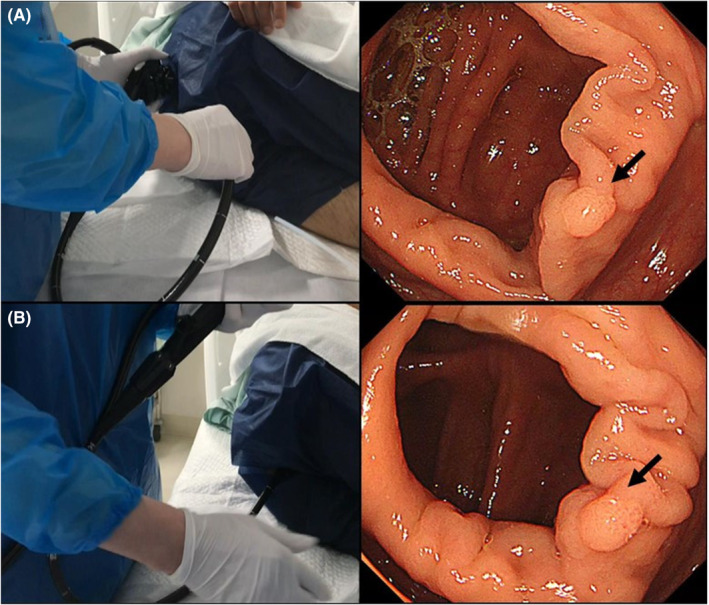 FIGURE 1
Peer Reviews
No public reviews on file for this paper yet. If you reviewed it on a platform where reviews are public (OpenReview, ICLR, NeurIPS, ICML), you can paste yours below so the community can read it here.
Videos
No videos yet. Explain this paper in a talk, walkthrough, or lecture? Add one.
Taxonomy
TopicsGastric Cancer Management and Outcomes · Colorectal Cancer Screening and Detection · Esophageal and GI Pathology
INTRODUCTION
1
Endoscopists must rotate the endoscope to bring the lesion closer to the forceps hole (typically in a 5–6 o'clock direction) while performing endoscopic colorectal resections.1, 2 During this process, a loop is sometimes created in the colonoscope shaft and the endoscopist's hands frequently need to maintain the loop to keep the same endoscopic view, making free hand movement difficult.
Unwinding the colonoscope shaft loop via the universal cord can be used for colorectal endoscopic treatment, such as colorectal endoscopic resections, because it frees the endoscopist's hands while maintaining the same endoscopic view during colorectal endoscopic resections (Figure 1, Video 1).
Colonic polypectomy case depicting the unwinding usage of the colonoscope shaft loop via the universal cord. Polyp of macroscopic type 0–Is, 5 mm in size, and located in the proximal ascending colon; arrow indicates the polyp. (A) Endoscope must be rotated counterclockwise to bring the polyp to the 5 o'clock direction, restricting the endoscopist's hand movement. (B) After unwinding the colonoscope shaft loop via the universal cord, the polyp remains in the 5 o'clock direction; however, the endoscope returns to a neutral position, enabling free hand movement.
Colonic polypectomy case using the unwinding of the colonoscope shaft loop via the universal cord.
AUTHOR CONTRIBUTIONS
Taiji Yoshimoto: Conceptualization; resources; supervision; writing – original draft; writing – review and editing. Hiroshi Takihara: Conceptualization; supervision; writing – review and editing. Ryuichi Yamamoto: Conceptualization; resources.
FUNDING INFORMATION
No funding was received.
CONFLICT OF INTEREST STATEMENT
The authors have no conflicts of interest to declare.
CONSENT
Written informed consent was obtained from the patient to publish this report in accordance with the journal's patient consent policy.
The reference list from the paper itself. Each links out to its DOI / PubMed record.
- 1Yoshimoto T , Takihara H , Yoshihara T , et al. Usefulness of “Nelaton attachment” for endoscopic submucosal dissection of colorectal neoplasms. Endosc Int Open. 2019;7(9):E 1187‐E 1191.31475238 10.1055/a-0961-7542 PMC 6715429 · doi ↗ · pubmed ↗
- 2Hsu CW , Wu CC , Lee MH , Wang JH , Chen YH , Chang MC . Endoscope rotating technique is useful for difficult colorectal endoscopic submucosal dissection. Surg Endosc. 2020;34(2):1006‐1011.31482351 10.1007/s 00464-019-07105-1 · doi ↗ · pubmed ↗