Low-cost and convenient screening of disease using analysis of physical measurements and recordings
Jay Chandra, Raymond Lin, Devin Kancherla, Sophia Scott, Daniel Sul, Daniela Andrade, Sammer Marzouk, Jay M. Iyer, William Wasswa, Cleva Villanueva, Leo Anthony Celi

TL;DR
This paper discusses how smartphones and low-cost sensors can be used to screen for diseases in low-resource areas, though challenges remain in bringing these tools to market.
Contribution
The paper highlights the potential of low-cost, smartphone-based diagnostic tools and identifies key challenges for their adoption.
Findings
Smartphones with sensors can collect medically relevant data for disease screening.
Low-cost tools are useful in areas with limited access to expensive diagnostic equipment.
Challenges include algorithmic bias and data storage/transfer issues.
Abstract
In recent years, there has been substantial work in low-cost medical diagnostics based on the physical manifestations of disease. This is due to advancements in data analysis techniques and classification algorithms and the increased availability of computing power through smart devices. Smartphones and their ability to interface with simple sensors such as inertial measurement units (IMUs), microphones, piezoelectric sensors, etc., or with convenient attachments such as lenses have revolutionized the ability collect medically relevant data easily. Even if the data has relatively low resolution or signal to noise ratio, newer algorithms have made it possible to identify disease with this data. Many low-cost diagnostic tools have been created in medical fields spanning from neurology to dermatology to obstetrics. These tools are particularly useful in low-resource areas where access to…
Genes, proteins, chemicals, diseases, species, mutations and cell lines named across the full text — each resolved to its canonical identifier and authoritative record.
Click any figure to enlarge with its caption.
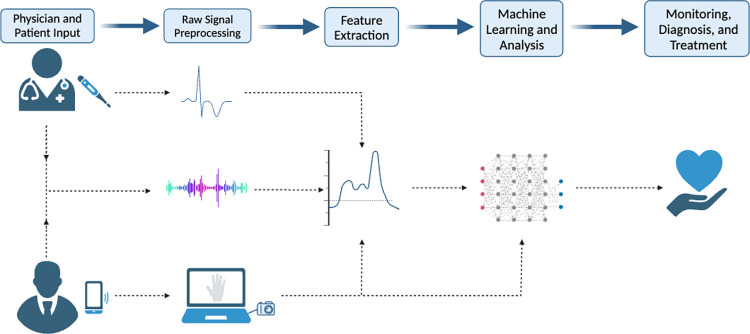 Figure 1
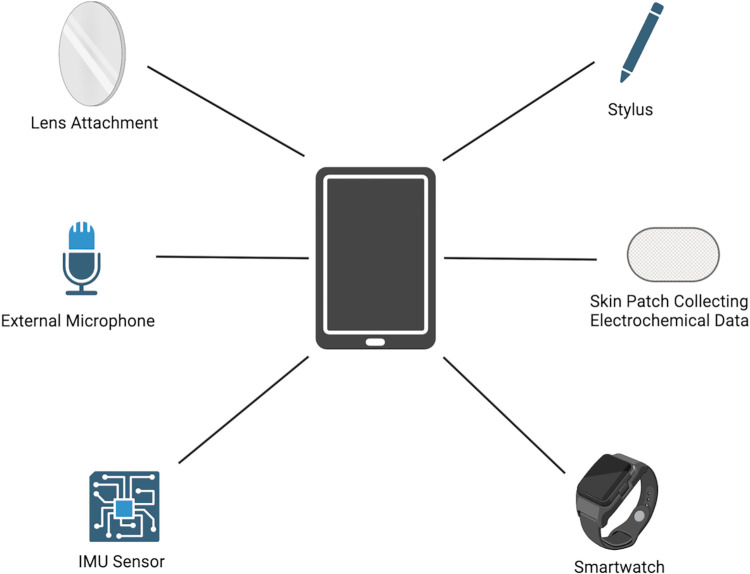 Figure 2
Peer Reviews
No public reviews on file for this paper yet. If you reviewed it on a platform where reviews are public (OpenReview, ICLR, NeurIPS, ICML), you can paste yours below so the community can read it here.
Videos
No videos yet. Explain this paper in a talk, walkthrough, or lecture? Add one.
Taxonomy
TopicsBiosensors and Analytical Detection · Digital Imaging for Blood Diseases · Phonocardiography and Auscultation Techniques