Longitudinal DNA methylation in parent–infant pairs impacted by intergenerational social adversity: An RCT of the Michigan Model of Infant Mental Health Home Visiting
Rebekah L. Petroff, Jennifer Jester, Jessica Riggs, Emily Alfafara, Katherine Springer, Natalie Kerr, Meriam Issa, Alanah Hall, Katherine Rosenblum, Jaclyn M. Goodrich, Maria Muzik

TL;DR
This study explores how early childhood experiences and a home visiting therapy program affect DNA methylation in infants and their mothers, suggesting that the epigenome may be sensitive to parenting and early life interventions.
Contribution
The study provides new insights into how parent-infant psychotherapy may influence DNA methylation in infants, particularly at genes related to stress and neurodevelopment.
Findings
Infant BDNF methylation decreased in response to the IMH-HV psychotherapy over 12 months.
SLC6A4 and LINE1 methylation in infants was associated with parenting attitudes.
Mothers' baseline methylation was not strongly linked to childhood adversity or treatment effects.
Abstract
Early childhood development is a strong predictor of long‐term health outcomes, potentially mediated via epigenetics (DNA methylation). The aim of the current study was to examine how childhood experiences, punitive parenting, and an intergenerational psychotherapeutic intervention may impact DNA methylation in young children and their mothers. Mothers and their infants/toddlers between 0 and 24 months were recruited at baseline (n = 146, 73 pairs) to participate in a randomized control trial evaluating the effectiveness of The Michigan Model of Infant Mental Health Home Visiting (IMH‐HV) parent–infant psychotherapy compared to treatment as usual. Baseline and 12‐month post‐enrollment data were collected in the family's home and included self‐report questionnaires, biological saliva samples, home environment observation, video‐taped parent–child interaction, and audio‐recorded…
Genes, proteins, chemicals, diseases, species, mutations and cell lines named across the full text — each resolved to its canonical identifier and authoritative record.
Click any figure to enlarge with its caption.
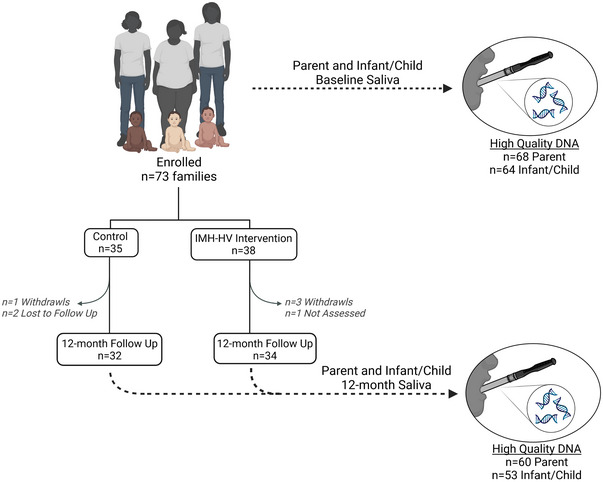 Figure 1
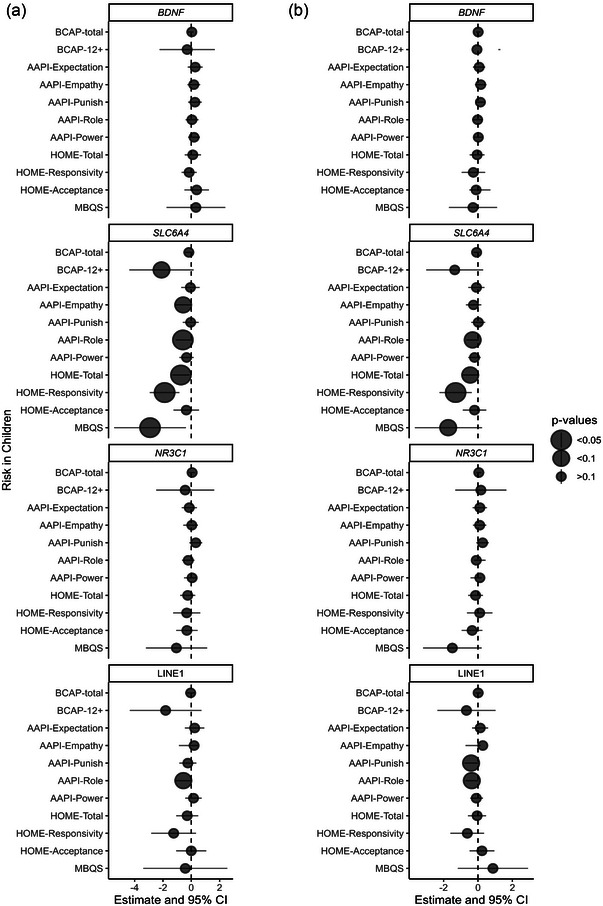 Figure 2
 Figure 3
Peer Reviews
No public reviews on file for this paper yet. If you reviewed it on a platform where reviews are public (OpenReview, ICLR, NeurIPS, ICML), you can paste yours below so the community can read it here.
Videos
No videos yet. Explain this paper in a talk, walkthrough, or lecture? Add one.
Taxonomy
TopicsChild Abuse and Trauma · Child Welfare and Adoption · Family Support in Illness