Reduction of peripersonal comfort space correlate with eating disorder symptoms in young adolescents: a network analysis approach
Beatriz Pereira Da Silva, Andrea Escelsior, Monica Biggio, Alessio Zizzi, Martino Belvederi Murri, Riccardo Guglielmo, Alberto Inuggi, Federico Delfante, Giacomo Marenco, Mario Amore, Gianluca Serafini

TL;DR
This study shows that reduced personal comfort space in adolescents is linked to eating disorder symptoms, suggesting socio-emotional issues may contribute to their development.
Contribution
The study applies network analysis to link peripersonal space and eating disorder symptoms in healthy adolescents.
Findings
Comfort distance estimation correlated with the visual scale of the AASP.
Eating disorder symptoms were linked to peripersonal space in healthy adolescents.
Touch scale scores were negatively correlated with eating disorder symptoms.
Abstract
Peripersonal Space (PS) is represented as the immediate area surrounding an individual. The extent of PS changes in relation to several factors, including emotional states, type of relationship or psychopathology. Attachment anxiety has an impact on the social adaptability of peripersonal space and anxiety and fear are associated with an expansion of peripersonal space, possibly serving as a mechanism of self-protection. Peripersonal space appears to be intricately linked to various psychiatric conditions like anxiety disorders and converging evidence suggests that social maladjustment may predict or exacerbate eating disorder symptoms expression. Fifty-eight healthy adolescents (38F, 20M) performed a comfort distance estimation task to assess peripersonal space. The Adolescent/Adult Sensory Profile (AASP) was used to assess sensory profiles and the SAFA protocol to investigate…
Genes, proteins, chemicals, diseases, species, mutations and cell lines named across the full text — each resolved to its canonical identifier and authoritative record.
Click any figure to enlarge with its caption.
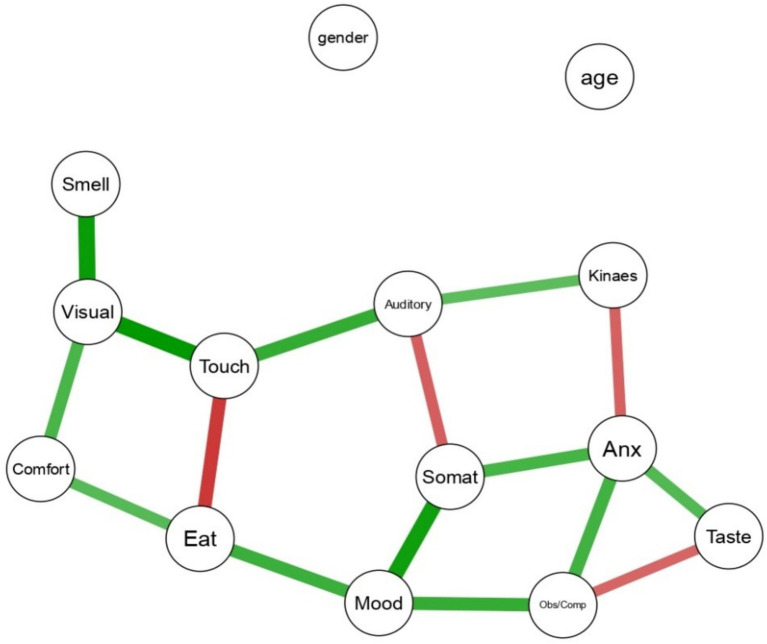 Figure 1
Peer Reviews
No public reviews on file for this paper yet. If you reviewed it on a platform where reviews are public (OpenReview, ICLR, NeurIPS, ICML), you can paste yours below so the community can read it here.
Videos
No videos yet. Explain this paper in a talk, walkthrough, or lecture? Add one.
Taxonomy
TopicsMental Health Research Topics · Eating Disorders and Behaviors · Psychological Well-being and Life Satisfaction