Detection of Hemoglobin Constant Spring: A Comparison of Capillary Electrophoresis Versus High-Performance Liquid Chromatography
Sharifatul Fatma Embong, Adibah Daud, Mohammad Hudzaifah Nordin, Sumaiyah Adzahar

TL;DR
This study compares two methods for detecting a type of thalassemia in Malaysia and finds capillary electrophoresis to be more effective than high-performance liquid chromatography.
Contribution
The study provides a direct comparison of diagnostic accuracy between capillary electrophoresis and HPLC for detecting Hemoglobin Constant Spring.
Findings
Capillary electrophoresis detected 92.3% of heterozygous Hb CS cases, while HPLC detected only 48.2%.
Both methods successfully detected all homozygous Hb CS cases.
A strong linear relationship was found between CE and HPLC results (p<0.001).
Abstract
Introduction: In Malaysia, Hemoglobin Constant Spring (Hb CS) is the most common non-deletional α-thalassemia, caused by a mutation at the termination codon of the α2-globin gene (TAA>CAA). Detection typically involves identifying an abnormal peak at zone 2 on capillary electrophoresis (CE) or a small peak at the C-window on high-performance liquid chromatography (HPLC), indicative of Hb CS. Objective: This study aimed to investigate the correlation between HPLC and CE in detecting Hb CS, evaluating their respective diagnostic accuracies and limitations. Methods: A cross-sectional study was conducted at Hospital Sultanah Nur Zahirah involving secondary school students (Form 4) from Terengganu who participated in a thalassemia screening program conducted by the Ministry of Health (MOH) from January 2019 to December 2022. Blood samples from subjects showing a positive peak in zone 2 of…
Genes, proteins, chemicals, diseases, species, mutations and cell lines named across the full text — each resolved to its canonical identifier and authoritative record.
Click any figure to enlarge with its caption.
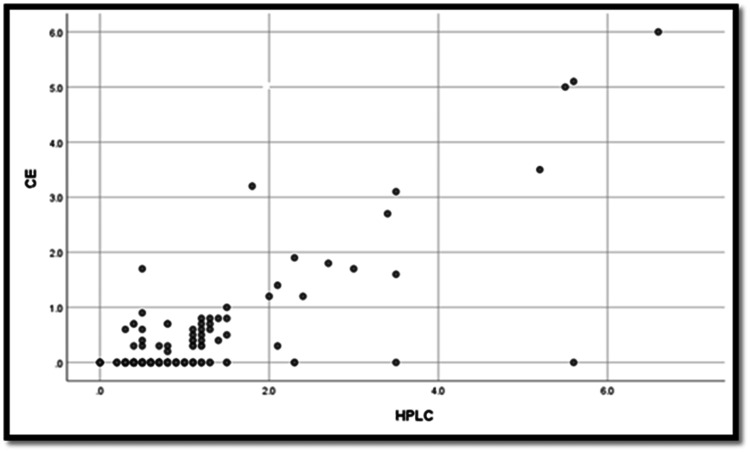 Figure 1
Peer Reviews
No public reviews on file for this paper yet. If you reviewed it on a platform where reviews are public (OpenReview, ICLR, NeurIPS, ICML), you can paste yours below so the community can read it here.
Videos
No videos yet. Explain this paper in a talk, walkthrough, or lecture? Add one.
Taxonomy
TopicsHemoglobinopathies and Related Disorders · Iron Metabolism and Disorders · Hemoglobin structure and function