Intra- and Extra-Articular Double-Level Osteotomy for Pediatric Malunited Proximal Phalangeal Fracture: A Case Report
Hirotaka Akezuma, Keikichi Kawasaki, Ichiro Okano, Kazutoshi Kubo, Yoshifumi Kudo

TL;DR
A 13-year-old boy with a malunited finger fracture was successfully treated with a double-level osteotomy to correct the deformity.
Contribution
This case report presents a successful surgical approach using intra- and extra-articular osteotomy for pediatric phalangeal malunions.
Findings
Surgical correction achieved near-anatomical alignment of malunited fracture fragments.
Solid bone union was achieved eight weeks post-surgery.
The double-level osteotomy is a viable option for pediatric bicondylar T-shaped malunions.
Abstract
A 13-year-old boy visited our clinic due to a malunion following a phalangeal bicondylar T-shaped fracture in the proximal interphalangeal (PIP) joint of his small finger. Imaging studies showed over 2 mm of fracture displacement and ulnar deviation of the radial condyle. The patient underwent surgical correction four weeks after the initial injury. The malunited fragments were reduced to their near-anatomical positions, and an extra-articular osteotomy was performed to realign the angular deformity. Solid bone union was successfully achieved eight weeks after the corrective surgery. This intra- and extra-articular double-level osteotomy is a good option for pediatric phalangeal bicondylar T-shaped malunions.
Genes, proteins, chemicals, diseases, species, mutations and cell lines named across the full text — each resolved to its canonical identifier and authoritative record.
Click any figure to enlarge with its caption.
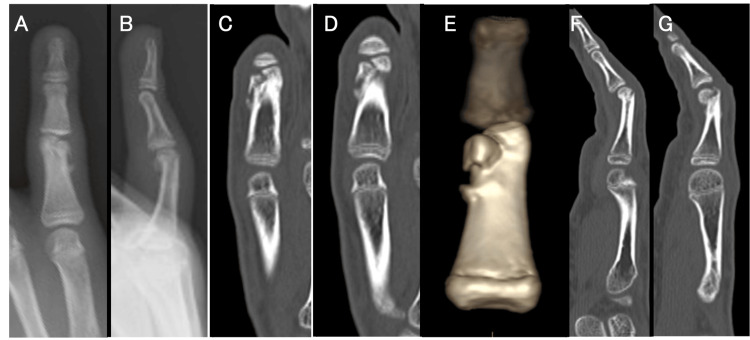 Figure 1
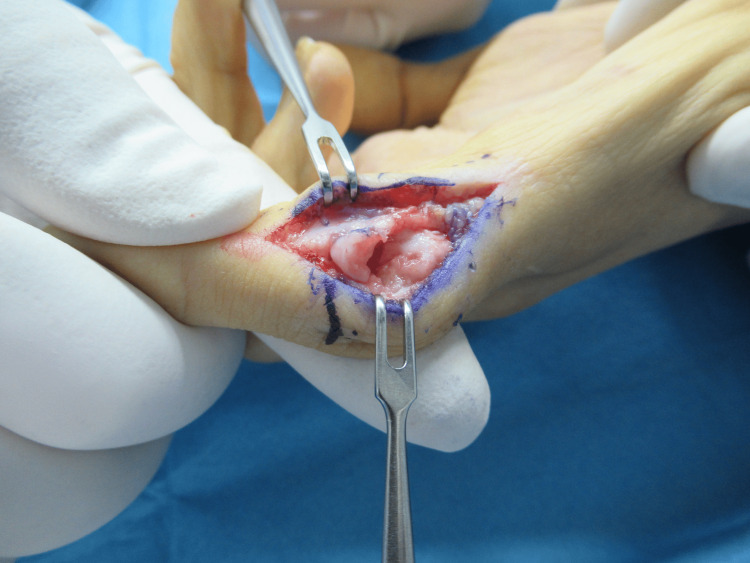 Figure 2
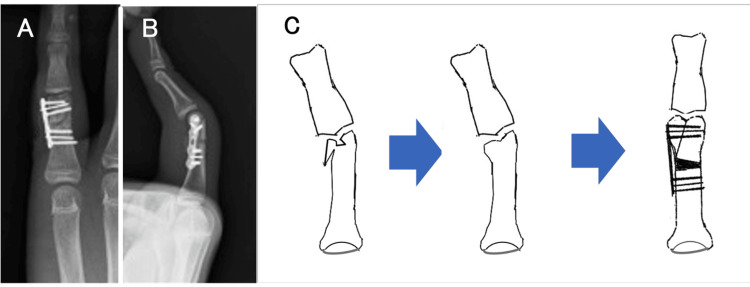 Figure 3
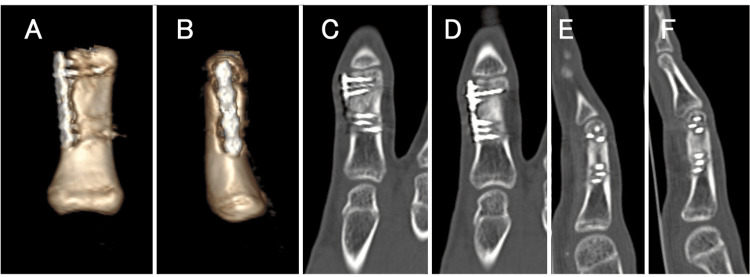 Figure 4
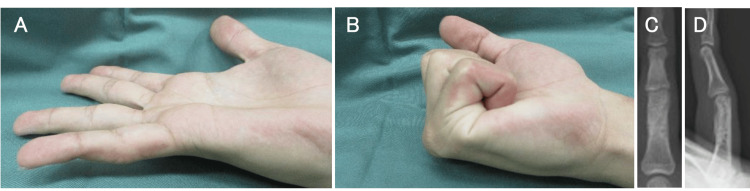 Figure 5
Peer Reviews
No public reviews on file for this paper yet. If you reviewed it on a platform where reviews are public (OpenReview, ICLR, NeurIPS, ICML), you can paste yours below so the community can read it here.
Videos
No videos yet. Explain this paper in a talk, walkthrough, or lecture? Add one.
Taxonomy
TopicsOrthopedic Surgery and Rehabilitation · Elbow and Forearm Trauma Treatment · Facial Nerve Paralysis Treatment and Research