Subword Representations Successfully Decode Brain Responses to Morphologically Complex Written Words
Tero Hakala, Tiina Lindh-Knuutila, Annika Hultén, Minna Lehtonen, Riitta Salmelin

TL;DR
This study shows that brain responses to complex Finnish words can be decoded using subword segments, suggesting the brain processes both whole words and their morphological components.
Contribution
The study introduces morphologically aware subword representations for decoding brain responses to morphologically complex words in agglutinative languages.
Findings
Decoding accuracy exceeded significance thresholds for all segmentations at 350–500 ms after stimulus onset.
Only morphologically aware segmentations reached significance in the brain decoding task.
Neural decoding using subword segments is effective for multimorphemic words in languages with complex morphology.
Abstract
This study extends the idea of decoding word-evoked brain activations using a corpus-semantic vector space to multimorphemic words in the agglutinative Finnish language. The corpus-semantic models are trained on word segments, and decoding is carried out with word vectors that are composed of these segments. We tested several alternative vector-space models using different segmentations: no segmentation (whole word), linguistic morphemes, statistical morphemes, random segmentation, and character-level 1-, 2- and 3-grams, and paired them with recorded MEG responses to multimorphemic words in a visual word recognition task. For all variants, the decoding accuracy exceeded the standard word-label permutation-based significance thresholds at 350–500 ms after stimulus onset. However, the critical segment-label permutation test revealed that only those segmentations that were morphologically…
Genes, proteins, chemicals, diseases, species, mutations and cell lines named across the full text — each resolved to its canonical identifier and authoritative record.
Click any figure to enlarge with its caption.
 Figure 1
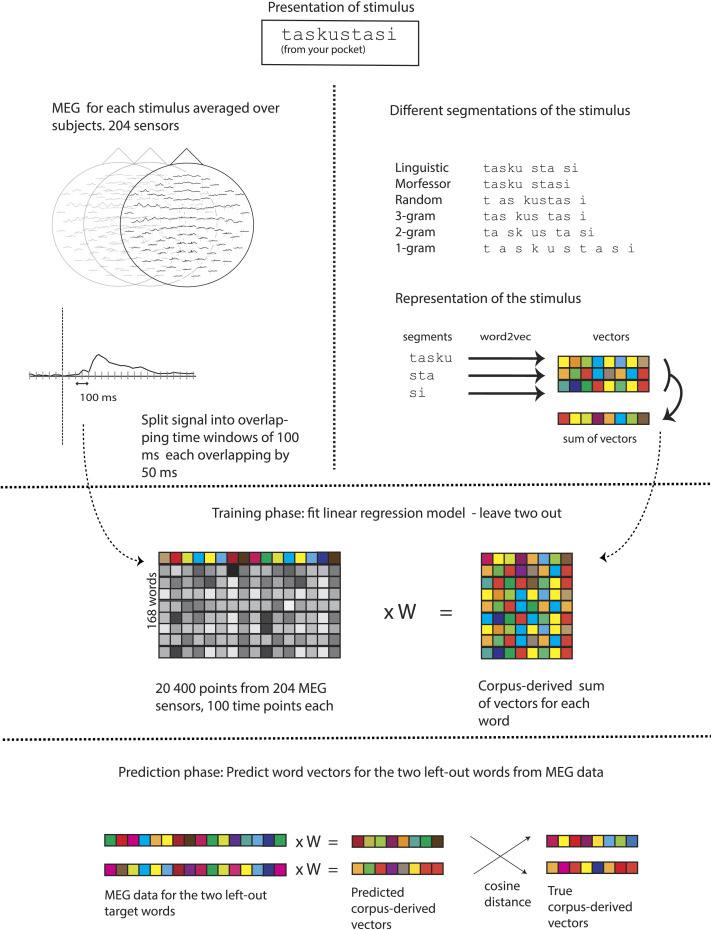 Figure 2
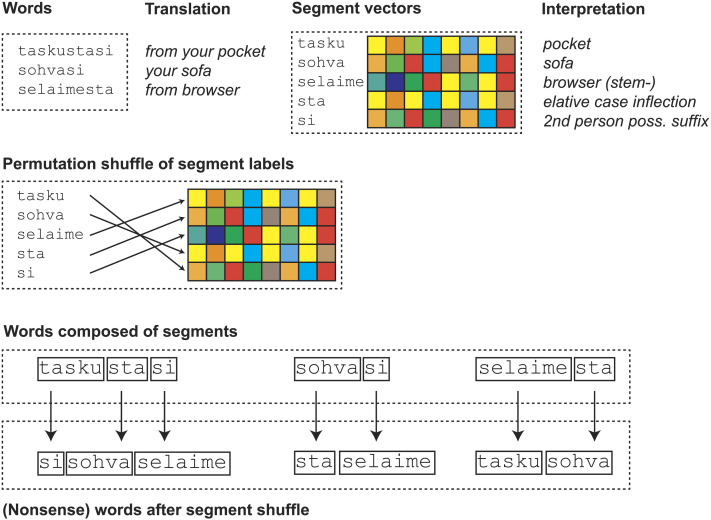 Figure 3
 Figure 4
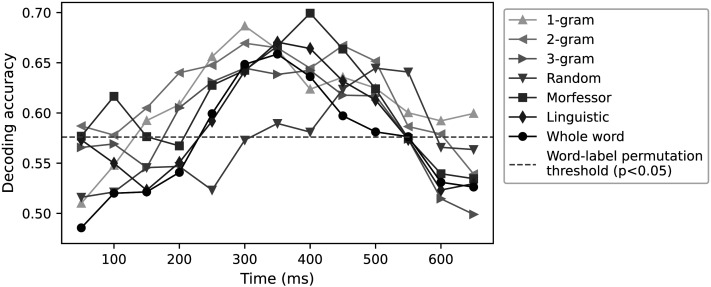 Figure 5
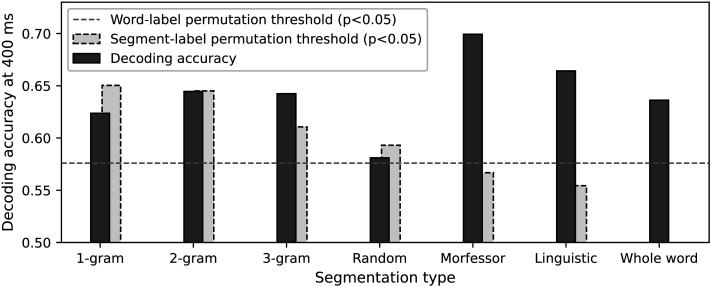 Figure 6
 Figure 7
 Figure 8
Peer Reviews
No public reviews on file for this paper yet. If you reviewed it on a platform where reviews are public (OpenReview, ICLR, NeurIPS, ICML), you can paste yours below so the community can read it here.
Videos
No videos yet. Explain this paper in a talk, walkthrough, or lecture? Add one.
Taxonomy
TopicsNeurobiology of Language and Bilingualism · Reading and Literacy Development · EEG and Brain-Computer Interfaces