White islands in a sea of red
Sara Elizabeth Milla Salguero, Eduardo Smelin Perdomo Domínguez

TL;DR
Dengue is a viral disease transmitted by mosquitoes, with skin symptoms that help distinguish it from other illnesses.
Contribution
The paper highlights the importance of dermatological manifestations in diagnosing dengue.
Findings
Dengue is caused by a single-stranded RNA virus from the Flaviviridae family.
Aedes aegypti and Aedes albopictus mosquitoes are primary vectors for dengue transmission.
Dermatological symptoms can help differentiate dengue from other diseases.
Abstract
Dengue is a viral disease caused by a single-stranded RNA virus from the Flaviviridae family, primarily transmitted by the Aedes aegypti mosquito, although Aedes albopictus also plays a role as a vector. Clinical features of dengue range from nonspecific symptoms to severe forms like dengue shock syndrome. Among these clinical features, dermatological manifestations are particularly noteworthy, as they can aid in differentiating dengue from other illnesses.
Genes, proteins, chemicals, diseases, species, mutations and cell lines named across the full text — each resolved to its canonical identifier and authoritative record.
Click any figure to enlarge with its caption.
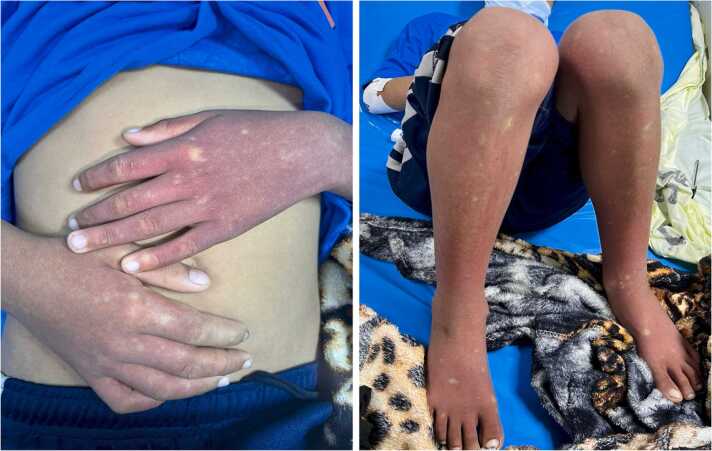 Figure 1
Peer Reviews
No public reviews on file for this paper yet. If you reviewed it on a platform where reviews are public (OpenReview, ICLR, NeurIPS, ICML), you can paste yours below so the community can read it here.
Videos
No videos yet. Explain this paper in a talk, walkthrough, or lecture? Add one.
Taxonomy
TopicsMosquito-borne diseases and control