Chronic exertional compartment syndrome of the forearm diagnosed in a wider spectrum of patients and not seldom with a history of the same diagnosis in the lower legs
Louise Sjöcrona, Sophia H. Lindorsson, Kajsa Rennerfelt

TL;DR
This study shows that chronic exertional compartment syndrome in the forearm occurs in a broader range of patients, including those with a history of the condition in their lower legs.
Contribution
The study expands the known patient profile for forearm CECS and questions the standard diagnostic pressure cutoff for this condition.
Findings
More male patients were diagnosed with forearm CECS compared to those without.
Over 20% of forearm CECS patients had prior treatment for lower leg CECS.
Standard intramuscular pressure cutoffs for diagnosing CECS may be too high for forearm compartments.
Abstract
To identify patient characteristics associated with forearm chronic exertional compartment syndrome (CECS) and to demonstrate the distribution of intramuscular pressure (IMP) values at 1 min postexercise in a cohort of patients with exercise‐induced forearm pain. A consecutive series of 99 patients seeking orthopaedic consultation for chronic exertional forearm pain underwent IMP measurements between 2010 and 2023. The diagnosis of CECS was confirmed (n = 34) or ruled out (n = 65) based on the patient's history, clinical examination and IMP measurements. There were significantly more male patients in the CECS group than in the group of patients where the diagnosis was ruled out. Furthermore, a significantly higher proportion of the CECS patients had been previously treated for CECS of the lower legs. The most common occupation was office worker (21%), followed by craftsperson (18%).…
Genes, proteins, chemicals, diseases, species, mutations and cell lines named across the full text — each resolved to its canonical identifier and authoritative record.
Click any figure to enlarge with its caption.
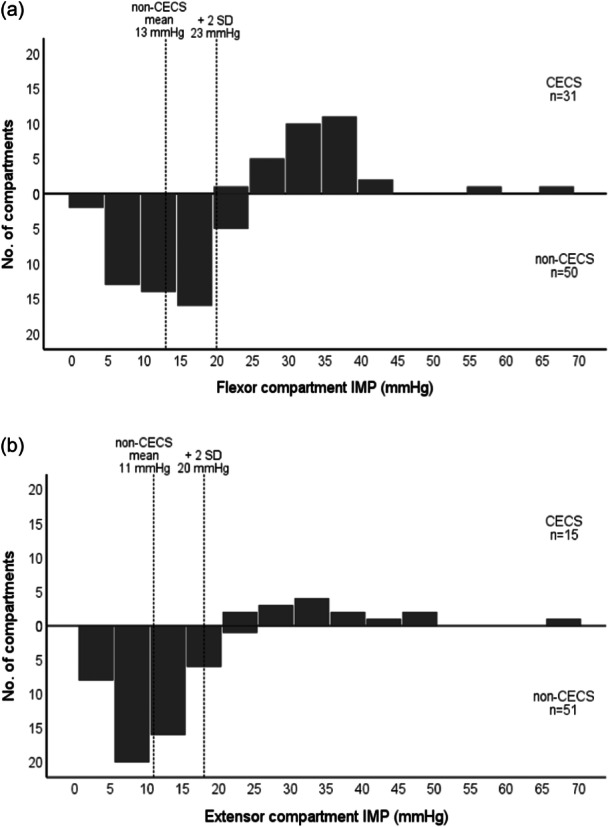 Figure 1
Peer Reviews
No public reviews on file for this paper yet. If you reviewed it on a platform where reviews are public (OpenReview, ICLR, NeurIPS, ICML), you can paste yours below so the community can read it here.
Videos
No videos yet. Explain this paper in a talk, walkthrough, or lecture? Add one.
Taxonomy
TopicsMuscle and Compartmental Disorders