Country-level income inequality and risky health behaviors of “golden youth” in the post-Communist countries of Europe: A cluster analysis
Armen Albert Torchyan, Inge Houkes, Hans Bosma

TL;DR
The paper finds that high-income adolescents in post-Communist European countries with high income inequality are more likely to engage in risky health behaviors.
Contribution
This study introduces a cluster analysis approach to examine how income inequality affects risky behaviors among high-socioeconomic status adolescents in post-Communist Europe.
Findings
High-SEP adolescents in countries with higher income inequality are more likely to engage in risky behaviors like alcohol consumption and bullying.
The odds of risky behaviors among high-SEP adolescents increase significantly in countries with high Gini index values.
Policies promoting income redistribution could reduce risky behaviors among affluent adolescents in post-Communist countries.
Abstract
•High-SEP adolescents might be at an increased risk for unhealthy behavior in post-Communist countries of Europe.•Wide income inequality might contribute to risky behaviors among high-SEP adolescents.•Policies promoting a fairer distribution of income may be necessary in several post-Communist countries of Europe. High-SEP adolescents might be at an increased risk for unhealthy behavior in post-Communist countries of Europe. Wide income inequality might contribute to risky behaviors among high-SEP adolescents. Policies promoting a fairer distribution of income may be necessary in several post-Communist countries of Europe. We aim to study the “golden youth” hypothesis, which suggests that risky behaviors might be prevalent among affluent adolescents in post-Communist countries of Europe (PCCE) with high income inequality. We included 71,119 adolescents aged 11–15 from 14 PCCE…
Genes, proteins, chemicals, diseases, species, mutations and cell lines named across the full text — each resolved to its canonical identifier and authoritative record.
Click any figure to enlarge with its caption.
 Figure 1
 Figure 2
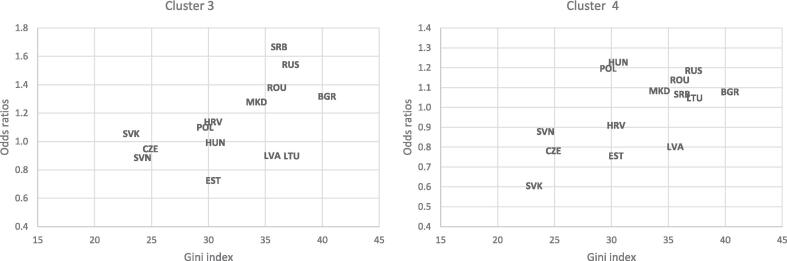 Figure 3
Peer Reviews
No public reviews on file for this paper yet. If you reviewed it on a platform where reviews are public (OpenReview, ICLR, NeurIPS, ICML), you can paste yours below so the community can read it here.
Videos
No videos yet. Explain this paper in a talk, walkthrough, or lecture? Add one.
Taxonomy
TopicsOptimism, Hope, and Well-being · Health and Conflict Studies · Health disparities and outcomes