DNA replication recruits a friend to overcome a challenging break-up
James M Dewar

TL;DR
This paper explains how leftover DNA replication complexes can block new replication and how cells use specific proteins to resolve this issue.
Contribution
The study reveals the biochemical mechanisms by which leftover replisomes are removed to allow new DNA replication.
Findings
Leftover replisomes hinder the next round of DNA replication.
Specific helicases help overcome the problem caused by leftover replisomes.
Abstract
Replication complexes, or replisomes, are removed from DNA upon completion of DNA synthesis, but the importance of replisome removal, as well as how cells might respond to defects in this process, has remained elusive. New work by Polo Rivera et al (2024) and Olson et al (2024) reveals that leftover replisomes are an obstacle to replication and provides a first glimpse into the biochemical mechanisms that solve this problem. Two recent articles reveal that leftover replisome impede the next round of replication, and how specific helicases can help to overcome this problem.
Genes, proteins, chemicals, diseases, species, mutations and cell lines named across the full text — each resolved to its canonical identifier and authoritative record.
Click any figure to enlarge with its caption.
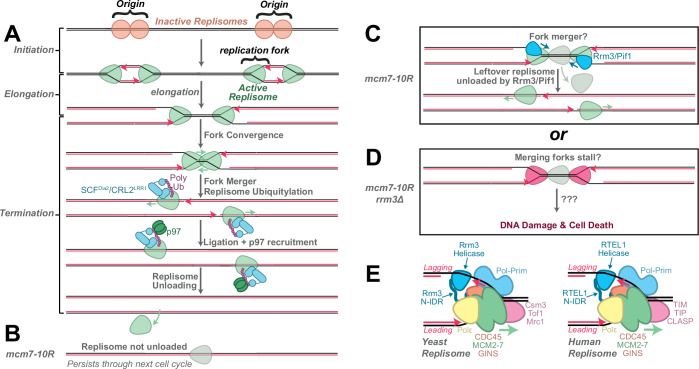 Figure 1
 Figure 2
Peer Reviews
No public reviews on file for this paper yet. If you reviewed it on a platform where reviews are public (OpenReview, ICLR, NeurIPS, ICML), you can paste yours below so the community can read it here.
Videos
No videos yet. Explain this paper in a talk, walkthrough, or lecture? Add one.
Taxonomy
TopicsDNA Repair Mechanisms · PARP inhibition in cancer therapy · Epigenetics and DNA Methylation