GTAM: a molecular pretraining model with geometric triangle awareness
Xiaoyang Hou, Tian Zhu, Milong Ren, Bo Duan, Chunming Zhang, Dongbo Bu, Shiwei Sun

TL;DR
GTAM is a new model that improves molecular representation learning by combining 2D and 3D information for better drug discovery and chemistry applications.
Contribution
GTAM introduces a novel contrastive learning strategy that integrates 2D and 3D molecular representations with geometric triangle awareness.
Findings
GTAM outperforms existing methods in capturing geometric dependencies in molecular structures.
The model shows superior performance on various 2D and 3D downstream tasks.
GTAM's contrastive training objectives enhance the transfer of edge information between 2D and 3D representations.
Abstract
Molecular representation learning is pivotal for advancing deep learning applications in quantum chemistry and drug discovery. Existing methods for molecular representation learning often fall short of fully capturing the intricate interactions within chemical bonds of 2D topological graphs and the multifaceted effects of 3D geometric conformations. To overcome these challenges, we present a novel contrastive learning strategy for molecular representation learning, named Geometric Triangle Awareness Model (GTAM). This method integrates innovative molecular encoders for both 2D graphs and 3D conformations, enabling the accurate capture of geometric dependencies among edges in graph-based molecular structures. Furthermore, GTAM is bolstered by the development of two contrastive training objectives designed to facilitate the direct transfer of edge information between 2D topological…
Genes, proteins, chemicals, diseases, species, mutations and cell lines named across the full text — each resolved to its canonical identifier and authoritative record.
Click any figure to enlarge with its caption.
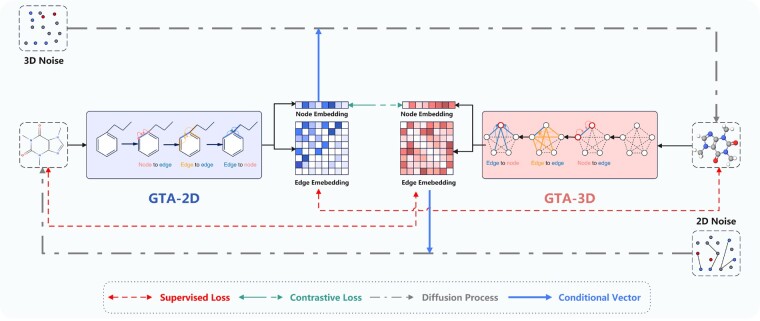 Figure 1
 Figure 2
Peer Reviews
No public reviews on file for this paper yet. If you reviewed it on a platform where reviews are public (OpenReview, ICLR, NeurIPS, ICML), you can paste yours below so the community can read it here.
Videos
No videos yet. Explain this paper in a talk, walkthrough, or lecture? Add one.
Taxonomy
TopicsMachine Learning in Materials Science · Computational Drug Discovery Methods · Protein Structure and Dynamics