The complete chloroplast genome of Elaeagnus bambusetorum hand.-mazz. 1933 and its implications for phylogenetic relationships in the Elaeagnus genus
Yuchen Yang, Jun Li, Zhixiang Zhang, Mengxue Zhang

TL;DR
This paper reports the complete chloroplast genome of Elaeagnus bambusetorum and its evolutionary relationships with other species in the Elaeagnus genus.
Contribution
The study provides the first complete chloroplast genome sequence for Elaeagnus bambusetorum and clarifies its phylogenetic position.
Findings
The chloroplast genome is 152,265 bp long with 113 genes and a GC content of 37.1%.
Phylogenetic analysis shows E. bambusetorum is closely related to E. loureirii and E. conferta.
The genome structure includes inverted repeats and single-copy regions typical of angiosperms.
Abstract
Elaeagnus bambusetorum Hand.-Mazz. is a rare plant from China in the Elaeagnaceae family. In this study, we sequenced its complete chloroplast genome. The whole chloroplast genome was 152,265 bp in length, containing a pair of inverted repeats of 25,897 bp, separated by large single copy and small single copy regions of 82,291 bp and 18,180 bp, respectively. The complete genome contained 113 genes, including 79 protein-coding genes, 30 tRNA genes, and 4 rRNA genes. The overall GC content was 37.1%. Phylogenetic analysis using the whole chloroplast genome revealed that E. bambusetorum is sister to E. loureirii and E. conferta. Our study provides valuable insights into the genetic information of E. bambusetorum, which may have important implications for species conservation.
Genes, proteins, chemicals, diseases, species, mutations and cell lines named across the full text — each resolved to its canonical identifier and authoritative record.
Click any figure to enlarge with its caption.
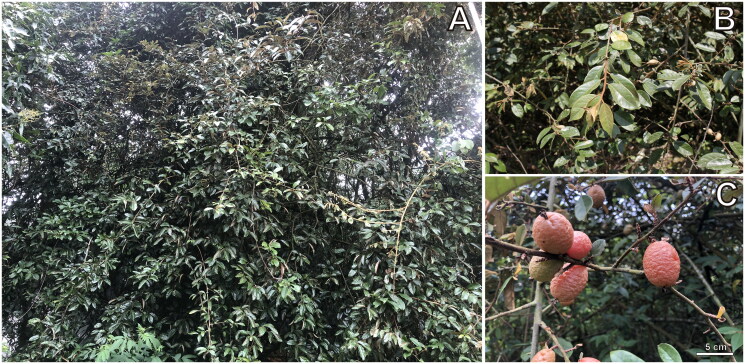 Figure 1
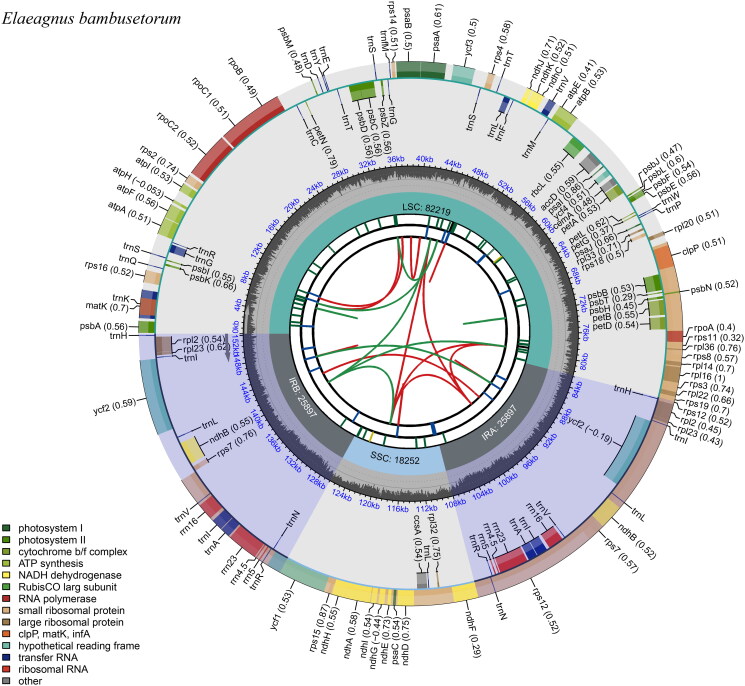 Figure 2
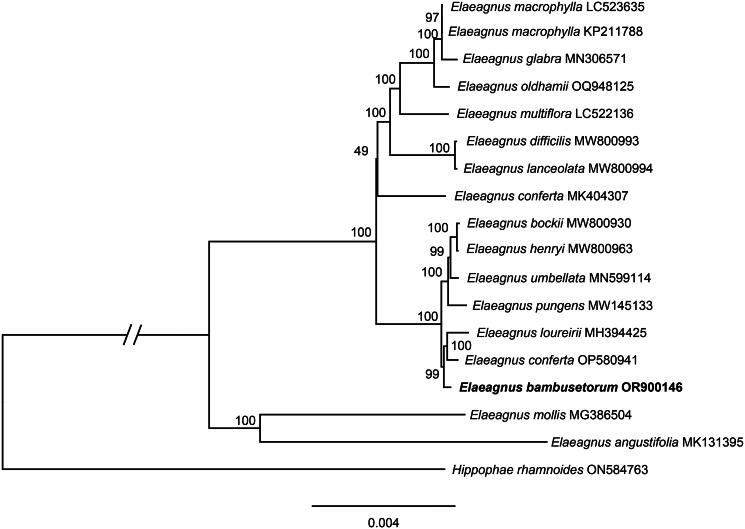 Figure 3
Peer Reviews
No public reviews on file for this paper yet. If you reviewed it on a platform where reviews are public (OpenReview, ICLR, NeurIPS, ICML), you can paste yours below so the community can read it here.
Videos
No videos yet. Explain this paper in a talk, walkthrough, or lecture? Add one.
Taxonomy
TopicsPhytochemical and Pharmacological Studies