Evidence of survival bias in the association between APOE-Є4 and age at ischemic stroke onset
Joanna von Berg, Patrick F. McArdle, Paavo Häppölä, Jeffrey Haessler, Charles Kooperberg, Robin Lemmens, Alessandro Pezzini, Vincent Thijs, Sara L. Pulit, Steven J. Kittner, Braxton D. Mitchell, Jeroen de Ridder, Sander W. van der Laan

TL;DR
This study suggests that a genetic variant linked to earlier stroke onset may actually reflect survival bias rather than a direct effect on stroke risk.
Contribution
The paper introduces a novel hypothesis that the APOE-Є4 allele's association with stroke age at onset may be due to survival bias, not direct stroke causation.
Findings
The APOE-Є4 allele is associated with a 1.29-year earlier age at onset of ischemic stroke in women.
Simulations suggest that the observed effect could result from survival bias due to higher mortality in non-carriers.
The association may not reflect a direct causal relationship with stroke but rather a general survival effect.
Abstract
Large genome-wide association studies (GWASs) using case–control study designs have now identified tens of loci associated with ischemic stroke (IS). As a complement to these studies, we performed GWAS in a case-only design to identify loci influencing the age at onset (AAO) of ischemic stroke. Analyses were conducted in a discovery cohort of 10,857 ischemic stroke cases using a linear regression framework. We meta-analyzed all SNPs with p-value <1 x 10⁻⁵ in a sexcombined or sex-stratified analysis using summary data from two additional replication cohorts. In the women-only meta-analysis, we detected significant evidence for the association of AAO with rs429358, an exonic variant in apolipoprotein E (APOE) that encodes for the APOE-Є4 allele. Each copy of the rs429358:T>C allele was associated with a 1.29-year earlier stroke AAO (meta p-value = 2.48 x 10⁻¹¹). This APOE variant has…
Genes, proteins, chemicals, diseases, species, mutations and cell lines named across the full text — each resolved to its canonical identifier and authoritative record.
Click any figure to enlarge with its caption.
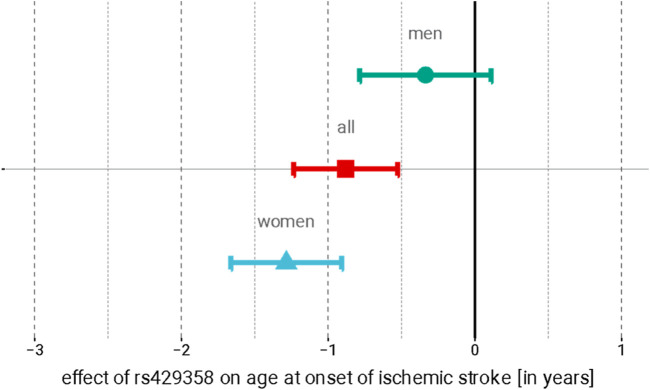 Figure 1
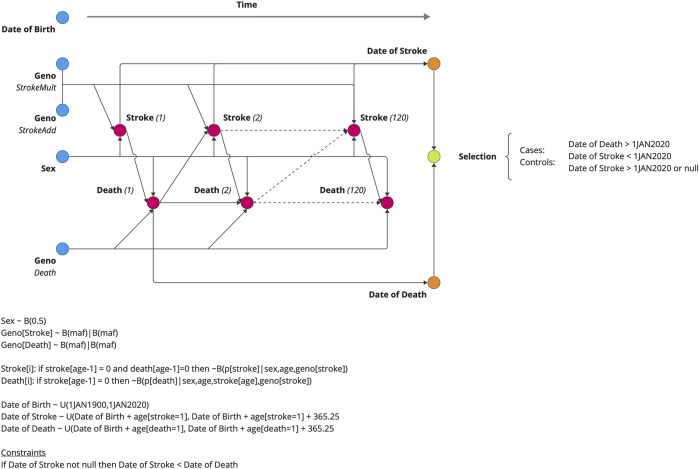 Figure 2
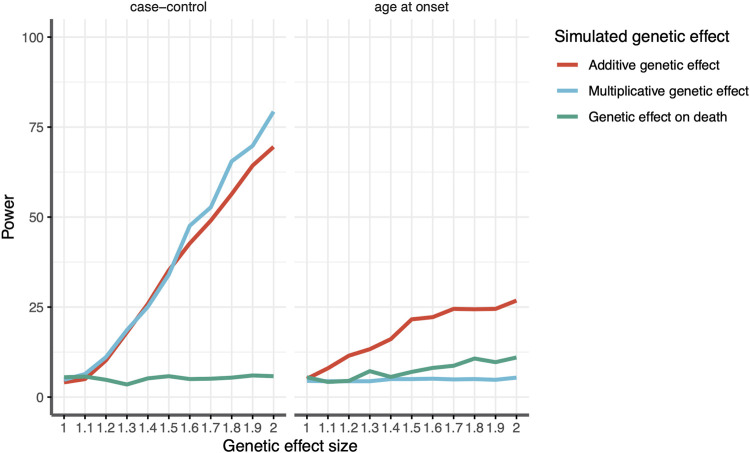 Figure 3
Peer Reviews
No public reviews on file for this paper yet. If you reviewed it on a platform where reviews are public (OpenReview, ICLR, NeurIPS, ICML), you can paste yours below so the community can read it here.
Videos
No videos yet. Explain this paper in a talk, walkthrough, or lecture? Add one.
Taxonomy
TopicsGenetic Associations and Epidemiology · Cancer-related molecular mechanisms research · Bioinformatics and Genomic Networks