The changing contributory role to infections of work, public transport, shopping, hospitality and leisure activities throughout the SARS-CoV-2 pandemic in England and Wales
Susan Hoskins, Sarah Beale, Vincent G Nguyen, Thomas Byrne, Alexei Yavlinsky, Jana Kovar, Erica Wing Lam Fong, Cyril Geismar, Annalan M. D. Navaratnam, Martie van Tongeren, Anne M. Johnson, Robert W. Aldridge, Andrew Hayward, Benjamin Wachtler, Larese Filon Francesca

TL;DR
This study shows how work and public transport were major infection sources during the pandemic, while leisure and hospitality became more significant as restrictions eased.
Contribution
The study identifies changing risk factors for SARS-CoV-2 infections linked to specific non-household activities during different pandemic phases in England and Wales.
Findings
Work and public transport were key infection sources during strict restrictions.
Leisure and hospitality activities became more significant as restrictions eased.
Indoor use of hospitality and leisure venues posed higher infection risks than outdoor use.
Abstract
Understanding how non-household activities contributed to severe acute respiratory syndrome coronavirus 2 (SARS-CoV-2) infections under different levels of national health restrictions is vital. Among adult Virus Watch participants in England and Wales, we used multivariable logistic regressions and adjusted-weighted population attributable fractions (aPAF) assessing the contribution of work, public transport, shopping, and hospitality and leisure activities to infections. Under restrictions, among 17,256 participants (502 infections), work [adjusted odds ratio (aOR) 2.01 (1.65–2.44), (aPAF) 30% (22–38%)] and transport [(aOR 1.15 (0.94–1.40), aPAF 5% (-3–12%)], were risk factors for SARS-CoV-2 but shopping, hospitality and leisure were not. Following the lifting of restrictions, among 11,413 participants (493 infections), work [(aOR 1.35 (1.11–1.64), aPAF 17% (6–26%)] and transport…
Genes, proteins, chemicals, diseases, species, mutations and cell lines named across the full text — each resolved to its canonical identifier and authoritative record.
Click any figure to enlarge with its caption.
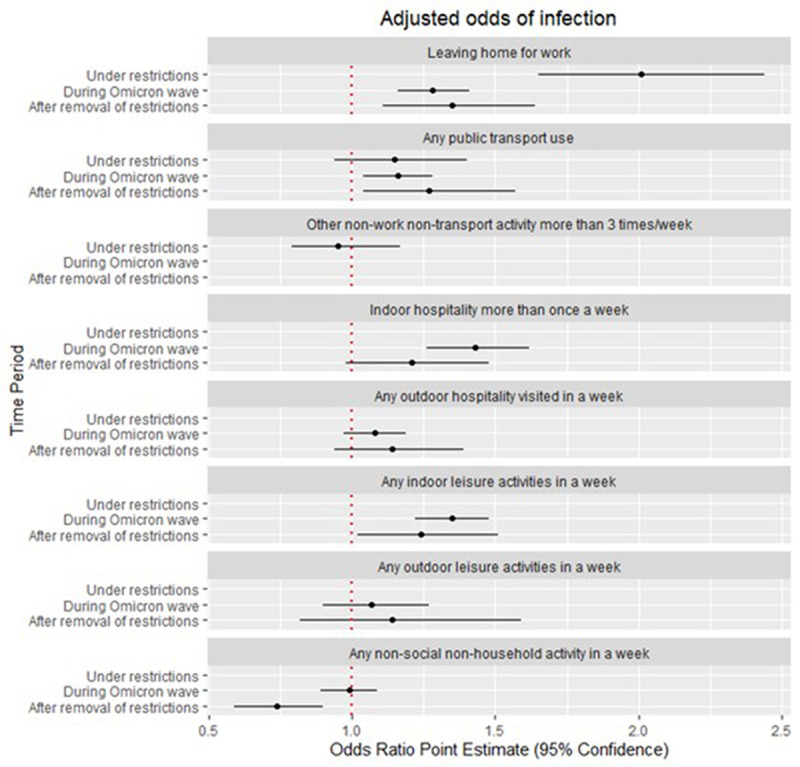 Figure 1
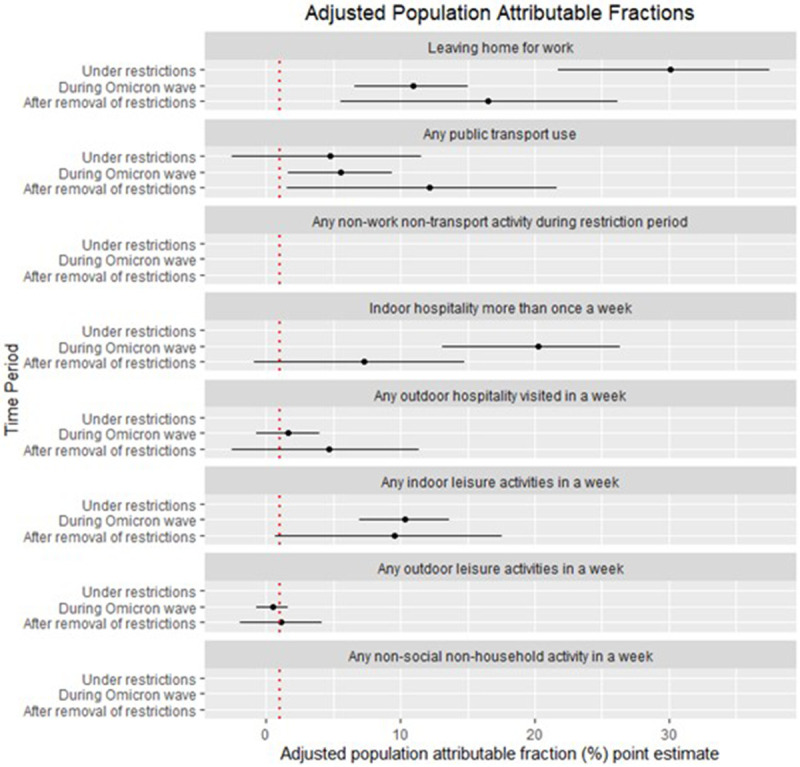 Figure 2
Peer Reviews
No public reviews on file for this paper yet. If you reviewed it on a platform where reviews are public (OpenReview, ICLR, NeurIPS, ICML), you can paste yours below so the community can read it here.
Videos
No videos yet. Explain this paper in a talk, walkthrough, or lecture? Add one.
Taxonomy
TopicsCOVID-19 epidemiological studies · COVID-19 Pandemic Impacts · COVID-19 and Mental Health