Expression of Aberrant MicroRNAs and p16INK4a Associated with HPV (6, 11, 16, 18, 31, 33, 35, 42, 43, 44, 45, 52, 53, and 56) in Oral Dysplasia and Squamous Cell Carcinoma: A Retrospective Study
Layla Hafed, Olfat Shaker, Ghada Ayeldeen, Hatem Amer, Gamilah Al-Qadhi

TL;DR
This study found that certain microRNAs and p16INK4a are overexpressed in HPV-related oral dysplasia and cancer, suggesting they could be useful biomarkers.
Contribution
The study identifies specific miRNAs and p16INK4a as potential biomarkers for HPV-associated oral diseases.
Findings
MiRNA-21, miRNA-22, and miRNA-224 were overexpressed in HPV-positive oral dysplasia and squamous cell carcinoma.
p16INK4a showed intense staining in 17 out of 17 OSCC specimens positive by RT-PCR.
Control specimens showed no expression of the studied miRNAs or p16INK4a.
Abstract
Objective: A few studies indicate that human papillomavirus (HPV) induces aberrant expression of microRNAs (miRNAs) and correlate this with p16INK4a in oral dysplasia (OD) and oral squamous cell carcinoma (OSCC). Therefore, this study aimed to evaluate the expression of miRNA-21, miRNA-22, and miRNA-224 by q-PCR and the p16INK4a by immunohistochemical (IHC) as markers for HPV-positive OSCC and OD in comparison to controls as miRNA expression can be altered by the HPV oncogenes and hence can be used as a biomarker for HPV positive cases. Material and Methods: Fifty-two specimens were collected from archived paraffin blocks for patients aged between 19 and 88 (31 males and 21 females) from various oral sites. They were examined by IHC using p16INK4a, by RT-PCR for the detection of HPV (6, 11, 16, 18, 31, 33, 35, 42, 43, 44, 45, 52, 53, 56), and by q-PCR for the expression of miRNA-21,…
Genes, proteins, chemicals, diseases, species, mutations and cell lines named across the full text — each resolved to its canonical identifier and authoritative record.
Click any figure to enlarge with its caption.
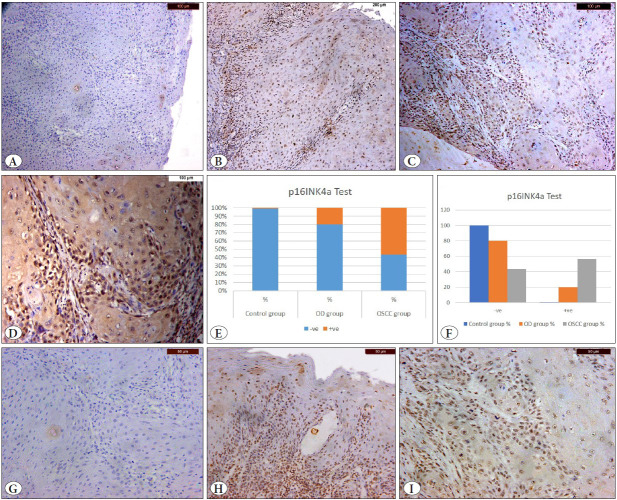 Figure 1
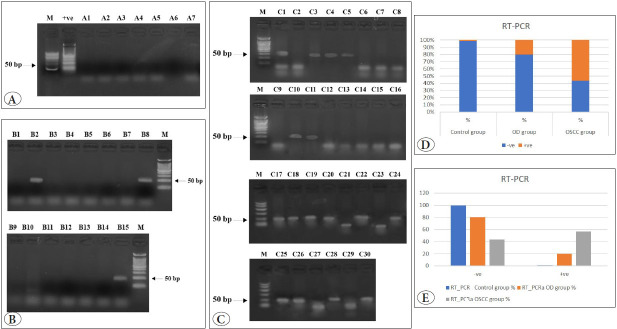 Figure 2
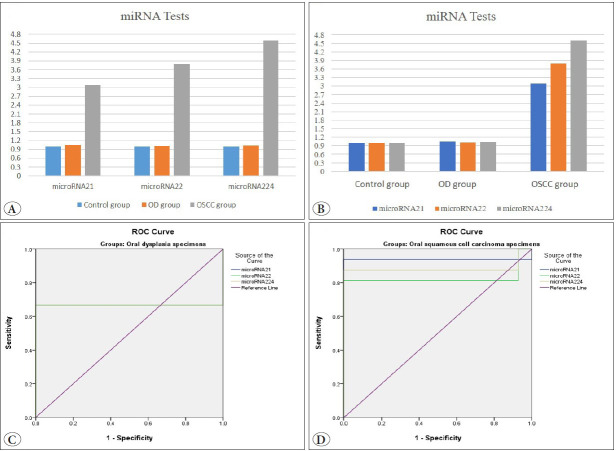 Figure 3
Peer Reviews
No public reviews on file for this paper yet. If you reviewed it on a platform where reviews are public (OpenReview, ICLR, NeurIPS, ICML), you can paste yours below so the community can read it here.
Videos
No videos yet. Explain this paper in a talk, walkthrough, or lecture? Add one.
Taxonomy
TopicsMicroRNA in disease regulation · Cancer-related molecular mechanisms research · RNA modifications and cancer