A brief review and guidance on the spatiotemporal sampling designs for disease vector surveillance
Abdollah Jalilian, Jorge Mateu, Luigi Sedda

TL;DR
This paper reviews spatiotemporal sampling methods for disease vector surveillance to help researchers collect representative data on mosquitoes and other vectors.
Contribution
The paper provides concise guidance on choosing optimal spatiotemporal sampling designs for vector-borne disease surveillance.
Findings
Non-probabilistic preferential sampling can lead to biased mosquito parameter estimates.
A mixed random and grid survey is optimal when little prior information is available.
Adaptive designs improve efficiency when previous data is available.
Abstract
Obtaining a representative sample of disease vectors (mosquitoes, flies, ticks, etc.) is essential for researchers to draw meaningful conclusions about the entire vector population in a target study area and during a specific study period. To achieve this, a carefully chosen surveillance design is required to ensure that the sample captures essential spatial and temporal variations in the target vector population(s) and/or that the study results can be generalized to the entire population. Designed-based and model-based spatiotemporal sampling (or in our context surveillance) designs can be used to maximize information gain within given resource constraints. In this paper, we aim to offer a concise overview of common spatiotemporal field sampling designs, their advantages and disadvantages and their practical applications in the context of surveillance and management of vector-borne…
Genes, proteins, chemicals, diseases, species, mutations and cell lines named across the full text — each resolved to its canonical identifier and authoritative record.
Click any figure to enlarge with its caption.
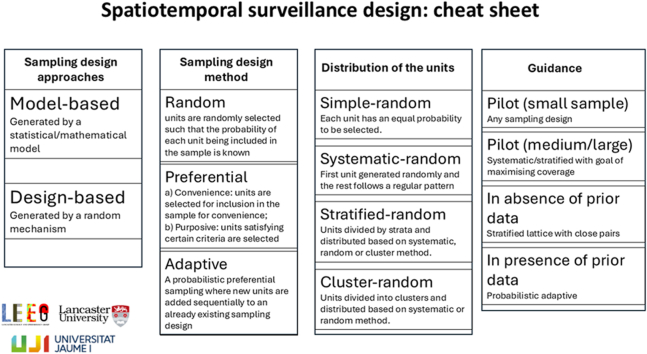 Figure 1
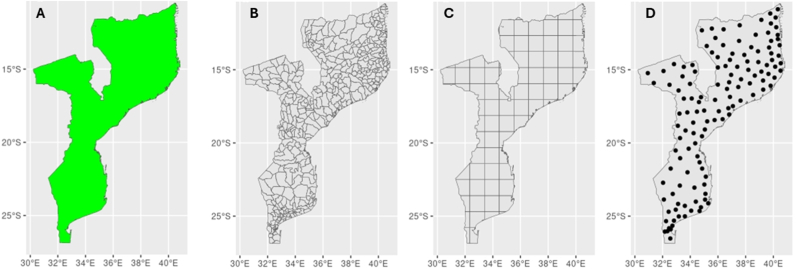 Figure 2
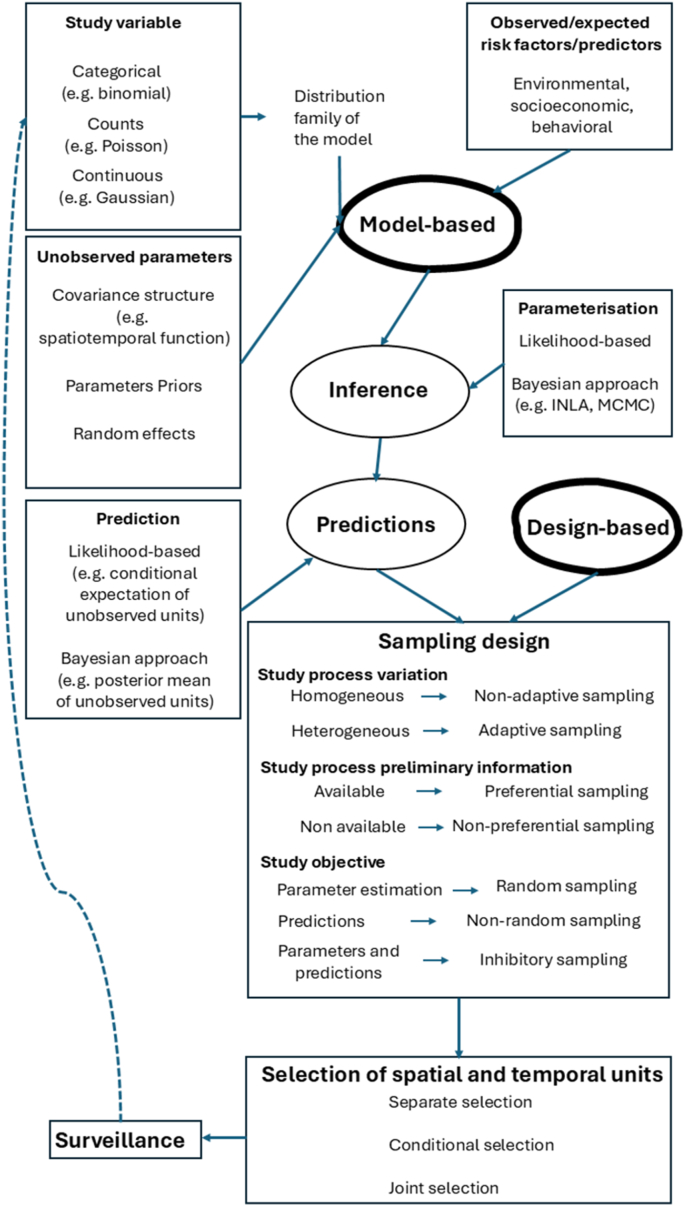 Figure 3
Peer Reviews
No public reviews on file for this paper yet. If you reviewed it on a platform where reviews are public (OpenReview, ICLR, NeurIPS, ICML), you can paste yours below so the community can read it here.
Videos
No videos yet. Explain this paper in a talk, walkthrough, or lecture? Add one.
Taxonomy
TopicsItalian Fascism and Post-war Society · Historical and Environmental Studies