Unilateral vulval swelling in a cyclist: A case report
Farrah Aljuhani, Jean-Philippe Arnault, Guillame Chaby

Abstract
Genes, proteins, chemicals, diseases, species, mutations and cell lines named across the full text — each resolved to its canonical identifier and authoritative record.
Click any figure to enlarge with its caption.
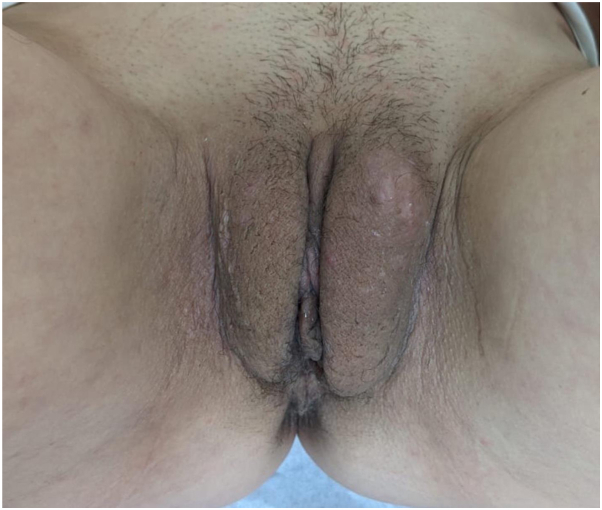 Figure 1
Peer Reviews
No public reviews on file for this paper yet. If you reviewed it on a platform where reviews are public (OpenReview, ICLR, NeurIPS, ICML), you can paste yours below so the community can read it here.
Videos
No videos yet. Explain this paper in a talk, walkthrough, or lecture? Add one.
Taxonomy
TopicsUrological Disorders and Treatments · Pregnancy-related medical research · Injury Epidemiology and Prevention
Introduction
Bicycle riding has been associated with a number of health risks in both males and females including orthopedic injuries, pelvic neurovascular compromise, and complications related to urogenital system, causing genital numbness, erectile dysfunction, priapism, infertility, and hematuria.1, 2, 3
Moreover, many chronic injuries related to intensive cycling in female individuals specifically have been recognized, most commonly urogenital complaints such as friction dermatitis, folliculitis, ecchymosis, hematoma, hematuria, clitoral microcalcification, difficulty in achieving orgasm, perineal numbness, iliac vein syndrome, and pudendal neuralgia.4^,^5 A new clinical problem has been observed: bicyclist’s vulva. It is characterized by painless vulvar swelling that is usually unilateral.3 This condition has recently been described and is still under-recognized by dermatologists and gynecologists because of its nonspecific symptoms and rarity in the literature. To date, fewer than 25 cases have been reported. In this article, we report a case of an adult female cyclist with bicyclist’s vulva that was misdiagnosed for 1 year.
Case report
A 47-year-old female individual first visited our outpatient clinic in March 2023 with bilateral vulvar edema since 1 year. She was initially diagnosed with genital herpes and treated with valaciclovir for 1 year without improvement. Her medical history included Lynch syndrome complicated with endometrial cancer, which was treated with total hysterectomy, bilateral adnexectomy, and brachytherapy. She had been a competitive, long-distance cyclist for 25 years. Her vulvar swelling on the left side was intermittent and aggravated by heavy training. There was no family history of lymphedema or other risk factors for vulvar lymphedema.
Physical examination revealed bilateral symmetrical vulvar swelling with small punctures and folliculitis (Fig 1). There were no fistulas, signs of hidradenitis suppurativa, Crohn’s disease, or lichen sclerosis. Further examination revealed no lymphadenopathy. Ultrasound examination revealed no underlying lymphatic malformations. The edema was limited to the labia majora. No involvement of the labia minora or clitoris was observed.Fig 1. Physical examination showing bilateral symmetrical vulvar swelling with small punctures and folliculitis.
After reviewing the literature and excluding other diseases, a diagnosis of bicyclist’s vulva was concluded.
Discussion
Bicyclist’s vulva is defined as a unilateral or bilateral chronic swelling of the labium majus seen in female high-level cycling competitors and is correlated with more intense and longer training.4^,^6 It was first reported by Humphries in 2002.7 The swelling was not consistent with lymphedema but was associated with folliculitis of the overlying skin.
Since 2002, 18 cases of bicyclist’s vulva have been reported.5, 6, 7 This emerging clinical problem remains under-recognized by dermatologists and gynecologists because of the nonspecific symptoms and few reports in the literature. This is consistent with the case of our patient who was misdiagnosed with a vulvar herpetic infection for 1 year.
Our patient was a middle-aged woman, consistent with that observed in previous studies in that the condition most commonly occurs in adulthood.5, 6, 7
Vulvar lymphedema may be caused by a combination of chronic inflammation in the vulvoperineal area, which is very common in competitive cyclists, and microtrauma to the lymphatic vessels. Another factor is the chronic pressure on the inguinal lymphatic vessels due to the curved posture of the cyclists, leading to obstruction of the lymphatic drainage; thus, localized lymphedema has been described.4^,^7
Treatment should primarily include adjustment of the bicycle to reduce the risk of perineal and vulvar microtrauma, along with the application of ice packs immediately after cycling. Additionally, elevating the legs after cycling can improve vulvar edema by improving lymphatic drainage.
Conflicts of interest
None disclosed.
The reference list from the paper itself. Each links out to its DOI / PubMed record.
- 1Guess M.K.Partin S.N.Schrader S.Women's bike seats: a pressing matter for competitive female cyclists J Sex Med 81120113144315310.1111/j.1743-6109.2011.02437.x 21834869 PMC 4343541 · doi ↗ · pubmed ↗
- 2Vicari D.S.S.Patti A.Giustino V.Saddle pressures factors in road and off-road cyclists of both genders: a narrative review J Funct Morphol Kinesiol 8220237110.3390/jfmk 802007137367235 PMC 10299674 · doi ↗ · pubmed ↗
- 3Bressel E.Reeve T.Parker D.Cronin J.Influence of bicycle seat pressure on compression of the perineum: a MRI analysis J Biomech 401200719820210.1016/j.jbiomech.2005.11.01716423357 · doi ↗ · pubmed ↗
- 4Leibovitch I.Yoram M.The vicious cycling: bicycling related urogenital disorders Eur Urol 47200527728710.1016/j.eururo.2004.10.02415716187 · doi ↗ · pubmed ↗
- 5Coutant-Foulc P.Lewis F.M.Berville S.Unilateral vulval swelling in cyclists: a report of 8 cases J Low Genit Tract Dis 182014 e 84e 8910.1097/lgt.000000000000002724832171 · doi ↗ · pubmed ↗
- 6Baeyens L.Vermeersch E.Bourgeois P.Bicyclist's vulva: observational study BMJ 3252002138139 PMC 11723212130610 · pubmed ↗
- 7Humphries D.Unilateral vulval hypertrophy in competitive female cyclists Br J Sports Med 36200246346410.1136/bjsm.36.6.46312453843 PMC 1724576 · doi ↗ · pubmed ↗