Impact of Different π-Bridges on the Photovoltaic Performance of A-D-D′-D-A Small Molecule-Based Donors
Lingjun Yang, Yu Wu, Pachaiyappan Murugan, Peng Liu, Yulong Peng, Zhiyong Qiu, Zaifang Li, Changlin Yu, Shiyong Liu

TL;DR
This study explores how different π-bridges in small donor molecules affect solar cell performance, showing that thiophene π-bridges improve efficiency and voltage.
Contribution
The novel contribution is demonstrating that thiophene π-bridges with alkyl chains enhance photovoltaic performance in small molecule donors.
Findings
Using a thiophene π-bridge increases open circuit voltage to 0.75 V and achieves 3% power conversion efficiency.
Adding alkyl chains to the π-bridge improves solubility, leading to higher current, filling factor, and 4.25% PCE.
Abstract
Three small donor molecule materials (S1, S2, S3) based on dithiophene [2,3-d:2′,3′-d′]dithiophene [1,2-b:4,5-b′]dithiophene (DTBDT) utilized in this study were synthesized using the Vilsmeier–Haack reaction, traditional Stille coupling, and Knoevenagel condensation. Then, a variety of characterization methods were applied to study the differences in optical properties and photovoltaic devices among the three. By synthesizing S2 using a thiophene π-bridge based on S1, the blue shift in ultraviolet absorption can be enhanced, the band gap and energy level can be reduced, the open circuit voltage (VOC) can be increased to 0.75 V using the S2:Y6 device, and a power conversion efficiency (PCE) of 3% can be achieved. Also, after developing the device using Y6, S3 introduced the alkyl chain of thiophene π-bridge to S2, which improved the solubility of tiny donor molecules, achieved the…
Genes, proteins, chemicals, diseases, species, mutations and cell lines named across the full text — each resolved to its canonical identifier and authoritative record.
Click any figure to enlarge with its caption.
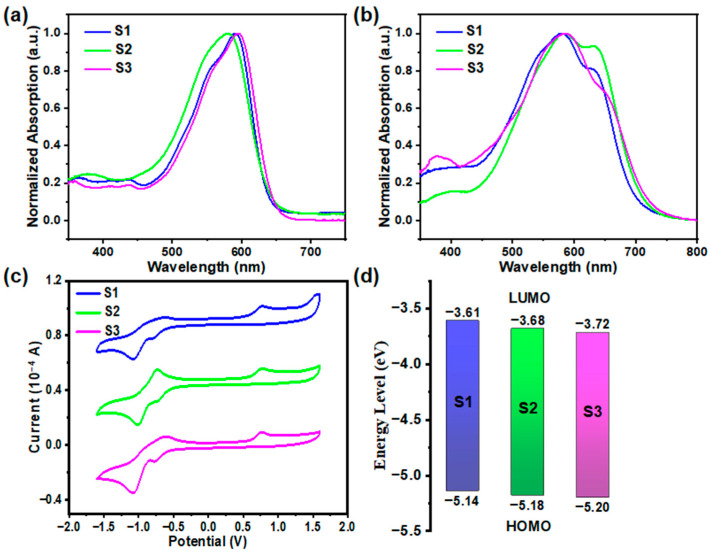 Figure 1
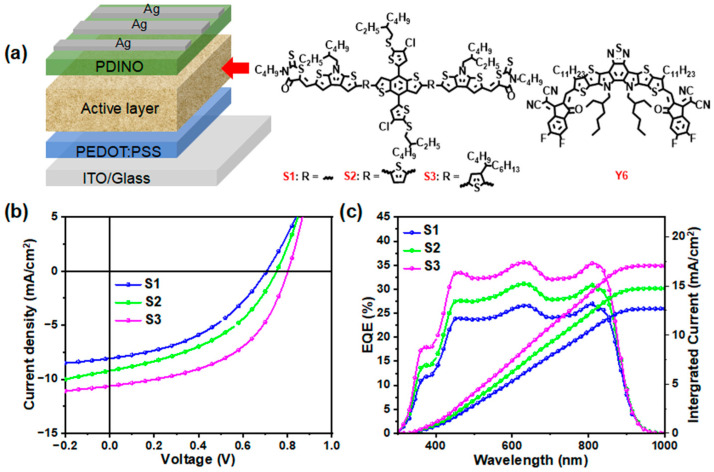 Figure 2
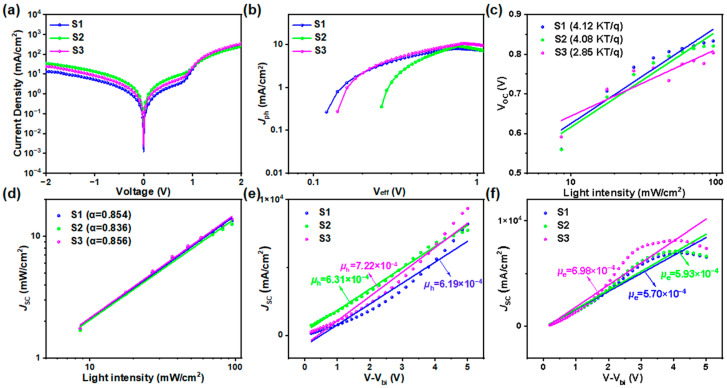 Figure 3
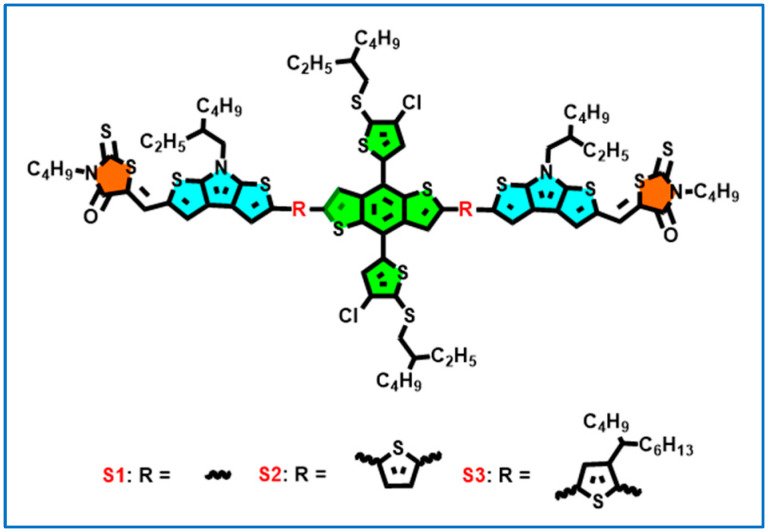 Figure 4
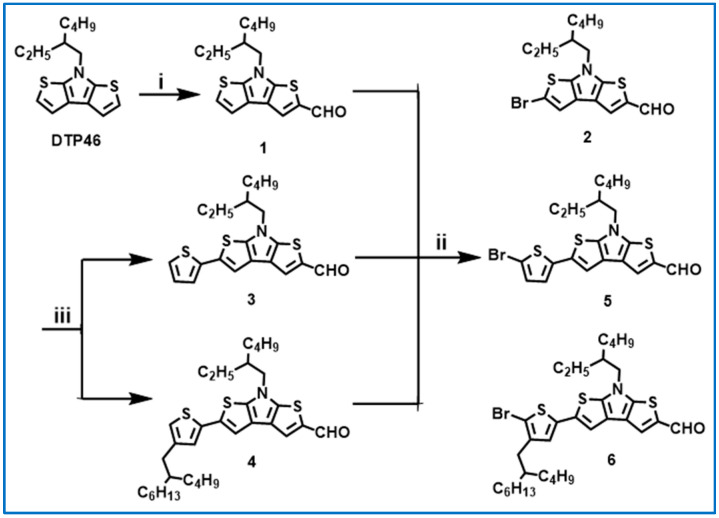 Figure 5
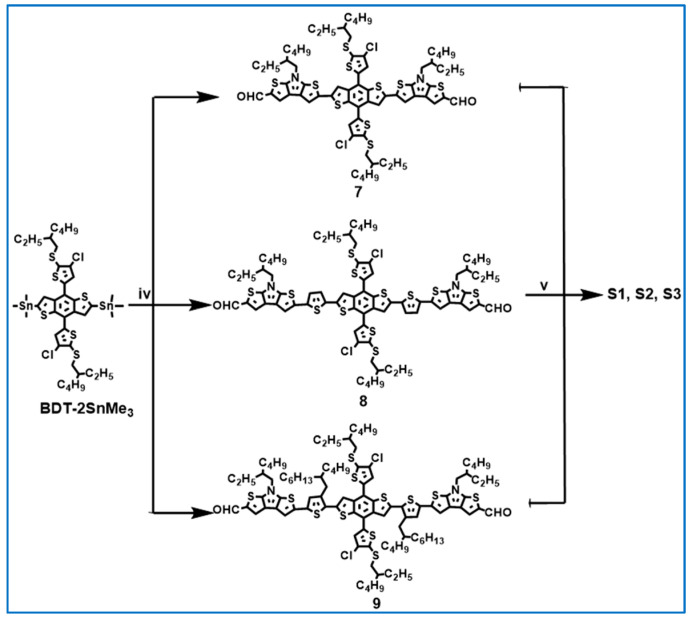 Figure 6
Peer Reviews
No public reviews on file for this paper yet. If you reviewed it on a platform where reviews are public (OpenReview, ICLR, NeurIPS, ICML), you can paste yours below so the community can read it here.
Videos
No videos yet. Explain this paper in a talk, walkthrough, or lecture? Add one.
Taxonomy
TopicsOrganic Electronics and Photovoltaics · Perovskite Materials and Applications · Conducting polymers and applications