Thermodynamic Study of 1,4-Bis(3-methylimidazolium-1-yl)butane Bis(trifluoromethylsulfonyl)imide ([C4(MIm)2][NTf2]2) from 6 to 350 K
Alexey V. Markin, Andrea Ciccioli, Andrea Lapi, Semen S. Sologubov, Natalia N. Smirnova, Stefano Vecchio Ciprioti

TL;DR
This study measures the heat capacity and thermodynamic properties of a dicationic ionic compound over a wide temperature range.
Contribution
The paper provides new thermodynamic data for a dicationic ionic compound and compares it with monocationic compounds.
Findings
The compound forms crystal, liquid, and supercooled liquid phases between 6 and 350 K.
The fusion temperature, enthalpy, and entropy were measured as 337.88 K, 52.79 kJ mol−1, and 156.2 J K−1 mol−1, respectively.
Thermodynamic functions like heat capacity and entropy were calculated and compared with monocationic compounds.
Abstract
The molar heat capacity of 1,4-bis(3-methylimidazolium-1-yl)butane bis(trifluoromethylsulfonyl)imide dicationic ionic compound ([C4(MIm)2][NTf2]2) has been studied over the temperature range from 6 to 350 K by adiabatic calorimetry. In the above temperature interval, this compound has been found to form crystal, liquid, and supercooled liquid. For [C4(MIm)2][NTf2]2, the temperature of fusion T°fus = (337.88 ± 0.01) K has been determined by the fractional melting experiments, the enthalpy of fusion ΔfusH° = (52.79 ± 0.28) kJ mol−1 has been measured using the calorimetric method of continuous energy input, and the entropy of fusion ΔfusS° = (156.2 ± 1.7) J K−1 mol−1 has also been evaluated. The standard thermodynamic functions of the studied dicationic ionic compound, namely, the heat capacity Cp°(T), the enthalpy [H°(T) − H°(0)], the entropy S°(T) and the Gibbs free energy [G°(T) −…
Genes, proteins, chemicals, diseases, species, mutations and cell lines named across the full text — each resolved to its canonical identifier and authoritative record.
Click any figure to enlarge with its caption.
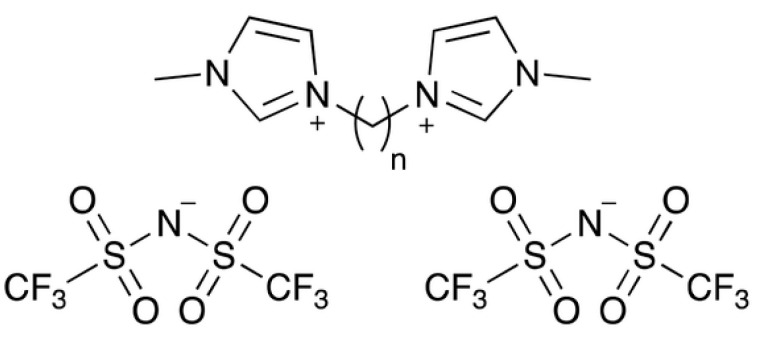 Figure 1
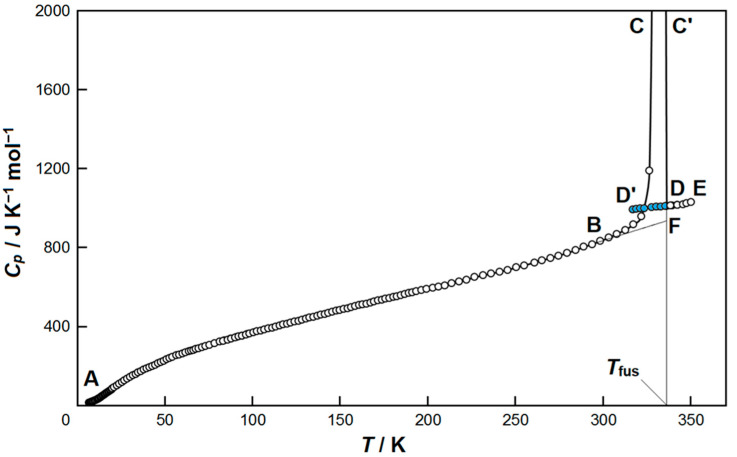 Figure 2
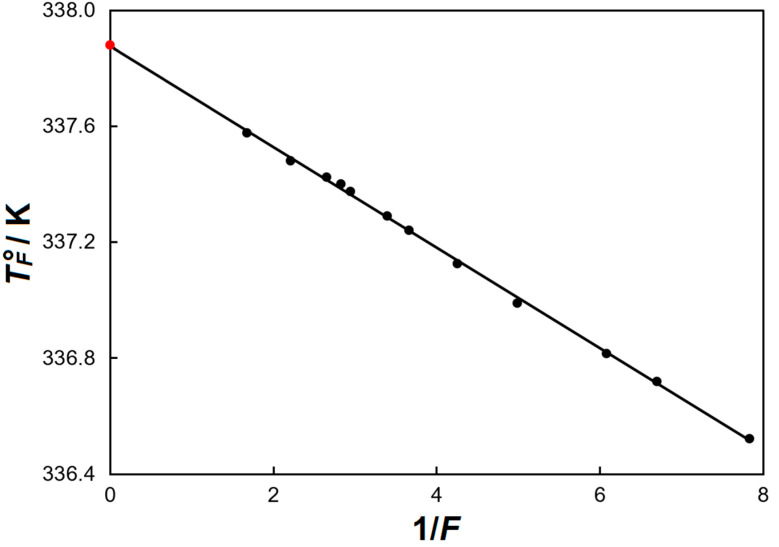 Figure 3
Peer Reviews
No public reviews on file for this paper yet. If you reviewed it on a platform where reviews are public (OpenReview, ICLR, NeurIPS, ICML), you can paste yours below so the community can read it here.
Videos
No videos yet. Explain this paper in a talk, walkthrough, or lecture? Add one.
Taxonomy
TopicsIonic liquids properties and applications · Carbon dioxide utilization in catalysis · Chemical Thermodynamics and Molecular Structure