Patient-Oriented Questionnaires and Machine Learning for Rare Disease Diagnosis: A Systematic Review
Lea Eileen Brauner, Yao Yao, Lorenz Grigull, Frank Klawonn

TL;DR
This paper reviews how patient questionnaires combined with machine learning can help diagnose rare diseases, but more research is needed to apply these methods in real-world medical settings.
Contribution
A systematic review of how machine learning can use patient-reported data to improve rare disease diagnosis.
Findings
26 studies were identified showing ML can achieve promising results using patient-oriented questionnaire data.
Most studies focused on rare diseases, but practical application in medical practice remains unexplored.
The review highlights both the potential and limitations of using ML with patient-reported data.
Abstract
Background: A major challenge faced by patients with rare diseases (RDs) often stems from delays in diagnosis, typically due to nonspecific clinical symptoms or doctors’ limited experience in connecting symptoms to the underlying RD. Using patient-oriented questionnaires (POQs) as a data source for machine learning (ML) techniques can serve as a potential solution. These questionnaires enable patients to portray their day-to-day experiences living with their condition, irrespective of clinical symptoms. This systematic review—registered at PROSPERO with the Registration-ID: CRD42023490838—aims to present the current state of research in this domain by conducting a systematic literature search and identifying the potentials and limitations of this methodology. Methods: The review adheres to Preferred Reporting Items for Systematic Reviews and Meta-Analyses (PRISMA) guidelines and was…
Genes, proteins, chemicals, diseases, species, mutations and cell lines named across the full text — each resolved to its canonical identifier and authoritative record.
Click any figure to enlarge with its caption.
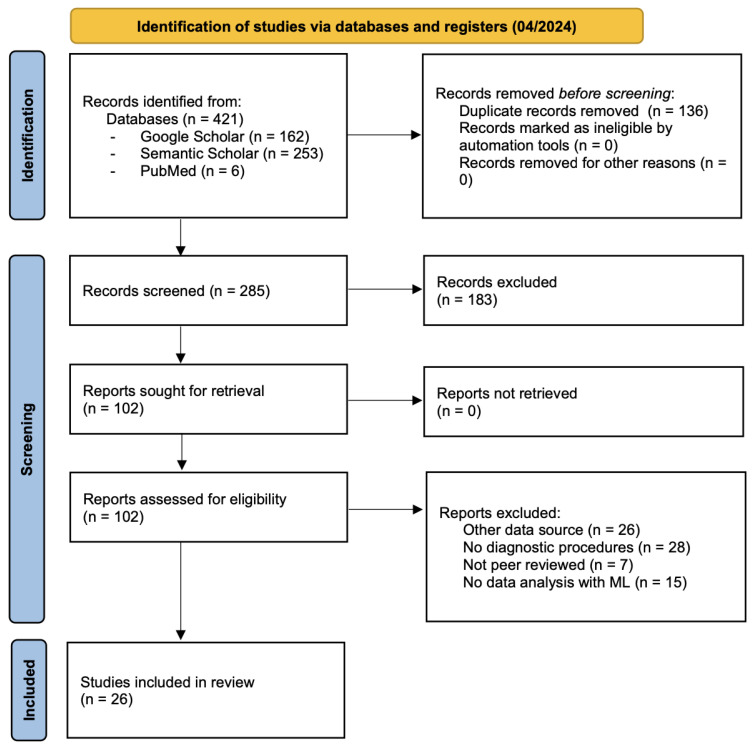 Figure 1
 Figure 2
Peer Reviews
No public reviews on file for this paper yet. If you reviewed it on a platform where reviews are public (OpenReview, ICLR, NeurIPS, ICML), you can paste yours below so the community can read it here.
Videos
No videos yet. Explain this paper in a talk, walkthrough, or lecture? Add one.
Taxonomy
TopicsGenomics and Rare Diseases · Biomedical Text Mining and Ontologies · Machine Learning in Healthcare