Pharmacokinetics of Efmoroctocog alfa by Two-Compartment Model Highlights Hemophilia A Patients with Biphasic Decay, Long Mean Residence Time, and Beta Half-Life
Massimo Morfini, Flora Peyvandi, Maria Elisa Mancuso, Emanuela Marchesini, Annarita Tagliaferri, Roberta Gualtierotti, Giancarlo Castaman, Berardino Pollio, Cristina Santoro, Luisa Banov, Mariasanta Napolitano, Paola Stefania Preti, Rita Carlotta Santoro, Antonio Coppola

TL;DR
This study shows that a new long-acting FVIII treatment for hemophilia A has better pharmacokinetics than standard treatments, with a two-compartment model revealing biphasic decay and longer half-life in most patients.
Contribution
The study is the first to apply a two-compartment model to a large cohort of hemophilia A patients using Efmoroctocog alfa, revealing biphasic decay patterns and improved pharmacokinetics.
Findings
A two-compartment model showed biphasic decay in 61% of patients receiving Efmoroctocog alfa.
Efmoroctocog alfa had a longer Beta half-life (20.42 h) and mean residence time (25.64 h) compared to standard half-life FVIII products.
Pharmacokinetic parameters measured by one-stage and chromogenic assays showed significant differences in Cmax and Beta half-life.
Abstract
Background/Objectives: A compartmental pharmacokinetics (PK) analysis of new extended half-life FVIII concentrates has never been performed in a large cohort of hemophilia patients. An improved PK analysis of individual outcomes may help to tailor hemophilia replacement treatment. Methods: PK outcomes after the infusion of a standard single dose of Efmoroctocog alfa were collected from 173 patients with severe/moderately severe hemophilia A in 11 Italian hemophilia centers. Factor VIII clotting activity (FVIII:C) was measured by one-stage clotting assay (OSA) in all patients, and chromogenic substrate assay (CSA) in a subgroup (n = 52). Fifty patients underwent a comparative PK assessment with standard half-life (SHL) recombinant FVIII (rFVIII) products. Non-compartmental analysis (NCA), one compartment model (OCM), and TCM were used to analyze the decay curves of all patients, and…
Genes, proteins, chemicals, diseases, species, mutations and cell lines named across the full text — each resolved to its canonical identifier and authoritative record.
Click any figure to enlarge with its caption.
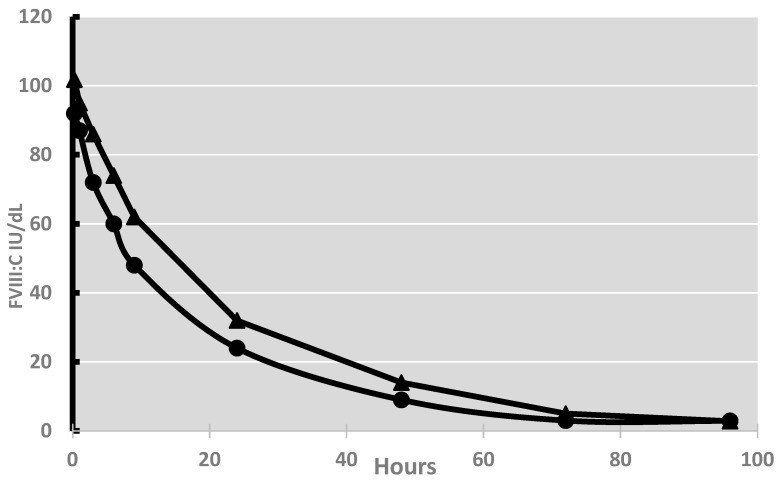 Figure 1
Peer Reviews
No public reviews on file for this paper yet. If you reviewed it on a platform where reviews are public (OpenReview, ICLR, NeurIPS, ICML), you can paste yours below so the community can read it here.
Videos
No videos yet. Explain this paper in a talk, walkthrough, or lecture? Add one.
Taxonomy
TopicsHemophilia Treatment and Research · Coagulation, Bradykinin, Polyphosphates, and Angioedema · Blood Coagulation and Thrombosis Mechanisms